Sunday, 8 September 2013

Zaireeka – Mark Richardson (2010)


As much as I love music I rarely read books on the subject, but when a good friend of mine lent me this book I knew that I’d have to read it. Both The Flaming Lips and the Zaireeka album are fascinating and compelling subjects. The Flaming Lips are perhaps the most rewarding underground band to have emerged in America in the last thirty years. Their career arc has been one of unbridled adventurousness, always following their muse without concern for commercial gain, whilst at the same time maintaining a high level of quality control.

Zaireeka was released in 1997 as a four CD set designed to be listened to simultaneously on four separate CD players. As an album Zaireeka also stands as one of the best The Flaming Lips have produced in their long and eccentric career. Richardson notes in the introduction that when he mentioned to friends that he was going to write about Zaireeka they would joke about him having to write four separate books meant to be read simultaneously. A good joke yes, but this inspired Richardson to structure the book in four separate parts that contain eight ‘tracks’ each, a format that serves the subject well.

If you are a fan of The Flaming Lips then Zaireeka is an essential read. Richardson examines Zaireeka as an idea, where it came from and how it then became a fully realized album. He also includes a condensed history of The Flaming Lips that answers the question of how an amateurish bunch of small town freaks inspired by both punk and the likes of Pink Floyd came to transform themselves into an innovative and accomplished band. Both the story of the band and the Zaireeka album are truly inspirational and Richardson does a fine job of articulating just how it all happened.

If you happen to not be a fan of the band then why would you want to read about a bunch of freaks that made an album that is inherently difficult to actually sit down and listen to?  Well believe it or not there is quite a bit of cultural significance attached to Zaireeka. The requirement of actually having to organize four stereos (that’s at least eight speakers!) means that there needs to be at least two or more people present, something that results in gatherings known as Zaireeka listening parties. The act of listening in groups, Richardson muses, is not all that common and when it does happen is fraught with psychological issues; a theory that is perhaps questionable, but also fascinating to consider.

In an age in which both convenience and speed are paramount Richardson argues that Zaireeka represents the music world’s equivalent to the concept of slow food and therefore by extension the slow living movement. I’ve taken part in two Zaireeka listening parties, one amazingly using the vinyl version, in which organisation, patience and sociability were all integral to the overall experience. Zaireeka, fortunately, is well worth the effort.

Zaireeka is number sixty-eight in the thirty-three and a third series of pocket books that focus on one important album. There are some significant albums on the list, including Bowie’s Low, The Beach Boys’ Pet Sounds and Love’s Forever Changes, but no other album engages with the listener in Zaireeka’s unique way. Other albums are more culturally significant, but Zaireeka alone stands in opposition to the effects of the rapid cultural changes driven by technology in recent decades. I recommend to anyone who is interested in listening to the album that they read this book first, after all, you’ll only need one copy and it will make your Zaireeka experience a richer one.

Saturday, 24 August 2013

Profundis – Richard Cowper (1979)


Richard Cowper is a pseudonym for John Middleton Murry Jr, son of John Middleton Murry, a significant English writer and critic during the pre WWII era. Murry Jr first wrote fiction under the pseudonym Colin Murry before then venturing into science fiction during the 1960’s. Profundis is my first encounter with Cowper. I was lured by both the desire to read some 1970’s science fiction and also the book’s fantastic old school cover art.

Profundis is a post nuclear apocalypse novel, the kind of science fiction work that was rife the 1970’s when the cold war was growing ever colder and the production of nuclear weapons was escalating out of control. Set in the then near but just far enough away future of the early twenty first century, the gigantic submarine HMS Profundis trawls the depths of the oceans, staying out of the way of the harmful radiation generated by WWIII.

The eponymous submarine turns out to be a microcosm of what it left behind, with all of the social, economic and political problems that had blighted humanity before the unthinkable happened. This premise allows Cowper to satirically critique humanity’s flaws. The plot is driven by the misadventures of the innocent yet talented protagonist Tom Jones (no not that Tom Jones). Tom attracts the attention of the fantastically named Admiral Horatio Prood, who is up for some messianic manipulations. Initially the most interesting fact about Tom is that he can talk to dolphins and fortunately for him it turns out that the dolphins quite like him. Despite Tom’s talents he’s totally naïve, even about himself; a characteristic that allows Cowper to show how the innocent can be corrupted by the system.

Despite such serious themes Profundis is not science fiction at its best, but it doesn’t stoop to pulp level either. Cowper’s stylistic abilities make the novel an enjoyable one to read in a Sunday afternoon movie kind of way. Cowper writes with a nice dose of sly humour and his style is subtle and lyrical in places. Apparently Cowper was well known for displaying a more human centric approach to his science fiction writing, rather than relying on technology and outrageous plot devices; something reviewers of the time often criticized him for. Profundis does indeed display such characteristics, but also present are the familiar science fiction tropes of androids, a conscious super computer and humans with enhanced psychic abilities. Perhaps Cowper had been listening to his critics?


The main trouble with Profundis is that it initially seems to one of those science fiction novels that is building to a mind-blowing twist, but then unfortunately it doesn’t quite happen. It also doesn’t help that the last third is a bit muddled both in terms of plot and pacing.  Profundis ends with a mildly satisfying conclusion when what was really needed was something dramatic to underline the novel’s thematic concerns.

To be fair Cowper was probably a much better science fiction writer than Profundis would suggest. Apparently The Twilight of Briareus (1974) and The Road to Corlay (1978) are the ones to read. Cowper was a good friend of the great Christopher Priest, who wrote a nice obituary when Cowper died in 2002. If Cowper comes highly recommended by Priest then I’ll give him another chance. No doubt he’ll crop up again in one of my favourite second hand bookstores in the near yet just far enough away future.

Friday, 16 August 2013

WA's Mostly Books


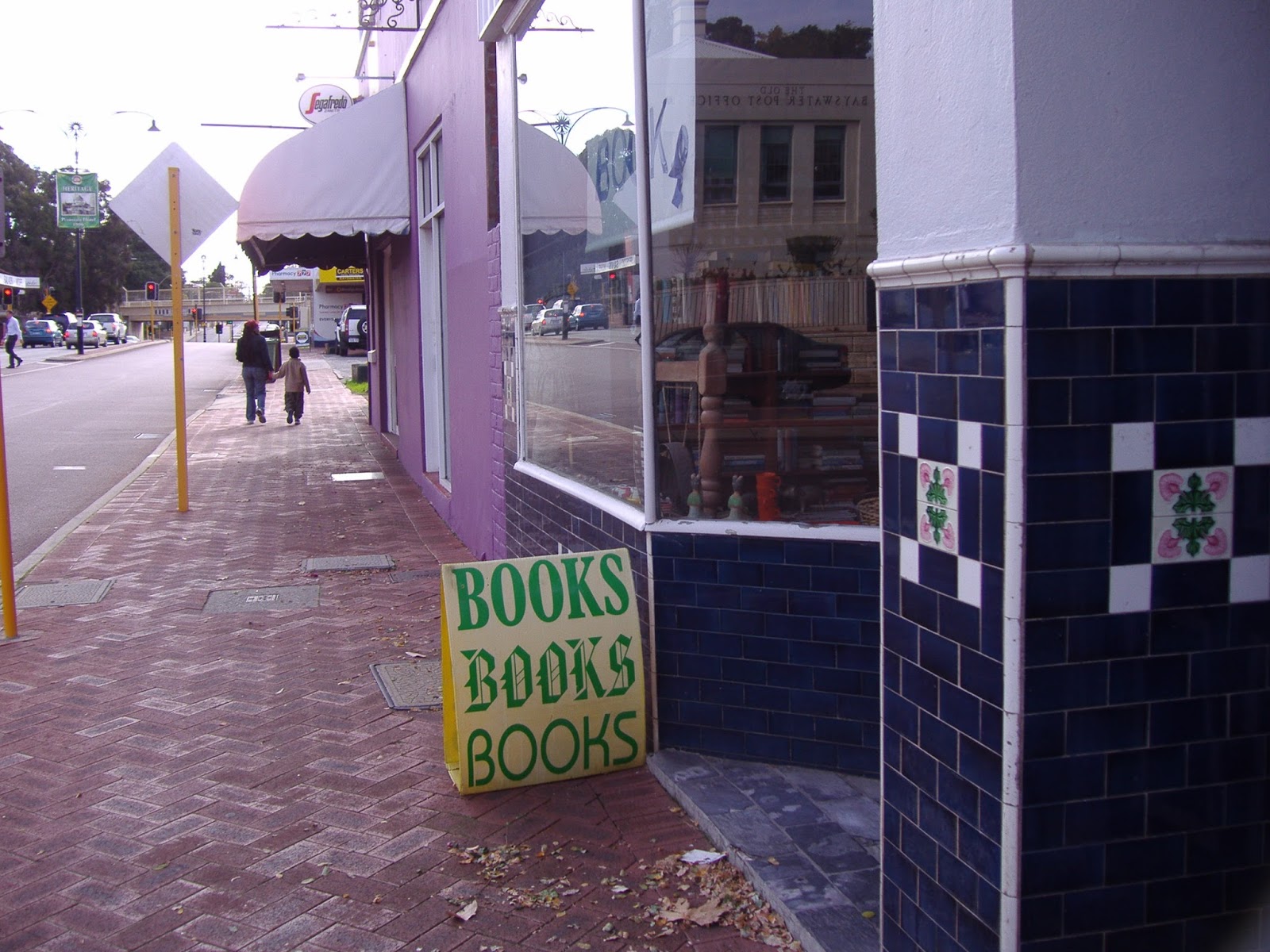
Before I went on my journey north of Perth I finally checked out the latest incarnation of Mostly Books, a second-hand bookstore that has been around since the late 1980's. Mostly Books is one of those great book stores that is much more than a depository of used books. The art on the wall and the various objects laying around around are also for sale. They also add to the esoteric ambience whilst you browse the array of interesting books. 


Back when Mostly Books was in Highgate - North Perth, I would visit occasionally and chat with Don, the proprietor, and he would always have something interesting to say. Once he told me that during the London blitz he would venture up onto the rooftops to view the bombing because the terrible beauty of the destruction was too alluring to worry about safety. When Mostly Books was in Highgate Don had a bookshelf in the corner with a sign saying 'Head Section' - and yes, there were some interesting books to be found there!


These days the shop is in Bayswater - 13A King William St to be exact. As you can see from the photos there is a plethora of great books to look through. I found some seminal 1970's science fiction by the likes of Michael Moorcock and Frederic Brown. The shop also features a great literature section, if you are so inclined. Also Don is quite a character, so make sure you have your wits about you before you venture forth. 


Lastly the reason why the shop is now called WA's Mostly Books is because Don had let the license on the business name slip and someone else from another state claimed the name. Hence it became WA's Mostly Books, in other words WAS Mostly Books, geddit?


Thursday, 25 July 2013

Guest Post


Hello fellow book lovers. Today I'm featured on Annabel Smith's blog talking about one of my favourite books - Roberto Bolano's The Savage Detectives. Annabel Smith is a published author of two books - A New Map of the Universe and Whiskey Charlie Foxtrot. Check out her blog and read her books!

Wednesday, 10 July 2013

Matter – Iain M. Banks (2008)


And so Mr. Banks has passed on, leaving us behind to ponder the greatness of his work. And it is great. And he was also satisfyingly prolific, apparently capable of writing a novel in three months. And he was a witty and cultured guy (pardon the pun). That’s a lot of ands. When I bought Matter from a second-hand bookstore in Bunbury nearly two years ago I never imagined that by the time I got around to picking it up again Banks would be diagnosed with incurable liver cancer and would die as I was reading it. And it made me sad.

Matter is the seventh Culture novel of nine and at the time it came after seven years of no new Culture novels. Will there be more? Does Banks have any almost complete Culture novels tucked away for posthumous release? Whatever may happen Banks’ stature as one of the great science fiction writers of the last few decades is assured. Matter is not the greatest Culture novel, but it is certainly excellent.

The premise and plot of Matter is typically complex and is not summarized easily. The novel contains one of Banks’ great inventions – a Shellworld called Sursaman. Shellwords were built by a long departed alien race called the Veil and it is one of four thousand that were initially created, with half of them destroyed by another alien race called the Iln, who are also extinct. Different alien races live on the habitable levels inside the Shellworld and each level is gigantic, with its own geography, atmosphere and astonishing wonders.

Such a premise allows Banks to indulge himself and he certainly does, but with sometimes mixed results. Matter allows Banks to bring a complete medieval humanoid civilization to life called the Sarl. There are epic battles, courtly duplicity and manipulations of the Sarl by their mentoring alien species the Oct. Prince Ferbin, Heir to the throne, flees his home level and much of the narrative follows his fortunes as he tries to avenge his father’s wrongful death. Enter Djan Seriy, his sister who long ago became part of the Culture’s covert organisation Special Circumstances. Special Circumstances appears in most of the Culture novels and as usual there is great entertainment to be had with the amazing technology possessed by the Culture, not to mention the moral ambiguities that come with such power.

With most of the usual Culture tropes in place a wild imaginative ride is guaranteed, however Matter is unevenly paced. There is a long preamble that sets up the main players and plot arcs, but does so with slightly less panache than you’d expect from Banks. It takes a while but once things get going Matter does resolve into an absorbing read. One of the many highlights comes when Djan visits an Oct space habitat, which allows Banks to let his brilliant imagination to run wild. Djan is accompanied by her sentient combat drone that is operating covertly and is therefore cunningly disguised as a dildo, revealing that Banks’ usual sly humour is fully present.

The endgame of Matter is slightly rushed and if you were taking notice of the clues earlier in the novel it is also perhaps a bit predictable. This is a minor criticism because Banks is such a quality writer that he makes up for any shortcomings with his erudite style, incredible imagination and his ability to create believable characters, even when they are machines or are totally alien. Apparently after his untimely death sniffy critics mostly talked about the literature he wrote as Iain Banks, rather than the brilliant science fiction he wrote with the added M. between his first and second name. That’s a shame because Banks is one of the greatest science fiction writers of any era and his unique sensibility has become highly influential. Only last week I was watching a rerun of the second episode of the first series of the Dr. Who reboot and during the scenes where the last human appears on the viewing platform to witness the final hours of planet Earth I realized that what I was watching was pure Iain M. Banks. And that made me smile.

Monday, 1 July 2013

Canada – Richard Ford (2012)


Richard Ford is best known for his novel The Sportswriter, his 1985 story of a failed novelist turned sportswriter who is faced with the deep crisis of a dead son. Its sequel – Independence Day (1995) won the Pulitzer Prize. Ford is also a noted short story writer and has been seen as being part of the Dirty Realism school of writing along with such writers as Raymond Carver, Cormac McCarthy, Carson McCullers and of course the great Charles Bukowski.

Not having even read a single word of Ford’s writing previously, I came to Canada as a total Ford novice, absolutely free from any knowledge or opinion. My first impression was that Ford is a writer of nuance and craft, taking his time to build the plot and reveal his characters. At first I appreciated this and warmed to the fifteen year old Dell Parsons, who narrates the novel retrospectively from the vantage point of retirement. Dell lives with his twin sister, Berner and their parents Bev (the broad shouldered ex-airman) and the frustrated Jewish would be intellectual Neeva. It’s a sad grey world of isolation and confusion for Dell and Berner and it slowly becomes apparent that there is a deep psychological element to Canada that is perhaps more evident in hindsight. The motivations of Dell’s parents are murky at best, even to Dell himself, who comes across as a bewildered innocent.

With a narrative pace bordering on catatonic Dell recounts his dysfunctional family life and the events that lead up to his parents robbing a bank. During this long first part Ford’s measured and meticulous style becomes repetitive and Dell’s repeated ruminations about the psychology of his parents decision making leading up to the robbery becomes tedious. When the robbery occurs it’s an anticlimax and the inevitable consequences take forever to arrive; squandering any tension generated by events leading up to Dell’s parents arrest. I’m giving nothing away here due to the fact that nearly every major event in Canada is revealed well in advance (from the first line!), which turns out to be a fatal flaw.


The second part finds Dell deposited in a small town in Canada by a friend of Neeva to avoid the long reach of the authorities. Initially the shift to Canada brings the novel alive, particularly when Dell meets the louche Charley Quarters. Charley provides a much-needed presence, with his seedy manner, penchant for lipstick, rouge and poetry. Dell finds himself marginalized, living in an overflow shack away from the main hotel in a one-horse town that survives due to geese hunters visiting from America. Suddenly the reader’s interest is revived and the pathos of Dell’s situation hits home. But once again any tension generated is wasted when the dodgy character of hotelier Arthur Remlinger comes to the fore, with his oblique character traits that fascinate Dell so much and his semi-interesting back-story as a political radical. There is a climax of sorts, when Remlinger has to deal with his past catching up with him, but its execution is fumbled and it merely becomes just another event witnessed at a remove.

A strange ambivalence permeates this novel; it’s difficult to connect with the characters lives due to Ford’s ponderous style and Dell’s monochrome recollections. There are long sections that you could only describe as being dull, which is frustrating because there is a sense of something deeper lurking there, something that speaks of the dark vagaries of human existence. Dell is fascinated with chess and bee keeping, two seemingly disparate pastimes which actually represent his subconscious need for order in his life which is at the mercy of the capriciousness of wayward adults. If the prose had been more vital and there had been more interest generated by the tension of not knowing what was going to come next then such deeper aspects of Canada would have far more import. Ford can certainly write, as his reputation suggests, however the novel is a disappointment, which is a shame really. 

Sunday, 16 June 2013

The Lighthouse – Alison Moore (2012)


It has been such a long time since I actually read this book that I considered not reviewing it at all, but for various reasons The Lighthouse has stayed with me, so I decided to write about it in brief anyway. The Lighthouse is Alison Moore’s debut novel and is notable for the fact that it made the shortlist for the 2012 Man Booker Prize, therefore gaining this slight novel some serious attention.

The Lighthouse is the story of a middle-aged man called Futh, who embarks on a walking holiday in Germany after the dissolution of his marriage. Unfortunately for Futh he embodies the term ‘absolute loser’ and is an almost completely unlikable character. During his circular ramble though the German countryside his bathetic past is thoroughly picked through and it makes for very bleak reading indeed. Futh’s life was initially blighted by being abandoned by his mother, only to be left with his insipid father, who then went on to have one soulless affair after another. Pretty much all of the supporting characters are both dysfunctional and unlikable. I wouldn’t recommend The Lighthouse as a holiday read, unless you particularly enjoy the psychology of human dysfunction.

The fact that The Lighthouse in an entirely depressing narrative does not particularly worry me, it is the fact that it made the Man Booker Prize shortlist for 2012 and has been lauded for its “serious” qualities. The novel does deal with the important theme of how past traumas can shape the future. It is also a precisely pieced together narrative – something akin to a literary jigsaw puzzle with everything ultimately linked to each other. Unfortunately The Lighthouse also suffers from having its internal mechanisms being entirely visible. There are a multitude of all too obvious literary devices used throughout the narrative, all of which could have been either omitted or used with more subtlety.  Within its pages we have lighthouses, moths and that old chestnut the Venus Fly-Trap as all too apparent metaphors. Futh’s circular route through the German countryside, taking him back to the guesthouse he started out from (called Hellhaus – meaning lighthouse in German, sigh…) is a clichéd analogy for the dysfunctional eternal return of his life. The most unoriginal metaphor occurs when Futh meets his childhood ‘friend’ at the supermarket and ends up buying a bun that he had handled, complete with a fingerprint - a heavy-handed metaphor for the fact that Futh’s friend was sleeping with his wife.

The Lighthouse is perfect fodder for book clubs, so much so there is even a page on Alison Moore’s website containing questions for book-clubbers. My book club groups (26 members) almost universally pondered over the fact that the book is so highly regarded when they struggled to be engaged with the characters and found the narrative to be obvious and unrelentingly bleak without much reward. After all, this book was short-listed for the Man booker Prize along with the winner – Hilary Mantel’s Bring Up the Bodies and such writers as the super erudite literary freak Will Self.


This brings us to the question of the worth of literature prizes such as the Man Booker. Mantel’s two winning novels are certainly worthy, but what about the truly excruciating The Finkler Question that won a few years ago – the worst book I’ve ever read? That book still haunts me and I feel like my psyche has been damaged in an insidious way. I’ve heard whispers that judges shirk reading the books, passing the task onto underlings for assessment. I’ve also been told that a former judge revealed in an interview that often the judges are so deadlocked on deciding he final winner that the only compromise is to give the award to a lesser book.

Perhaps the most interesting issue to think about is whether literature awards are actually good for authors and the industry as a whole. With everyone so fixated on awards perhaps many worthy authors and books are overlooked, with undeserving novels getting unwarranted attention whilst the more deserving fall by the wayside. There’s a rich tapestry of literature out there, far more than what appear on award long-lists. So are awards worth our attention? Or are do they create an illusion of quality and are more about the powerful sway of the market? I’m undecided – the jury’s out so to speak, but these days I’m feeling less inclined to read award-winning novels and I’m pretty sure my book club members are too.