Sunday, 23 September 2012

Tinkertown: an interview with Nathaniel Moncrieff and Sam Farringdon


Last week I caught up with Perth playwright Nathaniel Moncrieff and producer and co-director Sam Farringdon, who talked at length about Nathaniel’s new play – Tinkertown. Tinkertown follows on from Sleepyhead, which was both a critical and commercial success when it was performed at the Blue Room earlier this year.

Tinkertown is a tragic comedy with plenty of dark humour and combines car chases with dysfunctional father/daughter bonding, music and yaks, apparently. Oh, and nudity – so be warned!

You can check out Tinkertown at The Blue Room between September 25 and October 13. Visit the website for tickets and relevant information.


What’s the inspiration behind Tinkertown?

Nathaniel:

       Tinkertown was written about two years ago; it came after I had written Sleepyhead. Sleepyhead started getting attention; it had picked up an award and was short listed for the Griffin Award and after that the attention had gone to my head and I had spent six months or more working on an epic Victorian horror piece that was a weird combination of Kafka and Henry James…


Sam:
         And self indulgence.

N & S: laughs

N:     …and Oscar Wilde, and when that wasn’t getting positive reactions from the people I sent it to, I decided I needed to write something more contained. I worked on an idea I had been tossing around for a while, which was pitched somewhere between Bruce Springsteen’s Nebraska and a 70’s road movie, and that was what was to become Tinkertown. I wrote the first draft in about a week and it came after a bad time in my life, so the original draft was a strange amalgam of heavy emotions and also…

S:     Trademarked Moncrieffian bleakness.

N & S: laughs

N:     …humour, I was going to say! So that’s how Tinkertown initially came about. I sent that around and it got a lot of interest from a few people. Sam really liked it and that spurred me on in terms of subsequent drafts. Eventually I was to hone it to what it is now.


During our last interview you mentioned that Tinkertown was meant as a companion to Sleepyhead. Is that still the case, and if so can you elaborate on that?

N:      I think that Tinkertown and Sleepyhead are stylistically similar and in   some other respects…

S:      Thematically as well, because they are about family relationships.           

N:      Yeah, thematically both are concerned in some ways with father/daughter dynamics and I think even from the outset I wanted to write another piece that would complement the style of Sleepyhead. I think while some of the themes and the dialogue and certain aspects of the world of the play cross over with Sleepyhead, Tinkertown differs in terms of being much lighter in tone. Whereas Sleepyhead was a very claustrophobic piece, Tinkertown is much more expansive in its setting, and the journey that takes place is a much more physical one, compared to the metaphorical one in Sleepyhead. 

S:      Tinkertown is a lot more accessible I think.

N:      Yeah, a lot of people will find Tinkertown more enjoyable and accessible than Sleepyhead.


Would you say it’s a progression from Sleepyhead? 

N:      I learned a lot from Sleepyhead about how audiences react to work and interpret a work. How you convey narrative elements to an audience, what needs to be explained, what doesn’t need to be explained, but also how to write humour as well. I always thought Sleepyhead was a very funny play, but as the play was so dark audiences tended to miss the humour. So that was very important to me when I wrote Tinkertown – how to incorporate the dark elements whilst not interfering with the humour.

Tinkertown has been performed in Melbourne, how did that go?

N:      I very much liked what MKA did with the play. MKA are, to my mind, one of the most exciting companies producing works in Australia at the moment. I feel privileged that they have now done two of my plays. What was unfortunate was that I don’t think Tinkertown was quite at the stage that it is now when it was produced, so while MKA did the best they could with the play, at that stage I had not yet heard the play read aloud or seen it performed live, so after I went over to Melbourne to see it performed. I immediately went back and re-worked a lot of it, so the Perth production will be a lot more finely honed.

So, that was my next question, is the Perth production very different to the Melbourne production? 

S:      Just about every week! laughs

N:      Yeah. It’s been great working on the play as co-director because it’s given me free reign to re-work and re-write the elements that I didn’t think were working or could be improved. I am quite a perfectionist when it comes to my writing, so I have been a bit of an annoyance at times to Sam and some of the actors, in terms of cutting lines and adding lines. I think that ultimately that will be a huge benefit to the script; it’s a much sharper, tighter work than it would have been had I not directed it.

Nathaniel and Sam


Tinkertown is being co-directed with Sam Farringdon. Sam - how did that come about and what did you contribute as co-director?

S:      I just imposed myself on Nathaniel’s work (laughs) and he just lets me do that. Obviously I read the very first draft of the script and immediately I fell in love with it. I had read a lot of Nathaniel’s previous scripts, they were mostly film scripts at that point, and when I read Tinkertown I immediately recognised that it was the most accessible thing he’d ever written. It’s funny, because I actually went back and read the first draft a couple of weeks ago, and compared to where it is now, the thing is actually a mess – but that’s only in the context of what I know the script to be now, in the process of the last year and a half of it being re-tooled. So I think that it really was quite something when I first read it, and that’s something that has carried on until now. In terms of my role in our relationship, I joked before that Nat brings the creativity and I bring the organisation and the practicality, and that’s really quite true to a certain extent. Nathaniel and I work very well together because we share a lot of the same artistic passions and ideas, and we bounce of each other quite well. We can throw ideas back and forth and reign in each other’s more outlandish ideas, or recast them as something that works a lot better for both of us. 

You produced Sleepyhead, is directing more of a challenge?

S:      Well I am producing Tinkertown as well. Producing and directing is a huge challenge in that it’s essentially twice the amount of work, but the way that we had planned it was that I was always going to produce and provide assistance in terms of direction, and Nathaniel would take on the most of the direction. That’s pretty much how it’s worked, but at the same time the direction has been collaborative and that’s something that I have really enjoyed. It has been really quite difficult at times, but it has been made considerably easier with the support we got from The Blue Room and also the support from our mentor, Mark Storen. He’s an amazing actor, writer and director in his own right…

N:      An incredible person all round…

S:      Yeah, he’s an incredible guy. The actors that we’ve had: Phil Moilin, Tessa Carmody, Hannah Day and Jeremy Levi – they interpret our vague, overlapping ideas and messy direction and deliver them to a tee, giving us what we want.

Sam - has this given you any ideas of your own, in terms of writing?

S:       It’s certainly inspired me. I have always written stuff, I just never really shared it with people, and I always tended to write more poetry and short prose rather than plays. It certainly has inspired me, and working with Nathaniel and Mark and Phil, Tessa, Hannah and Jeremy has inspired me to work on something of my own writing. I am really just happy to be involved in the whole creative process; it’s just fantastic to be among creative people and to be creating a piece of art. That’s exciting in itself and I hope to continue that. Regardless whether I continue to write, as long as I am around these creations, the creative process and these creative people I am quite content.

Nathaniel, Tinkertown has been described as a tragic comedy. Are you attracted to this genre or is it more of a means to get across what you are trying to say?

N:      I think all my work ends up being incredibly dark one way or another, it’s just the kinds of characters I’m attracted to, the kinds of stories I want to tell, so even if I aim to do a light comedy, which I aimed for with Tinkertown, it ends up being something quite twisted and quite dark. I don’t intend to write tragedies; just often the stories that linger in my mind and end up coming to fruition end up being grim in nature.

S:      Well, all the anecdotes that you tell, the stories from your own life are tragic comedies as well…

N:      Yeah, I think my sense of humour is kind of bent - I have a very dark sense of humour and that is reflected in my work. Even Sleepyhead, I thought that was a very funny play, it turned out that not that many people thought it was quite as funny as I did.

S:      The comedy in Sleepyhead was much more subtle, you have to be looking for it to find it in parts of it.

N:      This play gives the audience more permission to laugh. I think in Sleepyhead, because from the outset it’s such a grim world with characters that are so irredeemably messed up, that when the humour enters into the picture it’s harder for the audience to realize they’re allowed to laugh. I think Tinkertown from it’s very first line tells the audience what sort of play it is going to be and what sort of humour it’s going to possess. I think audiences will have a much easier time enjoying the comedy in this play.


Phil Miolin as Chester


Tell me about the character Chester?

N:      Chester is a character that is looking for redemption. He wants to fix his failed existence – he’s murdered his wife, he’s spent most of his life behind bars, and so he’s come out and he wants to make things right with his daughter. He’s such a fuck up, for want of a better term, that he just keeps making situations worse for himself. The reunion with his daughter just doesn’t go to plan, and that’s where we begin the play. From there it’s all downhill, one mistake after another.

S:      His intentions are always good, but he just doesn’t think things through enough for them to happen quite the way he intends them to.

N:      Yeah, he’s got a skewed way of thinking and he’s got a very skewed sense of honour, which…

S:      Which probably comes from his life behind bars and having to justify his way of life.

Tell me about Tammy, Chester’s daughter?

N:      Tammy is the antithesis of Chester because she’s been estranged from him since she was a baby, and was raised by her mother’s sister, who was a strict religious woman. She was raised in a very morally upright environment, so when they meet at the beginning of the play they are at complete odds in terms of beliefs and ethics. That sets the dynamic for the rest of the play, in terms of these characters who want to get along but just can’t, because they’re different in almost every respect.

S:      Tammy’s moral compass is a bit skewed as well, but it’s skewed towards righteousness, that’s where a lot of the conflict arises.

N:      Tammy has a lot of her father in her, but she’s in denial of that fact. The more she spends time with Chester the more her darker side comes out.
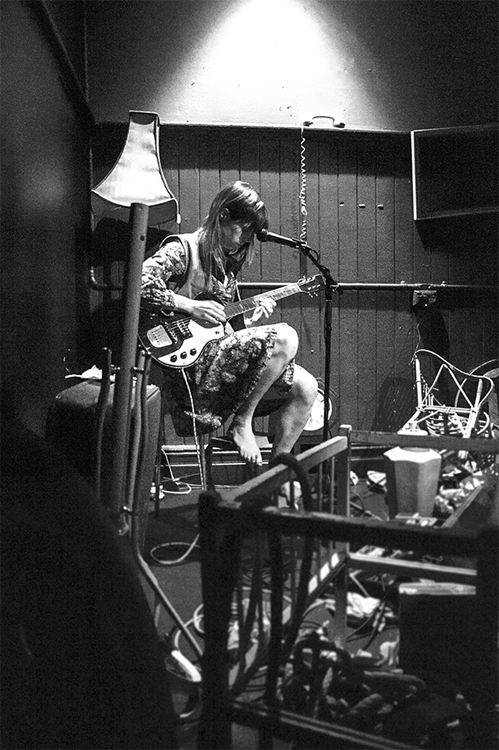
Felicity Groom


The music is performed by Felicity Groom, how did that collaboration come about? Does she perform live?

S:      Yes, she performs live. When we started talking about Tinkertown as a Blue Room show we were really adamant that it would be scored by live music, as music was a huge part of the influence for Nathaniel. I could hear the sounds for the music echo throughout the script. That was a reason that I think it resonated with me so much. Felicity was an acquaintance of mine, and when we were throwing ideas around as to how we could approach the live music her name came up because we really thought that her music had a haunting, ethereal quality to it that was fitting to the landscape and mood of the piece.

She’d worked on something for Renee Newman-Storen, Mark Storen’s wife at the Blue Room, which was received really well. So we arranged a meeting with her and she’s really lovely and very hardworking and was very passionate about the project as soon as she’d read the script. So all the stars aligned and it worked out for the best.

N:      When I wrote Tinkertown I was listening to a lot of folk music and a lot of blues and country music. Stuff like Jackson C. Frank and Townes Van Zandt – artists like that, and so the first draft of the script were very much littered with a lot of musical references and so music was very important to the world of the play. When we conceived the piece we really wanted a songwriter to come along and not only enhance the mood of the piece, but to also compliment the narrative. The example that comes to mind is Curtis Mayfield and the Superfly soundtrack, in which the film and the soundtrack are almost synonymous because the lyrics heighten the narrative and they really add a lot of depth and convey a lot of different angles and elements to the audience.

S:      It’s important to know that when Felicity’s on stage she’s a part of the world; very much omnipresent within the world, and her music expresses the mood and landscape of the piece. That was really important to colour the play. It’s not a case of her tacking on her music in between scenes, her music lives and breathes within the scenes and it gives the show as much life as the characters of Tammy and Chester do.

N:      Yeah, Felicity really has a knack of connecting with the play, her music and her lyrics really tapped into what I was going for when I wrote the piece. A lot of aspects of the characterisation that I didn’t discuss with her, she just automatically picked up upon. She’s done a fantastic job.

What else have you been working on? How’s Turn of the Screw coming along? Have you given up on it?

N:      The Turn of the Screw play I think is a tremendous piece of work, it’s sort of like Victorian Gothic Psychedelia.

S:      If that’s even a genre? It’s Moncrieffian! 

N:      It’s incredibly grotesque work and I’m not sure at this point in my career that it would be wise to unleash it – it’s experimental and certainly my most fucked up play. Not to mention that it would also be an incredibly costly piece of work. If any supremely well-funded organisations showed interest and were willing to spend hundreds of thousands of dollars on a play and potentially lose it, then I’d say I’d have one piece of work for them to see. It might fall by the wayside. But I have been working on another epic, completely uncommercial piece of work.


S:      I wouldn’t call it uncommercial, it’s just very very black.

N:      It’s almost at its first draft stage and I’m very happy with the way it’s going. It’s based on a true story so I’ve had to do a lot of research and work hard to combine the real life and fictionalized elements. It will be by far my ambitious work. It will be quite a few months before anyone will get to look at it, besides Sam I guess.

Is there anything else you’d like to say in general or about Tinkertown? Come and see it?
        
S:      It’s worth mentioning that we’ve had a huge amount of love and support from everyone involved at The Blue Room: Susannah, Thom, Kerry Roger and Sally. They’ve been hugely supportive from the beginning. As first time director doing their first show we are extremely grateful. It’s great to work under the banner of a theatre company that is recognized for excellent work. It’s a huge honour.

N:      We are very grateful. Also we wouldn’t be talking now if it weren’t for MKA and their ongoing support, both with Sleepyhead and this play. The Blue Room have been hugely supportive. We have an amazing crew as well.

S:      They’ve worked with enthusiasm and commitment. We really have the most talented people and it’s mind boggling just how great it is to work with these people and it will hopefully all show through in the final result.

Credits: Photographs of Nathaniel, Sam, Phil Miolin and Felicity Groom by Sophia Muoio

Tuesday, 11 September 2012

Victor Lavalle interview at Bookslut


Over at Bookslut there is a great interview with author Victor Lavalle. I've seen his books around but I'm yet to read his work. The interview reveals Lavalle to be an extremely interesting writer and I'm going to try and read one of his books soon. What he has to say about realism in literature is fascinating and his philosophy is one I can totally connect with:

"It has always seemed to me that realism attempts to describe what daily life looks like while the fantastic attempts to express what daily life feels like. Getting evicted from your home -- I mean genuine court-ordered, City Marshal enforced eviction -- can feel like an episode from a piece of Gothic fiction. The reportorial aspects of realism just aren't going to capture the matter. I can't fathom how only one type of writing -- whether realism, the fantastic, romance, mystery, etc. -- can ever summarize life on its own. Using all of it -- within the same book, sometimes within the same sentence -- seems like the only sensible way to try and capture the whole spectrum of human experience."

It's worth both reading this interview and checking out this great site. Enjoy.

Thursday, 6 September 2012

Absence of the Hero: Uncollected Stories and Essays, Volume 2 1946 - 1992 – Charles Bukowski (2010)


The unearthing of Bukowski’s writing continues and Absence of the Hero does not disappoint. I’ll get right to the point, rather like Bukowski himself, and advise all admirers of his work to get your hands on this collection because it is just brilliant. As for those who view Bukowski with distaste or have never heard of him – I’ll get to you later.

I’m not usually one for quoting, but on the rear cover of this book Tom Waits sums things up best: “He loads his head full of coal and diamonds shoot out of his finger tips.” Absence of the Hero features some of his earliest stories, unseen Notes of a Dirty Old Man columns that were originally published in underground papers, and most fascinating of all, critiques of other writers’ works and commentary about writing.

Two of the early highlights of this collection both play with perception. Cacoethes Scribendi is a rare third person excursion that finds an editor visiting a writer suspiciously like Bukowski himself. The Rapist’s Story gives you a tale of innocence from the rapist’s point of view. It lures the reader into being sympathetic towards the rapist, until you realize at the end that it’s all a matter of perception and that your own has been played with, with disturbing results. For seasoned Bukowski readers these two stories are surprisingly untypical and that’s the great pleasure of this collection – it presents another side of Bukowski.

A side of Bukowski that I’ve never read before are the critical essays and his ruminations about writing. As usual they are peppered with his succinct brilliance. It’s fascinating to read his critique of Alan Ginsburg’s work, in which he manages to examine both Ginsburg’s writing and the psychology of reviewing other writers. Hilariously he refers to Ginsburg as a “…bearded half-monk, kind of lighted with bedroom infractions and stinking nightmares of India and Cuba and coffeehouses, this flumping spread of hair that is Allen Ginsburg.” All aspiring writers need to read House of Horrors, in which Bukowski lays down the truth about writing. At the end he concludes that: “For after some years of writing, the soul, the person, the creature becomes useless to operate in any other capacity. He is unemployable. He is a bird in a land of cats. I’d never advise anybody to become a writer, only if writing is the only thing which keeps you from going insane. Then, perhaps, it’s worth it.” I hear you Bukowski.

More typical is Notes of a Dirty Old Man, Open City December 8 1967 in which Bukowski reveals that he was an American who fully understood irony when he twists an argument that he is a racist back onto the accuser, in a beautiful and succinct way of course. Another Notes of a Dirty Old Man, this time published in Free Press November 1975, is a hilarious misanthropic meditation about cars and people. There is also the usual stories about drunkenness – being drunk at poetry readings, on the way to poetry readings and after poetry readings, oh, and in the middle of the night, afternoon and morning, with or without other people, usually with hilarious results and with a dash of pathos thrown in. There’s sex and as usual it’s very masculine, but take note all you women reading Fifty Shades of F**king Grey (they’ll change its title to this in the future), it’s erotic in a powerful way and it will give you a thrill, not a cheap one though. Start with Vern’s Wife, page 140.

The thing about Charles Bukowski’s writing is that you can be feeling terrible and you read him and then you feel good again. Bukowski speaks directly to the hurt part of your soul; his humanity is palpable because it came directly out of his brain and onto the page unfiltered. No doubt his writing was like therapy to him and it certainly has that effect on the reader. Another thing is that his brand of existentialism is way better than, say, Sartre’s. I have no doubt that Bukowski would have thought that Sartre was a pussy, but he would have at least had a drink with Camus.

As for those of you who accuse Bukowski of misogyny, I’m afraid that you are sadly mistaken – he was a misanthrope. Read his work and after a while you realize that the men in his stories come in for some rough treatment. He loved to reveal the awful stupidity of men and he didn’t spare him-self from such treatment either. Besides, no one else has quite summed up the effect of a beautiful woman quite like this: “She walked in. Shining gold. Flare of eye in wild painting. Centuries of men killing for the like. I mean, you know, I was at last overcome.” It still didn’t get him laid though.

As for those of you who have never read Bukowski, hear this – every man and woman, but perhaps not child (teenagers are a grey area) should read Bukowski. Everyone should at least read Post Office (1971) and Women (1978). Quite frankly if you don’t read Bukowski then you will die having never experienced literature that comes from the core and reveals the essence of what it is to be human. Don’t miss out.

Sunday, 26 August 2012

One Year of Excelsior


This time last year I began writing book reviews for Excelsior. It started as a way to develop writing discipline when I made up my mind to start writing creatively again. I figured that working on book reviews would keep me writing even when I didn’t feel particularly creative. It has worked wonderfully. My writing has improved significantly over the last year and I have made a start on a novel and some short stories.

The whole process has also made me think about criticism and its worth. After all, the Internet has helped make everyone a critic now, for better or for worse. Websites like my own and those linked from my bloglist offer a guide for people wondering just what book to read next or which book to avoid. For readers there is also great value in disagreeing with what a critic has to say about a particular book because it helps to develop their own critical abilities. This is also one of the best reasons for writing reviews – it makes you a far better reader and in my case, a far better writer.


Over the last year I’ve read and reviewed twenty-five books. Some of these I’ve read for the book club I run at Subiaco Library. Most of these I would never have read if it wasn’t for the book club. Although this is sometimes a chore I’ve come to realize over the years that reading books that you wouldn’t normally consider has great intrinsic value. It exposes you to styles and authors that wouldn’t normally come your way. There is also great benefit in reading a book that you don’t particularly enjoy. The critical insight gained can end up being invaluable. There’s also something to be said for a certain level of discipline when it comes to reading. Next time you start a book and it doesn’t appeal to you, keep going because it may just make you a better reader and a better critic.

Of the twenty-five books I’ve reviewed over the last year only two gained my highest rating of sublime. These were Carson McCullers The Heart is a Lonely Hunter and John Fowles The Magus. For these two novels it is excusable to wheel out that dead cliché – “work of genius.” Both are brilliantly written and both show just how weighty issues can be approached without resorting to dumbing down or empty cliché. Although the other books featured over the last year were not in the same league, they are all worthy in one way or another. The only book I’d advise readers to think twice about reading is Allan Hollinghurst’s The Stranger’s Child; although this book gave me valuable insight regarding just what to avoid in my own writing.

So, another year of reading and writing awaits. The publishing industry may be going through great changes at the moment, but something that I’m sure will never change is the desire to immerse oneself in a great novel from which so much enjoyment and knowledge can be gained. Surely there aren’t many better ways to spend your time? After all, reading and writing helps to both define and to critique humanity, something we must never lose sight of in this age of endless distractions. 

Sunday, 19 August 2012

The Windup Girl – Paolo Bacigalupi (2009)


Paolo Bacigalupi is hot property at the moment due to The Windup Girl winning both the Hugo and Nebula awards for speculative writing and now he has a new novel out called The Drowned Cities (2012). The Windup Girl is his debut novel after many years of publishing acclaimed short stories.

I started reading without really knowing much about either the author or the book and after a while it occurred to me that perhaps this was a new sub-genre of science fiction and the word Ecopunk came to mind. Once I finished and looked Bacigalupi up I found out that I was on the right track, but it’s actually called Biopunk. Biopunk is dystopian in nature and mega-corporations control the world, but unlike Cyberpunk the dominant technology is centred on genetics rather than computers. It’s a great example of just how influential the likes of William Gibson, Bruce Sterling and the other Cyberpunk writers are in this post-Cyberpunk era (that’s how I refer to it anyway).

The Windup Girl is set around 180 years in the future in Thailand. The characters talk about “The Expansion” and “The Contraction”. It’s easy to work out that the former is globalization and the latter was the subsequent collapse of globalization. The world of The Windup Girl is blighted by rising seas, the collapse of fossil fuels and deadly bioengineered diseases and organisms. As a result many plants and animals are extinct. Bioengineered diseases like blisterust, cibiscosis and Nippon genehack weevil are constant threats to Thailand and the rest of the world. Newly created animals such as the giant elephant megodonts are used in factories in place of machinery and the chameleon like Cheshire cats roam the streets, blending perfectly with their surroundings whilst they scavenge for carrion

The Windup Girl presents a beautifully realized world filled with weird and terrifying possibilities that are, for the most part, not too fantastic to exist. I’m impressed by Bacigalupi’s imagination, as there are some great ideas on display in this novel. The narrative is also jammed full of atmosphere, sweat, grit and the stench of the dirty back alleys of a future Bangkok; a Bangkok in which Anderson Lake, just one of the many protagonists, roams searching for lost genetic material. Although the novel features political subplots and can also be seen as a critique of the present and future discontents of capitalism, it’s the notion of genetic tampering that gives this novel its dystopian bite.

There’s an ensemble of characters crammed into this moderately sized book, and even though some of them only have bit parts, they have presence and charisma. There’s a conflicted heroine (of sorts), sinister politicians vying for power with the military, fanatical ‘white shirts’ that protect the nation from outside genetic contamination and suave but slimy traders. One of my favourite characters is Hock Seng – Anderson’s untrustworthy Chinese accountant bent on survival and with his own compelling back-story. Then, of course, there is Emiko, the seemingly fragile engineered Windup Girl abandoned by her Japanese master; she bleeds through the plot like the blood of the Megodont killed in the opening section and ironically she provides some humanity to proceedings.

The writing is tight and well structured and Bacigalupi’s pacing is something to be admired. Even in the slower sections there is enough colour and intrigue to satisfy. It’s refreshing to read a science fiction novel set in South East Asia that also has enough great ideas for it to make a genuine claim for originality. Lets face it, dystopian novels proliferate and it takes something special to stand out. The Windup Girl is certainly not perfect – some of the later sections are too episodic, which slows the momentum somewhat, but this is a minor shortcoming.

Bacigalupi’s vision is certainly disturbing, but what is even more disturbing is that The Windup Girl ultimately comes across as a very possible vision of the future. Such prescience is something that the greatest science fiction offers and The Windup Girl would be an interesting book to read in 50 years time. Don’t wait that long though – read it now.

Monday, 30 July 2012

The Stranger’s Child – Alan Hollinghurst (2011)


In 2004 Alan Hollinghurst made literary headlines by winning the Man Booker Prize for his novel The Line of Beauty. Set in Thatcher’s 1980’s Britain it courted mild controversy with its depictions of cocaine abuse and graphic gay sex. Seven years later The Stranger’s Child made the Man Booker long list and then fell out of contention, which led to bitter complaints from those critics who believe that Hollinghurst is Britain’s greatest living writer.

I approached this book with optimism. I hadn’t read The Line of Beauty but I knew enough to realize that Hollinghust could be an interesting proposition. The novel begins just prior to WWI and finds the sixteen-year-old Daphne Sawle reading poetry and awaiting the arrival of her older brother George and his university friend Cecil Valance - a poet from a wealthy family who also happens to be bisexual. Cecil’s impact over the course of his stay is significant; he upsets George’s mother, who suspects the truth of their relationship, causes a servant to marvel at his collection of silken underwear, frolics with George in the woods and flirts with Daphne. Most significantly he writes a poem, supposedly for Daphne, called “Two Acres”, after the name of the Sawles property. After his death in the war Cecil and his poem become immortalized when Winston Churchill quotes from “Two Acres” in a speech.

The events of this first section, just one of five, set the novel up for an exploration of mythmaking, the changing attitudes to homosexuality and the subjective nature of truth. Hollinghurst also devotes a great deal of space to the question of the moral ambiguity of biographers and their trade, particularly during the latter half of the book. Such a concentration of weighty themes seems more than enough to make the novel both entertaining and philosophically intriguing. Disappointingly The Stranger’s Child mostly fails in both regards, although it does have its moments.

The novel’s strengths lay in the way it depicts the evolution of British culture during the twentieth century and how it affected people’s lives. In this regard the scope of the novel is ambitious and does at least move the plot forward. The naiveté and pleasures of the pre war section give way to the bleak post war section, in which Daphne has married Cecil’s brother – Dudley, who is beset by mental problems due to his part in the war. Everyone suffers, including the children, Daphne and an old German woman who comes to an untimely end (a parody of Agatha Christie?). The third and most pleasing section, set in 1967, finds several gay characters, including the future Cecil biographer Paul Bryant, discussing the impending decriminalization of homosexuality in Britain. By the novel’s close, set in 2008, everything’s changed and significantly the gay characters are marrying each other and can now live their lives in the open.

Despite the novel’s initial promise and Hollinghurst’s ambition I was quite often utterly bored with The Stranger's Child. Turgid is a good adjective to use. There is simply too much dialogue, with endless boring interactions between characters at parties and dinners. During these extended scenes the characters are regularly nervous to the point of being neurotic. Often they appear to be hamstrung by politeness and therefore never say what they really mean. Hollinghurst is probably making a point about what it is to be English or even human, but unfortunately it happens so often that you begin to tire of it and start to feel that way yourself.

With many of the major events taking place outside of the narrative the plot is stretched thin and therefore there is virtually no tension generated and no real desire to find out what may happen next, or to invest emotionally in the characters. The novel is also overwritten to the point of exhaustion. No character can speak without a description of their facial expression or how they are looking narrowly at another character or off into the middle distance. Hollinghurst’s writing is incredibly detailed, which is sometimes quite startlingly effective, but his obsession with the minutiae of everyday interactions does not make for riveting reading.


As a literary monument to the cultural history of Britain over much of the twentieth century The Stranger's Child succeeds to an extent, but it is ultimately hamstrung by its flaws. As with most books some readers respond well whilst others do not. A handful of my book club members absolutely loved this book, but most either marginally appreciated it or thought that it was too long and tedious. In the end The Stranger’s Child simply made me yearn for the succinct brilliance of Carson McCuller’s writing. Despite Hollinghurst’s fine reputation my advice is to approach this novel with caution, or perhaps not at all. It seems that the judges of the Man Booker prize were right after all.

Sunday, 15 July 2012

New Blog - Closed Groove


There are, fortunately, quite a number of things in life that make it all worthwhile. Books and literature are certainly up there, there’s no doubt about that. But in my opinion music listened to on a vinyl record is one of the greatest pleasures offered up by this crazy culture we find ourselves living in. In many ways the humble LP can say just as much about humanity as a well-written novel.

I've been collecting and listening to records since my early teens. When I thought about starting up a blog records appeared to be a more obvious choice than books, but for some reason it didn't feel right at the time. Since then I've been visiting many blogs run by vinyl obsessed collectors and I've realized that not only is it fun to read about records and view pictures of them, but it must also be great fun to write about them.

But still, why write about music? There are plenty of critics out there and perhaps even more so than books records are subject to unending criticism. There are a number of good reasons to write about music – for one it is a challenge! It’s actually really hard to write about music and I admire those critics who can write a well-considered review of a record.

What Closed Groove hopes to achieve is to not only be a forum for vinyl junkies to check out records, but also a place for the uninitiated to be introduced to the world of record collecting. I’ll also offer my humble opinion about the music and who knows, maybe you’ll discover your new favorite record or artist. If you are interested then check it out and if not I’ll still be writing about literature here on Excelsior