Showing posts with label Crime Noir. Show all posts

Sunday, 17 March 2024

Blood on the Moon - James Ellroy (1984)


Rating: Mediocre

Most regular readers of this blog would know that I don't read much in the way of crime, but I've long known about James Ellroy, in particular his tragic back-story, with his mother's unsolved murder. I also know that he is an intense guy and this was confirmed when I read about his upbringing, in particular after his mother died, but that's another story. I picked up an omnibus (I've always loved that term...) edition of all three novels in the Lloyd Hopkins Trilogy, his first major series of novels, preceding the L.A. Quartet (1987 - 1992), which includes L.A. Confidential (1990), which was then made into a great movie of the same name. So, a big build-up, but unfortunately I was disappointed. In an introduction to the omnibus written by Ellroy, he talks about reading Red Dragon (1981), the book that helped inspire the Silence of the Lambs (1991) movie (along with the book of the same name), after writing Blood on the Moon and realised that it was far superior. Blood on the Moon is Ellroy's third novel and you can tell that he's learning to write as he's actually writing; it's a transitional piece of writing, and I assume that he improved later, as he is so well regarded.  Here the writing is poor, in that you can see the joins, it's a bit clumsy and ham-fisted. The depictions of character psychology, and this includes the renegade sex-addicted cop, Lloyd Hopkins himself, comes across like a lurid cartoon. Everything is exaggerated into a hyperreal state, including the dialogue and scene descriptions. It became tiresome after a while unfortunately.

What Ellroy does have going for him, at this point at least, is his that his intense personality is shining through. There's something compelling about his style which urges you on and sometimes overcomes the poor writing. The plot moves along at a brisk pace too, although it's sometimes kind of ludicrous. The killer is a florid creation, bordering on the ridiculous. His motivations become apparent in the last third of the book, and are kind of cliched. That Ellroy is conflating Hopkins with the killer (I can't even be bothered looking up or recalling his name), showing that they are not that dissimilar, is handled reasonably well. Thanks to Hopkins Protestant ethics he's been drawn onto the side of 'good', although a highly flawed version. Hopkins dealings with women are cliched as well, the women are initially wary and then are irresistibly drawn to him, they just can't help themselves! Even the feminist poet can't help herself! The depictions of the mean streets of L.A. is also cliched, along with the corrupt drug-using gay cop who gets in the way of Hopkins crusade to find the killer. Fortunately the novel ends quite quickly, with the showdown between Hopkins and killer wrapping up before tedium kicks in. Will I read more Ellroy? I'd say so, I'm still curious and I acknowledge that Blood on the Moon is an early book. I don't think I'll bother with the other two books in the trilogy, Because the Night (1984) and Suicide Hill (1985), but I will try the L.A. Quartet, after all, they've been republished as Everyman Classics, so that should count for something.

Wednesday, 27 April 2022

The Expendable Man - Dorothy B. Hughs (1963)


Rating: Excellent

Another crime novel in quick succession, this one I found at the op-shop down the road from my library for a dollar. It's a beautiful New York Review of Books (NYRB) edition and as such is pretty much a guarantee of quality. Dorothy B. Hughes was a renowned crime writer, who wrote In a Lonely Place (1947), that became the basis of a successful film starring Humphrey Bogart. The Expendable Man was Hughs last novel and is regarded as one of her best. It is skilfully written, displaying a high literary quality without becoming stylistically over-bearing, which serves the plot and characters well. The main protagonist, Dr. Hugh Densmore, is introduced on the first page, as he drives his family's Cadillac from L.A. to Phoenix and picks up a young female hitch-hiker against his better judgement. The young woman, of course, goes on to cause Densmore a great deal of trouble, particularly after she is found dead in a canal. Densmore is the main suspect and much of the novel focusses on his efforts to both protect and clear his name. The Expendable Man is a compelling read and the tension builds nicely throughout. There are some cliched elements, like the character of Venner, a hard-man detective who sneers and slurs his speech in what is referred to as a 'pornographic' manner; and the red-neck elements working in the background to try and make sure that Densmore is framed for the murder. It's good to keep in mind, however, that at the time such tropes were not that over-done.

The novel is generally well-paced and the tension is only released in the last pages, which, when it comes, is a relief. Hughs was a clever writer and there's a moment about a third of the way through where, in one sentence, everything is turned on its head and the readers' perception of what is going on is completely changed. I almost gasped when I read the sentence and realised what had happened. There is evil in this novel, but it is not Densmore, rather it is institutionalised via the justice system and the moral standards of the era. The Expendable Man is an indictment of American society at the time and, although it's almost a cliche to say this now, could easily be freshly published today and be seen in the same light. This is noir crime fiction with a social conscience. Although the novel is genuinely excellent, and I did mostly enjoy it, it did leave me feeling slightly soiled by its atmosphere of desperation and deceit. Although I will be reading more crime novels in the future, I'm not sure I like the way they make me feel. At the library crime novels are the most heavily borrowed books and it is also the most successful fiction genre in the world, however it may turn out not to be for me in the end. Curiously the current novel I'm reading, The Little Friend by Donna Tartt (2002), involves both a crime and criminals, so I may be convinced yet.


Saturday, 16 April 2022

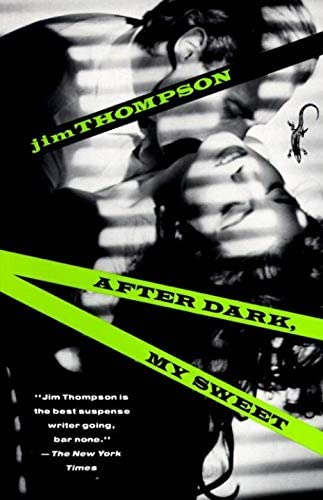
After Dark, My Sweet - Jim Thompson (1955)


Rating: Admirable

Crime is another genre, along with fantasy, that I haven't paid much attention to over the years. For some reason I'm being drawn to crime fiction now and mentioned it in passing to a good friend from Melbourne who then sent me four crime novels he had found in op-shops. Among them was After Dark, My Sweet, by one of the masters of crime noir from the mid twentieth century, Jim Thompson. The novel involves the sociopath, William Collins, former boxer and freshly escaped from a mental institution (his fourth), becoming involved with the alcoholic femme-fatale, Fay Anderson. William is recognised as the perfect fall-guy by Fay's crooked-cop associate, Uncle Bud, who between them have a scheme to kidnap the child of a wealthy family. Even a relative novice in the crime genre like me can recognise that the novel contains all of the typical tropes of crime noir. All of the characters are, in turn, brooding, unpredictable, scheming and violent. The atmosphere is bleak and desperate. The plot unfolds like a tense nightmare that is reasonably unpredictable, despite all the cliched crime tropes being present and correct.

Looking at Thompson's bibliography, he really pumped out the novels, publishing four in 1954 alone! A glance at Thompson's Wikipedia entry reveals the opinion that his output varied in quality, writing some novels in only a month. You can tell, as After Dark, My Sweet does not present as high quality writing, but it is not exactly pulp either. The novel is written in first person from the point of view of Collins, and so is coloured by his hard-man vernacular and distorted world view; so much so it's almost as if he wrote the novel himself. It took me a while to get used to and it doesn't help that there are barely any sympathetic characters throughout the novel. No one trusts each other, and this constant tension makes for a dark and nervous read. I wouldn't say reading After Dark, My Sweet was an enjoyable experience, but it was very interesting. I tried to imagine what it would have been like for readers in the mid-fifties being exposed to such sociopathic darkness, did they have more innocent exceptions back then and were they more easily affected by crime's dark underbelly? Perhaps not, but they might not have quite been used to Thompson's particular gritty, nihilistic style, something the modern reader is well used to by now. I may well read more of Thompson's work, after all he did write the script for Stanley Kubrick's film, The Killing (1956) and this novel did enough to interest me.