Showing posts with label Science & technology. Show all posts

Wednesday, 13 December 2023

Novacene: The Coming Age of Hyperintelligence - James Lovelock and Brian Appleyard (2019)


Rating: Excellent

James Lovelock was an important scientist who, among many achievements, saved humanity with his discovery (using one of his inventions) that CFCs were building up in the atmosphere and damaging the ozone layer. Lovelock also posited the Gaia Theory, that Earth is a self-regulating, synergistic system in which life maintains a habitable environment for itself, co-evolving with the inorganic environment in order to keep the planet cool, despite Sol's efforts to the contrary. The ideas behind Novacene go beyond organic life on Gaia toward the claim that the ultimate evolutionary endpoint for Earth will be cybernetic life based on information, which does seem to be the universe's universal currency. Lovelock refers to this soon to arrive era as the Novacene, despite the proposed current era of the Anthropocene not having been fully accepted as yet. Despite the small page count, Lovelock takes his time to explain his background reasoning, moving through his thoughts regarding life in the universe (he feels Earth contains the only existing life - I disagree), the meaning of our existence (we are are universe knowing itself - an idea I've always have been attracted to) and Earth's battle to contain the heat threat via its Gaian systems, something humanity is fast despoiling, which could be the end point of the Anthropocene I feel, although Lovelock begs to differ. According to Lovelock cybernetic life will, rather than destroying us, want to work with us in order to keep Gaia from overheating, an outcome he reasons would be just as bad for them as it would be for us.

Lovelock's thought processes and theories are fascinating and logically extrapolated. Lovelock genuinely believes that humanity will be the creators and midwives of cybernetic life which will exist on such a superior plane to us that we will be regarded in the same way that we regard house-plants. Such notions have been well explored by others, that AI's processes will take place at such accelerated levels that we will be more than redundant, however Lovelock's assertion that cybernetic AIs will want to keep us around goes against many accepted (pessimistic) theories on the subject, but his reasoning on this subject appears fairly sound and persuasive, although I don't agree with everything. Since Novacene was published we've seen the emergence of ChatGP and other such (for the moment) primitive AI systems. They are crunching information at frightening rates and interacting with humans in a sophisticated manner, however they are still not real AI, not conscious, self aware entities (that Lovelock pictures as spheres). Within this current context Novacene is a fascinating book and should be read by anyone interested in AI or the future of humanity. Along the way we also learn that Lovelock inadvertently held Stephen Hawking in his arms as a baby, was an advocate for nuclear power, but also that he was an extremely moral human, whose contribution to humanity was profoundly significant. Lovelock lived to be 103, but not long enough to see his Gaian Theory become accepted, nor to see humanity come to grips with human-caused climate change, but I hope he is correct about AI needing us around. Perhaps among the intractable problems that AI could help solve is the best and fastest way to terraform Mars, a planet Lovelock describes are totally inhospitable to life and a pipe dream for humanity. Then we would have the insurance of two homes. Although I hold no optimistic hope for humanity, you never know, maybe our future spherical AI overlords will really help us out.

This review is dedicated to my friend Eileen Bogart, who enthusiastically attended my library based book clubs and engaged with me with genuine warmth. Novacene was one of the many books she gifted to me before she passed a few months ago. I'll always remember you fondly Eileen, you were both interesting and interested, a quality not always found that readily among humans.

Monday, 5 July 2021

Possible Minds: 25 Ways of Looking at AI - edited by John Brockman (2019)


Rating: Admirable

It is fitting that Brockman dedicates this collection of essays about AI to "...Einstein, Gertrude Stein, Wittgenstein and Frankenstein." Brockman explains why in his introduction, which I will not go into, however that last name - Frankenstein, is very fitting, as that's how I see humanity's obsession with creating artificial intelligence, an obsession that says a lot about human hubris. What people refer to as AI at the moment is really nothing of the sort, merely powerful computers using algorithms to crunch data that then suggests varies outcomes or possibilities. I read Possible Minds hoping that it would give me greater insight as to where we are right now and where we are possibly heading in terms of 'true AI', however ultimately I came away relatively disappointed. 

An overarching aim of the collection is to comment on and expand upon a foundational text called The Human Use of Human Beings (1950) by Norbert Wiener, who apparently was the father of cybernetics. I'd never heard of Wiener, so that in itself was interesting, however throughout the essays the necessity of referencing Wiener sometimes seemed to be holding the essayists back, or perhaps I just became sick of hearing about him. The essayists themselves produce work that falls into three broad camps, those that are wary (although not too wary, on the whole) of the risks posed by AI; those that are not really worried at all, as long as humanity imposes 'control' on AI (they point out that, after all, as the creators, we can readily impose adequate controls) and those that produced essays that either focussed tightly on their field of study or expertise, or were flights of fancy that came across as slightly indulgent. I did learn quite a bit by reading these essays, however some were just downright boring! Curiously no essayists mentioned the potential of quantum computing as a means to producing true AI capability. I'm no scientist, but I remember that when I read about the recent breakthroughs in developing quantum computing that was the first thing I thought of; surely it has a significant role to play in potentially developing AI?


Westworld's conception of AI

A curious consequence of reading Possible Minds is that I've come away thinking that true AI will never happen. Of course I may well be wrong, but nothing I read here convinced me otherwise. Also, as I mentioned above - the sheer arrogance! The brains of living creatures on Earth have been honed over millions of years and we think that we could create AI within a century? Also brains, particularly human brains, are considered to be the most complex objects in the known universe, in terms of the complexity of neural pathways. Also we really do not have much of an idea how the brain and in particular, consciousness and sentience, works. Some theorists have speculated that there is perhaps a quantum element to consciousness - it could indeed be that deeply complex. Personally I think that it is more likely that the future of humanity lies in the convergence of biology and technology - we'll become cyborgs eventually (well, more cyborg in nature as technically even someone using glasses is a cyborg). Perhaps I've been influenced too much by the likes of Altered Carbon (TV series: 2018-20). Perhaps in the near, or far future, we'll be uploading our consciousness into quantum computing generated cyberspace, or perhaps fragments of it. What is certain is that computers will become far more powerful, but true AI? Let's wait and see...


Sunday, 21 March 2021

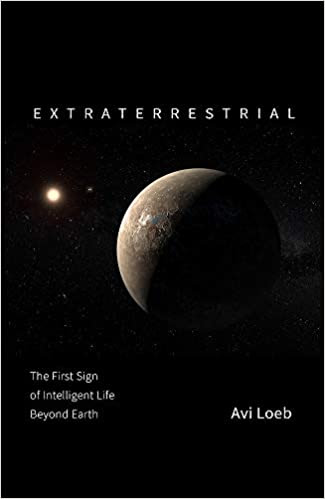
Extraterrestrial - Avi Loeb (2021)


Rating: Excellent

Being interesting in all things astronomical, I distinctly remember in 2017 the reports of a strange object, eventually dubbed Oumuamua (Hawaiian for 'scout'), visiting our inner solar system at a trajectory that could only mean that it came from deep space. Although no direct images were taken of the object it was observed as closely as we could at short notice and astronomers ascertained that it was a cigar-shaped object, possibly an asteroid or a comet. I also remember later reports of a scientist (which turned out to be Loeb) who proclaimed that Oumuamua was in fact a piece of alien technology, possibly a 'star-sail'. I remember scoffing at the idea and thinking that the astronomer had been reading too much science fiction. Now comes Avi Loeb's book and I have to say that he presents a convincing case, outlining logical arguments that both counter the idea that Oumuamua is a natural phenomenon and supporting his theory that it is in fact alien technology. 

I will not go into great details about Loeb's theories (read the book), but one of the two observations that won me over is that Oumuamua "...deviated from an orbit shaped by the sun's gravity without showing any discernible cometary tail..." For those that don't know, when these kinds of objects near the sun they outgas vapours which then usually alter their speed and/or trajectory - there was no evidence of outgassing, despite our best observations, and yet, to paraphrase Loeb paraphrasing Galileo, it moved. The other observation is that Oumuamua was travelling at a speed that placed it 'at rest' relative to the speeds of the stars in our neighbourhood (known is the Local Standard of Rest - LSR), meaning that relative to our solar-system it was pretty much standing still and we ran into it. Loeb likens Oumuamua to a buoy, perhaps placed in that position for a particular purpose, which really gets the imagination going.


Oumuamua's trajectory

Getting the imagination going is certainly one of the results of reading Extraterrestrial, however the more I read Loeb's book the more I got the impression that he was holding back from extrapolating too much about the startling implications of alien technology visiting our solar-system (lest his arguments be weakened and left open to attack?). Loeb takes a great deal of care to explain just how statistically improbable it would be that such a weird object, if natural, would be observed entering our solar-system by us within the very short time we have had those kinds of capabilities (< than a century) - such an object would have to be leaving other solar systems at a continual and prodigious rate, such is the vastness of our cosmos; but he doesn't then state that this notion means that it is definitely a piece of alien technology, rather it is another piece of supporting evidence. Loeb does, however, spend a great deal of the book lamenting the conservative state of scientific academia and the fact that well established theoretical paradigms such as string theory and supersymmetry, which have no supporting evidence, are routinely explored and yet the notion of extraterrestrial life gets short shrift by many scientists. Loeb evokes the example of Gallilao's discoveries being silenced by the Catholic Church in his arguments, which would no doubt piss off many up-tight scientists working in Loeb's field (that's another thing, Loeb isn't a fringe scientist, he's based at Harvard and has a multitude of important papers on subjects such as black holes behind him, he's very credible). Not coincidently other scientists have just put forward an updated version of what they think Oumuamua might be, perhaps as a refutation of Loeb's successful book. Having read it I'm still more convinced by Loeb's arguments.

Those (few) who read this blog regularly may recall that recently I reviewed Whitley Strieber's book, Communion (1987), and being dubious about Strieber's supposed 'encounters' with aliens here on Earth. Arthur C. Clarke once suggested that if aliens turned up their technology would be so advanced it would seem like magic to us. Perhaps this would be the case, certainly in some regards, however there's pretty hard evidence that to travel great distances quickly through space in a safe way is an extremely difficult thing to do, therefore aliens such as those in Communion would be unlikely (unless they arrived via generation ships - see below...). The best way around it is not to try and send out flesh and blood into the cosmos, but rather machines. Oumuamua could be one such machine, and why not?, humanity is doing such things right now. I've always thought, and in this book Loeb also talks along the same lines, that if you think about what humanity is capable of right now, or is theoretically capable of if time and money were not issues, it would be reasonable to assume that any intelligent aliens would also be capable of similar, and as Clarke noted, quite possibly a whole lot more. What if alien cultures were out there in near-by star systems and they sent out probes to examine local star systems looking for interesting planetary systems to contact or perhaps to visit (via extremely slow generation ships that travel for millennia - the only way to do it safely really). If so, maybe Oumuamua is reporting back and one day our solar-system will be visited. What would they find? Unfortunately, the way humanity is going, only remnants of a species with great potential that couldn't get through the 'Great Filter' of technology that both provides great promise and at the same time the very means of our destruction.

Monday, 12 February 2018

Radical Technologies: The Design of Everyday Life - Adam Greenfield (2017)


Rating: Excellent


An excellent analysis of where we are at and where it all could take us; covers smart phones, the internet of things, augmented reality, digital fabrication (3D printing), cryptocurrency and blockchains (I understand it all now, sort of...), automation and machine learning (AI). Greenfield writes too much like an academic - lacking a bit of flair, but this is a small criticism. As Brian Eno says on the back cover blurb - 'This is an essential book.' I say - beware the hegemony of the stacks!