Showing posts with label The Culture. Show all posts

Monday, 6 December 2021

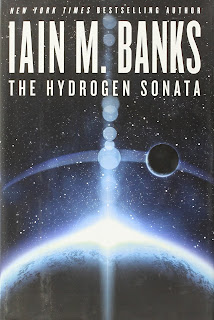
The Hydrogen Sonata - Iain M. Banks (2012)


Rating: Excellent

Well, that certainly was fun. I'd read that the last two Culture novels were not as good as the earlier ones, however The Hydrogen Sonata, the last, unfortunately, due to the author's death in 2013, is no slouch when it comes to Culture driven thrills. The novel is flawed, in that, as usual, Banks can really take a long time to get to the point, both when putting a plot together and during certain scenes in which dialogue or extrapolation is lengthy, however to many this is part of the attraction, including myself. Other than Banks' usual stylistic predilections, The Hydrogen Sonata is quality science fiction. The principal theme of the novel is the concept of subliming, when an advanced species has been around long enough and has achieved enough that it can move on to a higher reality. In the novel this is helpfully described as a limitless lucid dream state existence. The humanoid Gzilt, who once could have joined in on setting up the Culture, are set to sublime, however some have their doubts and there is a possibility that their holy book, The Gzilt Book of Truth, which ultimately directed them to this point, is all a pack of lies.

The Culture becomes very interested in whether the Gzilt are about to sublime under false pretences, as are two opposing factions of the Gzilt. Enter Vyr Cossont, an eccentric Gzilt women who sports an extra pair of arms so she can play T. C. Vilabier's 26th String-Specific Sonata For An Instrument Yet To Be Invented - 'The Hydrogen Sonata', on an instrument called an eleven string. Cossont is asked to look for Ngaroe QiRia, an extremely long-lived man who should have memories of when the Book of Truth was introduced to the Gzilt. This is a typical Banks premise, as is the clever humour and the legion of Culture ship Minds who band together to try and solve the mystery. I enjoyed the Minds in this Culture novel much more than in other some of the other books in the series, I'm not sure exactly why, but their personalities and motives seem much more tangible. The novel is ultimately nicely paced, once you get used to Banks' style of course, but where he really excels, as usual, is in the many set pieces that show off what was an exceptionally creative imagination. One of the best being the scenes on a Gzilt party ship, travelling through an immense tunnel within a circular habitat, partying hard for five years until the subliming, most notably when Cossont meets the chief partier, a body artist called Ximenyer, who features forty eight penises all over his body. Enough said, perhaps, except to say that The Hydrogen Sonata did not disappoint and Banks was at the height of his considerable powers nearing his premature death. It's such a pity he is no longer with us, as I'm sure he had many more Culture novels left to write.

Monday, 15 November 2021

The State of the Art - Iain M. Banks (1991)


Rating: Excellent

I knew I had to reach for an Iain M. Banks book after reading about M. John Harrison's friendship with the great writer, it had been a while after all. The State of the Art is a rarity in Banks' cannon, a collection of short stories. It's a curious bunch of stories. The first two seem like fragments, or experiments in preparation for bigger works. Road of Skulls (1988) is a gothic curio, which I'm still thinking about even though it seems inconsequential; two misfits travel along a road of skulls, literally, and only one person seems to know what it's all about, and it's not them. The second, A Gift from the Culture (1987) really does seem like a fragment, with a former citizen of the Culture being blackmailed to do the bidding of terrorists and is the most inconsequential story in the collection. Odd Attachment (1989) is darkly hilarious, which is exactly the kind of humour you find in his work, and is very entertaining. Descendant (1987) is very clever, making you go back to check how it all plays out. Cleaning Up (1987) is perhaps the best non-Culture story in this collection, and is, once again, very clever and darkly humorous, with a touch of misanthropy thrown in for good measure. Piece (1989) could be described in exactly the same way. So far so good.

The real highlight of this collection is the near novella set in the Culture universe, you guessed it, The State of the Art (1989). The story is brilliant and fully formed. The Culture visits Earth in 1977 and acts very much the anthropologist, with Culture humanoids visiting the surface to sample different countries and all the Earth has to offer. Some are cynics, some are entranced and want to save humans from themselves with contact (by, erm, Contact) and one individual wants a whole lot more. As with all Culture stories, there's a massive space-craft with an AI 'Mind' who is very much in control, pondering over the moral implications of interference. Banks' cynical approach to humanity is perhaps a bit overdone, however this was the Cold War era, so fair enough. It's fantastic writing and as usual Banks explores all kinds of existential issues throughout the narrative, coupled with the Culture's amazing technology. It's stirring stuff and made me immediately want to read the remaining Culture novels I haven't read yet. I'd forgotten just how much I love his writing. The collection ends with Scratch (1987) which is both slight and one of the most obtuse existential jokes ever. It made me think that Banks had been reading J G Ballard's more experimental short stories from the late seventies, which he probably had been I'd say. Despite a couple of minor curios, this collection is well worth the effort.

Wednesday, 10 July 2013

Matter – Iain M. Banks (2008)


And so Mr. Banks has passed on, leaving us behind to ponder the greatness of his work. And it is great. And he was also satisfyingly prolific, apparently capable of writing a novel in three months. And he was a witty and cultured guy (pardon the pun). That’s a lot of ands. When I bought Matter from a second-hand bookstore in Bunbury nearly two years ago I never imagined that by the time I got around to picking it up again Banks would be diagnosed with incurable liver cancer and would die as I was reading it. And it made me sad.

Matter is the seventh Culture novel of nine and at the time it came after seven years of no new Culture novels. Will there be more? Does Banks have any almost complete Culture novels tucked away for posthumous release? Whatever may happen Banks’ stature as one of the great science fiction writers of the last few decades is assured. Matter is not the greatest Culture novel, but it is certainly excellent.

The premise and plot of Matter is typically complex and is not summarized easily. The novel contains one of Banks’ great inventions – a Shellworld called Sursaman. Shellwords were built by a long departed alien race called the Veil and it is one of four thousand that were initially created, with half of them destroyed by another alien race called the Iln, who are also extinct. Different alien races live on the habitable levels inside the Shellworld and each level is gigantic, with its own geography, atmosphere and astonishing wonders.

Such a premise allows Banks to indulge himself and he certainly does, but with sometimes mixed results. Matter allows Banks to bring a complete medieval humanoid civilization to life called the Sarl. There are epic battles, courtly duplicity and manipulations of the Sarl by their mentoring alien species the Oct. Prince Ferbin, Heir to the throne, flees his home level and much of the narrative follows his fortunes as he tries to avenge his father’s wrongful death. Enter Djan Seriy, his sister who long ago became part of the Culture’s covert organisation Special Circumstances. Special Circumstances appears in most of the Culture novels and as usual there is great entertainment to be had with the amazing technology possessed by the Culture, not to mention the moral ambiguities that come with such power.

With most of the usual Culture tropes in place a wild imaginative ride is guaranteed, however Matter is unevenly paced. There is a long preamble that sets up the main players and plot arcs, but does so with slightly less panache than you’d expect from Banks. It takes a while but once things get going Matter does resolve into an absorbing read. One of the many highlights comes when Djan visits an Oct space habitat, which allows Banks to let his brilliant imagination to run wild. Djan is accompanied by her sentient combat drone that is operating covertly and is therefore cunningly disguised as a dildo, revealing that Banks’ usual sly humour is fully present.

The endgame of Matter is slightly rushed and if you were taking notice of the clues earlier in the novel it is also perhaps a bit predictable. This is a minor criticism because Banks is such a quality writer that he makes up for any shortcomings with his erudite style, incredible imagination and his ability to create believable characters, even when they are machines or are totally alien. Apparently after his untimely death sniffy critics mostly talked about the literature he wrote as Iain Banks, rather than the brilliant science fiction he wrote with the added M. between his first and second name. That’s a shame because Banks is one of the greatest science fiction writers of any era and his unique sensibility has become highly influential. Only last week I was watching a rerun of the second episode of the first series of the Dr. Who reboot and during the scenes where the last human appears on the viewing platform to witness the final hours of planet Earth I realized that what I was watching was pure Iain M. Banks. And that made me smile.

Monday, 8 April 2013

Iain [M] Banks


Today one of my colleagues at work told me that Iain Banks has terminal cancer and only has a matter of months to live. I was incredulous and deeply saddened by the news. A writer of rare ability, Banks has had two careers side by side. As Iain M. Banks he has been one of the greatest science fiction writers of the last twenty-five years or so. His Culture novels revealed Banks to be one of the most imaginative and playful writers in the genre.

As Iain Banks he has published literature, with a string of quality releases beginning with the left of centre classic The Wasp Factory in 1984. This was my first introduction to the brilliance of his writing and I still talk to people about that book today. However I’m more familiar with the Iain M Banks side of the story, with Use of Weapons (1990), Against a Dark Background (1993) and Look to Windward (2000) standing out as favorites.

Banks will be greatly missed, but he’s leaving behind an impressive body of work and for that he should feel satisfied. Thanks Iain, I’ve loved your books and I wish you a good end to this part of your story.

You can read Iain’s post about his illness and leave a message if you wish on his website here.

Sunday, 17 June 2012

The Player of Games – Iain M. Banks (1988)


Iain M. Banks Culture novels represent some the greatest science fiction of the last twenty-five years. The Player of Games is the second of nine Culture novels released so far and like the other Culture novels it revels in its ability to go out on a limb and explore big ideas whilst providing well-developed characters and compelling plots.

Perhaps the greatest achievement of Banks’ science fiction writing is his ability to overturn tired clichés of the genre and make them exciting and fresh again. Banks’ imagination is something to admire – it seems that he is never short of a great idea. It also helps that Banks’ writing is highly literate, displaying a level of sophistication not always seen in science fiction.

The Culture is a representation of human civilization thousands of years into the future. In The Player of Games one character refers to the benefits of eleven thousand years of space travel. They travel in style too, with a range of massive spacecraft that are ‘Minds’ – conscious, sentient, intelligent and with senses of humour. The Culture also has varied habitats. This time the protagonist lives on an artificial structure orbiting a sun with ‘plates’ - massive artificially constructed environments with landmasses and oceans. Another feature of the Culture are the ‘drones’ – sentient machines that share equal rights with humans. Basically the Culture is a near utopian society in which technology is almost boundless and where no needs or wants remain unfulfilled. Of course it’s not as simple as that and the Culture certainly has its dark side - represented by the mysterious and sometimes nefarious organisations ‘Special Circumstances and ‘Contact.’ 

The Player of Games is the story of Jernau Morat Gurgeh, one of the greatest game players the Culture has ever seen. As far as protagonists go Gurgeh is complex, flawed and grumpy but likeable. In fact I think that Gurgeh is modeled on the author himself. Gurgeh is described bearded with pointed features, which is how you could describe Banks himself.

After years of winning and luxuriating within the Culture Gurgeh is bored. When he mentions this to his drone friend Chamlis, some strings are pulled and Gurgeh finds himself being visited by a rather contrite drone from Contact. Gurgeh eventually finds himself on the way to the Small Cloud of Magellan (called the Lesser Cloud by the Culture) to the Empire of Azad - a barbarous but complex civilization that is dominated by a game that mimics life itself and helps decide who will rule and who will fall by the wayside.

What transpires is compelling entertainment and is never predictable. Having said that I guessed what was really going on at a certain point, but then perhaps I’ve read too many science fiction novels. Banks doesn’t bog down the narrative by trying to explain how the game works, instead he focuses on the psychological intensity of actually playing the game itself for both Gurgeh and his opponents. Along the way there are plenty of entertaining encounters with the Azadians, a race of beings that have three sexes and whose society is intensely hierarchical.

Perhaps the most entertaining section of the book is when the game players travel to the planet of Echronedal, a fire planet with a bizarre ecology dominated by the incandescence – a strip of volcanic fire that travels around the equator. The planet’s ecology is based around this destructive fire and Banks makes the effort to explain how it all works. Banks’ imagination is wild but he always makes the effort to build a cogent world around his sometimes outré ideas. On Echronedal Banks also indulges in his love of castles, with the final rounds of the game being played within the halls of a giant and sombre castle. Here the novel reaches an exciting and terrible climax.

Player of Games is one of the best Culture novels I’ve read. As usual Banks delivers well-drawn characters, including the machines, coupled with a tightly constructed plot that is littered with excellently executed ideas. You couldn’t ask for more really and I’m looking forward to finally catching up with the last couple of Culture novels – Matter (2008) and Surface Detail (2010) before the new one – The Hydrogen Sonatas is released. If you are curious about modern science fiction or have never read Banks, then head on down to your favourite bookstore (you do have one right?) and invest in this great writer’s works, you will not regret it.