Showing posts with label Science Fiction. Show all posts

Saturday, 10 October 2026

Galaxies Like Grains of Sand - Brian Aldiss (1959)


Rating: Admirable


Since reading his Helliconia Trilogy (1982,1983,1985), I’ve become quite the admirer of Brian Aldiss, so needing a short but entertaining read after the literary intensity of the last two books, I reached for my beautiful edition of Galaxies Like Grains of Sand that was (re)published in 1980. I’ve since discovered that this book was originally published in the UK in 1959 with the title, The Canopy of Time, and then in the US shortly after as Galaxies Like Grains of Sand. This and subsequent editions dropped a few stories, added some different ones and included extra text that thematically joined together what were originally stand alone short stories detailing a forty-million-year future history of the galaxy. Aldiss’s ‘fix-up’ approach was largely successful, particularly due to his superior way with narrative and masterful style. Despite these stories having been written in the 1950s, they have dated quite well. The stories are presented as snapshots of particularly significant millennia in humanity’s future, beginning with The War Millennia, in which ‘aliens’ are present on Earth collecting flora and fauna as the world is about to plunge into nuclear war. This is the story most tied to its era, with the Cold War in full swing and the risk of nuclear annihilation increasing with each year. Of course, all is not as it seems and what follows is even more intriguing.


Aldiss, looking to the future.

Being science fiction from the 1950s, robots are involved, and they feature strongly in the next couple of vignettes, particularly in The Robot Millenia, which had been published as a stand-alone short story called Who Can Replace a Man? It’s very clever, entertaining, and funny too. Aldiss definitely had a wry sense of humour and playfulness (this was also evident in the Helliconia Trilogy). The Mingled Millenia and The Dark Millenia detail eras in which humanity begins to recover and ventures out into the stars, whilst also losing touch with Earth, which remains a relative backwater in a galaxy where humans have otherwise established some level of primacy. Perhaps the best story is The Mutant Millenia, which gives forth some sci-fi horror and an intriguing evolutionary narrative in which humanity risks being superseded. The Megalopolis Millenia is the lesser of the stories, featuring characters viewing and arguing over some ‘found’ documentary footage of the futuristic, yet seedy Earth City of Nunion. Although well written, it does not add much to the overall narrative arc and diminishes the book’s standing somewhat. The final story, The Ultimate Millenia, is quite brilliant, offering up both the beginning of the galaxy’s end and the very reason for its previous existence. It provides a strong ending to an intriguing and mostly successful future history narrative, with Aldiss’s deft hand guiding the reader through both the big picture and the granular detail of humanity’s future. Although a bit inconsistent, Galaxies Like Grains of Sand can be recommended as an easy introduction to the work of Brian Aldiss, a science fiction writer who was definitely one of the greats, successfully straddling the so called ‘Golden Era (1930s-1950’s)’ and ‘The New Wave’ (1960’s-1970’s) of science fiction, to emerge out the other side with his relevance and status intact.


Classic 'Golden Era' cover art.


Sunday, 14 June 2026

The Ganymede Takeover - Philip K. Dick and Ray Nelson (1967)


Rating: Excellent

Some part of me that desired, no, actually needed a shot of paranoid weirdness that only Philip K. Dick can provide. This happens at least a couple of times a year. Fortunately, Dick was prolific, so there are still plenty of his novels I’m yet to read, despite being an avowed ‘Dickhead’ for decades. The Ganymede Takeover is one of the few novels that Dick collaborated on with another writer, in this case Ray Nelson, who was an interesting character in his own right, as an author, cartoonist and the inventor of the propeller beanie hat that went on to become emblematic of science fiction geekdom. Nelson and Dick were friends from childhood and it was after Nelson gave Dick his first LSD trip (I read somewhere that Dick didn’t have a particularly good time, no surprise there...) they decided to collaborate and apparently Dick rounded up some in-progress story fragments and they came up with The Ganymede Takeover. Set on a future Earth that has been invaded by reptilian worm creatures from, you guessed it, Jupiter's largest moon, Ganymede. The Ganymedian invaders are also aided by a ‘Creech’ slave race of ugly bipedal monsters. There’s only one area (a ‘bale’) left on Earth in Tennessee that resists the worms from Ganymede, where a ‘Neeg’ leader called Percy X leads a small army of black Americans. There’s also another rebel group called the ‘World Psychiatric Association' (of course) who end up collaborating with Percy X. This premise is merely the framework for hanging all of the typical Dickian tropes from, such as flying cars (ionocraft), telepaths (Percy X and Mekkis, one of the Ganymedian's), vidphones, androids, liberal drug taking and, of course, half deranged doctors who design weird brain warping machinery; everything you’d want from a Philip K. Dick novel basically.

P. K. Dick, staring down Ray Nelson

The Ganymede Takeover can be placed among Dick’s lesser novels; however it is a much better effort than many of his pulpy novels, which typically were knocked off under the influence of legal amphetamines to keep the money, and the amphetamines, coming in. It could very well have been the collaboration with Nelson that created a narrative that is more polished than the usual knock-off effort by Dick. It’s still a wild, schlocky ride though, particularly about halfway through, when an epic battle begins between the Neegs and the Creech led Ganymedian army, involving a herd of gigantic African Aardvarks with “...evil, glittering eyes...” and "...tongues that lick ionocraft out of the sky...", causing the greedy and slovenly character of Gus Swenesgard (a typical Dick character, well and truly trapped within the maw of his flaws) to exclaim “Oh my god, not Aardvarks!!” It becomes unbelievably wilder from that point on, with a totally crazy battle involving all kinds of bizarre creatures that emerge straight from the fevered minds of Percy X and his assistant, who are using a machine stolen from the mentally unstable Doctor Balkani that can create very real shared hallucinations. The plot becomes a bit convoluted from that point on, but it is entertaining non-the-less and it was a totally enjoyable 157 pages of Dick freakiness. The Ganymede Takeover is not the place to start for Philip K. Dick initiates, but for established Dickheads it's lots of freaky fun of the kind you’d expect and, of course, need in your life.

Sunday, 26 April 2026

Lord of Thunder - Andre Norton (1962)


Rating: Admirable

Having recently moved house, which involved packing and unpacking dozens of boxes of books, I realised just how many unread books I have dating back decades. Time to read them then, and so I grabbed Lord of Thunder off one of my new book shelves. I've had this slight science fiction novel in my possession since the 1970s, perhaps since I was ten years old. Although I loved the cover, and still do (just look at it! It's a fantastic example of sleek minimalism), I remember trying to read it and realising that it was beyond my capabilities. By the time I noticed it again, in my twenties, I thought it beneath my capabilities, and so it lay dormant, saved only by its cover. What I didn't realise was that Lord of Thunder is a YA novel, before publishers realised that there was such a thing. What I also didn't realise it that Andre Norton was a woman, Alice Mary Norton, who used a male pen name in order to smooth her way in the male dominated world of science fiction. Alice Norton wrote both science fiction and fantasy, publishing at least a dozen different series, most notably the Witch World series, which began in the 1960s and was still going in the 1980s. Lord of Thunder is the sequel to The Beast Master (1959). Both novels feature Hosteen Storm, a 'Beast Master' hailing from Earth (Terra), who can telepathically communicate with an eagle called Baku and a big cat called Surra. Together they make a formidable team in this rather bracing adventure on the planet Arzor, populated by Norbie aliens and human settlers from Terra, apparently long since dead. 


Alice Mary Norton, cat master.

Lord of Thunder has a wild west type of vibe, with the Norbie tribes resembling American Indians, albeit with blue skin and horns. This is the kind of adventure oriented science fiction that was very attractive to teenagers back in the 60s and 70s. Hosteen is jarred out of his newly settled life when he is forced to mount a rescue operation into the searing hot landscape of the 'blue' region of the planet. Also the Norbie tribes are calling truces and heading into the blue region en masse, which alarms Hosteen, as he believes it could only mean war with the human settlers. Although it quickly became clear that Norton could turn out a great adventure narrative, with a nice pared back style that wastes no time, I was surprised at just how good Lord of Thunder turned out to be. Perhaps the nostalgia of reading a proper sci-fi adventure (I grew up reading the likes of Harry Harrison's Stainless Steel Rat novels...) made it that more pleasurable. The novel also features one of the great science fiction tropes, the ruins of a lost alien civilisation. Even better is that the ruins are underground and embedded in cave systems within mountains. Hosteen and his brother, Logan (who was living with one of the Norbie clans) become trapped within the ruins and have to find their way out. These sections are the best part of Lord of Thunder, full of tension and mystery and not overdone or melodramatic. Since reading the novel I discovered that Norton is still much admired within the fantasy community, and I can see why, she was a classy writer. However Lord of Thunder is not without its flaws, with the denouement coming across as rushed and a tad predictable, which weakens the overall impact of the plot. Despite this I really enjoyed the novel and am pleased that I held onto it for so long, which just proves that hoarding books is totally justifiable and worthwhile.


Just one of many alternate covers.


Sunday, 30 November 2025

Stars in My Pocket Like Grains of Sand - Samuel R. Delany (1984)


Rating: Admirable

Samuel R. Delany is unlike most other science fiction writers, not only is his densely descriptive writing style highly erudite, but his work is conceptually sophisticated and quite often oblique. His themes explore gender norms, sexuality, sociology and cultural mores, especially relating to social politics and government bureaucracy. Delany has more in common with Ursula Le Guin than the likes of most other science fiction authors, particularly from the era in which he produced the majority of his published work, the 1960’s, 1970’s and 1980’s. Stars in My Pocket Like Grains of Sand takes place in a distant future in which humanity is spread across some 6000 planets. There are alien species, but only one shares humanity’s ability to harness faster than light travel, a xenophobic race known as XLv. Sounds simple enough, but Delany adds in two competing quasi-religious factions, the Family and the Sygn, both of which become only marginally understood as the novel progresses. One of the handful of main protagonists is Rat Korga, a gangly misfit who voluntarily undergoes a process called Radical Anxiety Termination, in which his brain is permanently altered to take away all mental suffering, but he effectively becomes a slave on a desert planet which is eventually destroyed in mysterious circumstances. The first section of the novel is taken up with his story, told in third person, until the narrative switches to first person, told from the perspective of the other principal protagonist, Marq Dyeth on the plant Velm.


The novel is an intense exercise in comprehensive and detailed world building in which the reader is totally thrown in the deep end. There’s very little in the way of background information regarding the Family or The Sygn, how humanity came to be spread across the stars, the nature of their space travel, but most significantly, the culture and society of Velm in which humans live alongside the Evelm, a reptilian species with a multitude of forms and social norms, including ‘dragons’ that live in the north of the planet. We get to know Marq Dyeth quite well, however her (Marq is actually a male, but it seems that everyone on the planet is referred to as a female, but at other times as a male, depending on sexual preferences…) interactions with her family and the Evelm are exceedingly complex. The array of cultural and societal norms is bewilderingly detailed and is explored comprehensibly throughout the latter half of the novel. It’s very easy to get lost and overwhelmed by such world building, as such it is both the novel’s strength and its weakness. The best way to approach Stars in My Pocket Like Grains of Sand is to just go with it and enjoy some of the novel’s more manifest joys, such as the literary elements, like the poetry recited at a social gathering, from where the title of the novel is taken, or Rat Korga’s experience with information cubes that transfer their data directly into the brain (many of which are great literary epics that sound fascinating - of course Delany goes into them in detail). There’s also the dragon hunting undertaken by Rat Korga and Marq Dyeth on Velm, which is unlike any hunting practice that you could reasonably consider. Delany also explores an internet like technology called the General Information Service, which reminds you that the novel was written and published during the early years of the Cyberpunk genre.


Samuel R. Delany, contemplating being oblique

Stars in My Pocket Like Grains of Sand demands a great deal from the reader, to the extent that it would simply be too frustrating for many readers; the XLv race is barely explored in the end, despite its obvious promise; there are just too many long detailed passages describing social customs and there's also the matter of confusing gender pronouns and a plot in which not much really happens in terms of action or typical plot devices that move the narrative forward in a dramatic fashion. Also, the novel was meant to be the first in a diptych, but the second novel, The Splendor and Misery of Bodies, of Cities has never been completed, meaning that there is a number of loose ends that are never resolved, as they were no-doubt going to be explored further in the second novel. Stars in My Pocket Like Grains of Sand is fascinating, beautiful, frustrating and even maddening. I really don’t know whether I fully enjoyed it, but three weeks after finishing it I’m still thinking about it, so I’d say it’s worth reading, but be prepared to be both bewildered and challenged.

Saturday, 4 October 2025

City - Clifford D. Simak (1952, complete edition - 1988)


Rating: Excellent

This 1988 edition of City (pictured above) contains a ninth tale, not included in earlier editions of this remarkable book, and an author's forward. Known as a 'fix-up' book, containing stories published separately between 1944-1951, it was then published in 1952 with interlinking tales that explain how the stories are fragments of a greater narrative. The ninth story, or Epilog, was first published separately in 1973. This edition begins with the rather sobering words: "City was written out of disillusion." Simak had lived through WWII and had despaired at its devastation. City is a rumination on what the future could hold for humanity, however Simak's visions of the future are unlike any other typical dystopias or utopias encountered in science fiction. The interlinked tales are woven together with brief extrapolations regarding their veracity and origins, how they came to be part of 'Doggish lore', for in City dogs are intelligent and can speak, having been given that capacity by the Webster family, who feature from the very first tale. Not only are there talking dogs, but there are also robots, in particular the servant robot, Jenkins, who features throughout the book. Robots, talking dogs and the future of humanity? You might consider that you'd know how the tales found in City will play out, but, once again, Simak produced work that defies typical science fiction tropes. Simak's writing is a curious blend of fable, fantasy, science fiction and folklore. It's a bit baggy and, indeed, shaggy, but is irrepressibly endearing because of these very tendencies.


Clifford D Simak, contemplating the future of humanity.

Within these tales humanity's future is marked by both stasis and expansion, some humans who have settled away from cities (as most of humanity end up doing, despite the title) find themselves becoming agoraphobic and in later stories many end up in virtual reality suspended animation. Some, whilst exploring a highly improbable conception of Jupiter, find escape into ecstasies of alien existence. Others are beginning humanity's exploration of the stars and disappear for good, others still become human mutant outliers, experts in logic, theory and their practical applications. Their impact on ants turns out to be significant, but no spoilers here. However it is the dogs that are at the heart of these tales, after all, they inherit the Earth and ponder the past via their Doggish fables of times long gone. They develop a sophisticated society over the eons, with the aid of the robots, the faithful servants of both humans and dogs. There's just enough weirdness and intrigue to keep the reader engaged, but Simak is careful not to reveal too much, keeping you wanting more. Probably my favourite parts of City involves the concept of 'cobblies', entities who live in other parallel worlds, with some of them slipping through to Earth, with unintended consequences. I'm surprised that City has never been made into a television series, or at least a movie, it would make an excellent visual narrative, but I could not find any mention of it ever being optioned in any way. Although eight of the nine stories here were written and published during WWII, they have aged well, perhaps because the notion that humanity is inherently fatally flawed is still persuasive. Also the concepts involved and the style in which they are presented are remarkably contemporary. Fortunately when I found my copy of City in a kooky second hand book store (Bella's Second Hand Book Store), I also bought six other Simak books, so I'm looking forward to more Simak thrills to come.

 
Two beautiful editions of City


Monday, 3 March 2025

Childhood's End - Arthur C. Clarke (1953)


Rating: Excellent

It's been some twenty five years since I last read Arthur C. Clarke's work. As a teenager and beyond I must have read at least a dozen of his novels, but I never got around to reading Childhood's End. Somehow I even missed out on encountering any hint regarding its plot or themes, and for that I am grateful. It has long been regarded as a true science fiction masterpiece, despite many of its tropes becoming science fiction cliches in the ensuing decades. Essentially an alien invasion narrative, Childhood's End begins with the space race, but not that one, instead it begins with an opening chapter that Clarke rewrote in 1990, replacing a competitive cold war race to land on the moon, with a united effort to reach Mars in the twenty-first century; until it is interrupted by the arrival of massive alien spacecraft that hover over the major cities of the world. Sounds familiar? Such a scenario has been played out countless times, particularly in the TV series V (1983, 1984-85) and the godawful movie, Independence Day (1996). Fortunately Clarke's approach is far more subtle, intelligent, philosophical and powerful. The aliens remain hidden for the first third of the novel, instead they direct humanity from behind the scenes into a utopian age in which all suffering ceases and world peace endures. I'd forgotten just how good Clarke's writing was, he was certainly stylistically sound, but more significantly he really knew how to build suspense and create an expectation that the secrets that are bubbling away under the surface would be worth the wait. This is exactly how it played out for me, not knowing the true nature of the aliens, dubbed the 'Overlords' by humanity, the reveal that arrives a third of the way through the novel was impactful and satisfying. 

Arthur C. Clarke - master of suspense

Childhood's End contains themes that Clarke would explore later in his career, but here the notion of a transcendent higher power comes with definite uncertainty as to just how benevolent it really is, unlike 2001: A Space Odyssey (1968), in which there seems to be a no stings attached evolutionary assist from higher powers. The Overlords themselves appear consistently benevolent throughout, however Clarke gives subtle hints as to what is really going on throughout the novel. When an Overlord known as Rashaverak attends a party at the residence of a man called Rupert Boyce and is found to be perusing his large collection of books on the paranormal, you can't help but be intrigued as to what is really going on. Clarke takes his time to let the reader in on the secret, something some modern readers can get impatient about, perhaps confirmed by some of the comments on Goodreads, with a couple of readers remarking that the novel is "tedious to get through". Actually the novel is perfectly paced, with the reveals regarding the Overlord's planet of origin, their ultimate role in Earth's fate and the nature of that fate itself, coming as well timed rewards for a little bit of patience. Childhood's End is an almost perfect science fiction novel and is rightly regarded as Clarke's best, it was also the moment when Clarke broke through as a novelist, both critically and commercially. On completion I was left with feelings of both wonder, and a nameless dread. Despite the unscientific paranormal elements Clarke utilises in the novel, the hard science aspects are sound, and given what we now know about the nature of the universe (that most of what is going on in the cosmos is a total mystery), the notion that we could at some stage be ultimately confronted by the shocking truth of the true nature of existence is not beyond the realms of possibility. 

Monday, 28 October 2024

10,000 Light-Years from Home - James Tiptree Jr. (1973)


Rating: Excellent

James Tiptree was actually a female writer using a male pen name to help her work be accepted in the male dominated world of science fiction. Her name was Alice Sheldon and judging from the fascinating and imaginative short stories found in this volume she was one of the best science fiction authors of the 1970s and 1980s. I grabbed 10,000 Light-Years from Home off the shelf because it presented a very different proposition to the heavy tomes I've been reading lately. It didn't disappoint. Tiptree's writing style and thematic bent reminds me of the short work of Walter Tevis. The stories are written in a vivid, almost hip style that pops out of the page with its inventiveness and intelligence. The unusual story titles reveal just how clever and snappy her writing is, the first being And I Awoke and Found Me Here on the Cold Hill's Side. Even after reading the story I'm not sure what it means, but the story slyly inverts the usual alien/human relationship, with the hapless humans totally addicted to the unique pleasures aliens provide. The Snows are Melted, the Snows are Gone drops the reader into an unfamiliar world with no explanation offered. The story is a vivid vignette involving an armless girl and her wolf, who trick a primitive human into capture. That's it basically, but Tiptree makes it very exciting and also leaves you wanting more. This story reminded me of the concepts found in the artwork of Moebius (Jean Giraud). In a similar fashion to Mobeius, Tiptree's stories are the kind that you just have to go with and not expect everything to be fully explained. The Peacefulness of Vivyan is the perfect example, an idiot savant who just wants to swim in an alien ocean is taken in by freaky seal-man creatures. All becomes apparent, kind of, but the writing is so good it doesn't matter either way, a big part of the reward is the narrative journey itself.


Alice Sheldon

One of the best stories in this collection is Painwise. A human starship pilot is along for the ride as his ship explores the galaxy, investigating worlds and the various freaky life-forms. He can't feel any pain, so when he is deposited on a planet it doesn't matter what happens to him, he'll survive and be patched up by the ship. Unfortunately he's had enough and tries many different ways to end his life, whilst also begging to be taken home. This is just the premise, what happens to him is ingenious and wild, you'll have to read the book to find out. Not every story has aged well, Birth of a Salesman is rooted in hip madmen style corporate argot that doesn't translate well for the current time, also the twist in the tale is just too obscure. However there's some great time travel stories, The Man Who Walked Home is brilliant and ingenious, as is Forever to a Hudson Bay Blanket, a tragic love story played out over a closed time loop. My favourite two stories are Mamma Come Home and Help. As with some of the stories in the Walter Tevis collection, Far From Home (1981), these stories feature reoccurring characters, in this case they work for NASA and are heavily involved when aliens, in the form of giant women, turn up. Tiptree has some fun satirising pulpy fantasies of giant sexy women, these women literally kill men by having sex with them, but not all is lost, as the clever ending reveals. In Help more aliens turn up and the crew have to try and deal with their religious fanaticism. Once again the satire is turned up to eleven and religion in general is the loser. These stories deal with some serious themes in fun and inventive ways, making you think a bit more deeply than you realise. Having finished 10,000 Light-Years from Home I'm not surprised that Alice Sheldon had a background in experimental psychology, worked for the CIA and was also a major in the US Air Force during WWII. Like her life, her fiction is a multifaceted and intelligent adventure. Recommended for those who want to be challenged, or who just love weird science fiction.

Thursday, 25 April 2024

Pattern Recognition - William Gibson (2003)


Rating: Admirable


Around the turn of the twenty first century William Gibson stated that any possible future that he could imagine would not be as weird as what was happening in the present. Accordingly, Pattern Recognition was the first of his novels to be set in the (then) present, so weirdly it is now set in the past. It has been a long time since I’ve read a Gibson novel, longer than the life of this blog. Pattern Recognition attracted me due to its fantastic premise, involving a female protagonist, Cayce Pollard, who displays allergic reactions to logos. Cayce makes a living as a marketing consultant, the worst her reaction is, the better the logo. Cayce is employed by the marketing company, Blue Ant, owned by the toothy Tom Cruise-like Hubertus Bigend (one of the best character names ever). In London to meet with the Blue Ant marketers, Cayce starts to experience a sequence of unsettling events, including being bullied by Blue Ant hard bitch, Dorotea Benedetti. In addition, Cayce, along with a world-wide coterie, is obsessed with very short arty film clips (referred to as ‘the footage’) that appear intermittently via the internet, and are created by an anonymous source, a source that Bigend wants to uncover, seeing it as a brilliant marketing art-form. Bigend, all toothy and hirsute, uses his persuasive powers, basically oozing cinematic charm, to hire a reluctant and paranoid Cacye to track down the creator.


Gibson, feeling weird in the (then) present


Pattern Recognition reveals a Gibson different to the one who produced significant novels such as Neuromancer (1984) and All Tomorrow’s Parties (1999). I always felt that although Gibson’s ideas were brilliant, technically his prose was slightly clunky. Not so with Pattern Recognition, in fact after only fifty pages I was comparing his prose style with that of DeLillo and Ballard, and I started to see the world differently while under the novel’s influence, something that happens rarely (but does with Ballard and DeLillo). Typically, Gibson displays a fine degree of cultural insight, tapping into the opaque signs and signifiers that lurk in our oversaturated media dominated world (as it already was back in 2003). Curiously, however, there are some quaint uses of technology; to watch segments of the ‘footage’ Bigend uses a potable DVD player! The novel was published six years before Smartphones became sophisticated and cheap enough to completely change our interactions with media, therefore DVD technology seems completely out of date as a portable medium now. Gibson produces some brilliant lines, and the novel is replete with visually expressive writing. The overall feel is very noirish, especially when Cayce ends up in Tokyo, perhaps the most natural environment for a Gibson novel. Despite an excellent start the novel begins to taper off about two thirds of the way through, particularly after several mysteries are cleared up. The novel’s denouement is melancholic (a good descriptor for the overall tone of the novel) and subdued, which was disappointing after such an intriguing beginning. Recently I read that short stories tend to be all middle, which is an appropriate descriptor for Pattern Recognition, as it doesn’t quite ignite. Overall, the novel is full of promise that doesn’t completely deliver, but I haven’t been put off and will read the second and third books in the trilogy, Spook Country (2007) and Zero History (2010).  

Sunday, 17 December 2023

Perihelion Summer - Greg Egan (2019)


Rating: Admirable

Greg Egan is Australia's preeminent science-fiction writer and is a mysterious character, never having attended science-fiction conventions, nor ever having a picture of him on the internet or anywhere else. Perihelion Summer is not listed with his novels on his own website, or on Wikipedia, instead it's listed under 'other short fiction', which makes it a novella. Perihelion Summer certainly reads like a novella, with  minimal, yet just enough character development to keep the reader engaged and a plot and exposition that is straight to the point. Set in Western Australia (Egan actually lives in Perth) in what appearers to be the present or near future, humanity is preparing for the arrival in the solar-system of a micro black hole called Taraxippus, that may cause calamitous floods as it passes through. Matt and some friends have created a floating habitat that creates its own power and food, including a large metal net with thousands of fish. They intend to wait out the effects of Taraxippus (a Greek word pertaining to mythology around dangerous presences) out to sea and try to convince their various loved ones to go with them, or to at least head inland, well away from any potential tsunamis. Of course, most choose to stay where they are, in Perth, which is right on the coast, thinking that living some kilometres away from the sea will keep them safe, mimicking the kind of wishful or naive thinking that most have regarding climate change (which is what this book is really about), that it will not really effect them personally.

Perihelion Summer is quite different to other works I've read by Egan, it is not mind-bendingly weird and contains a minor amount of speculative science, although it is quite well written. Essentially the novella is a very clever approach to exploring climate change without actually addressing human caused climate change, instead Taraxippus actually doesn't behave as predicted and causes irreversible climate extremes. Egan uses this parallel to examine human responses and behaviour toward climate change, both positive and negative. Matt and his friends aboard their ship, the Mandjet, respond as best they can, helping as many people as they can, despite the odds against them. It made for very fascinating, compelling and sober reading, in particular because the novella is set partly in my home city of Perth. Reading about familiar landmarks and environs depicted as being freezing, with ice and snow in winter (it never snows in Perth) and then during summer as being so hot that it is basically uninhabitable was alarming. Perihelion Summer has been criticised online for being underdeveloped and anticlimactic, but what critics have missed are the insightful ways in which Egan reveals the generational divide and woolly thinking around climate change. The pivotal scene in this sense is when Matt's sister informs him that their mother blames him for the calamity Taraxippus brings, because he would never "shut up about it." Climate change deniers just keep shooting the messengers, wishing they'd just go away and take any evidence of human induced climate change with them, but it is increasingly possible Earth will be something like it is depicted in Perihelion Summer and no doubt any deniers still around will be laying the blame elsewhere, just like they always have done.

Monday, 26 June 2023

Blue Mars - Kim Stanley Robinson (1996)


Rating: Excellent

Blue Mars continues the epic story of humanity colonising and terraforming the planet Mars, but in being the conclusion of the trilogy it has some inherent differences to the first two, Red Mars (1992) and Green Mars (1993). Perhaps the biggest difference is that Blue Mars features fewer singular events, rather, the focus is more evenly spread across political, scientific and geological themes as the planet has become much more dominated by water, along with a terraformed habitable climate. Blue Mars is much more of a travelogue than the first two books, taking the reader back to Earth, which is beset with environmental problems, and across most of the major areas of Mars, in particular the northern ocean, now teeming with life. On Mars the changed landscape is seen through the eyes of many of the remaining first hundred, but also some new characters, such as Zo, a young arrogant woman who embodies the hubris of new generations who are free of Earth's influence and high on the possibility of living for centuries due to further refinements to the longevity treatments invented on Mars by scientists from the first hundred. The clash between generations, between political movements and the demands of an ailing Earth drive the tensions that play out across the novel. As usual Robinson handles weighty themes and significant plot developments with aplomb. It's epic in scope, yet Robinson's detailed and highly descriptive prose style is as dense as ever, which all makes for an absorbing read.

I particularly enjoyed the sections in which the character Sax Russel features (in fact he is one of my all time favourite characters in science fiction). Sax is one of the first hundred and was behind the push to terraform Mars. His scientific perspective and philosophical musings regarding the clash between the terraforming of Mars and the 'Red Mars' movement's aim to preserve as much of Mars primal state as possible, are endlessly fascinating. Sax gives voice to Robinson's thoughts about science and philosophy, which, across all three novels, is a recurring theme. In Blue Mars this includes the notion as to whether geographical places have rights. Do rocks and geological formations have some kind of consciousness and do they have the right to remain 'unchanged', and what is 'unchanged' in any case? Sax slowly comes around to Ann Clayborne's views about keeping Mars as red as possible, although much of his terraforming work has born fruit. Also fascinating is the exploration of not just the physiological effects, but also the psychological effects of living for a very long time. As the remainder of the first hundred succumb to side effects of living so long, Sax makes up his mind to do something about it, and the resulting treatment and aftermath is one of the highlights of the novel, bringing together all of the remaining first hundred for a nostalgic send-off. Humanity is also branching out to other parts of the solar system and beyond, which is explored in a speculative, yet very convincing way by Robinson. The ending has a satisfying emotional impact and wraps up what really is one of the great trilogies in modern science fiction. Once again, perhaps stay away if you mostly enjoy space operas or soft science fiction, but for those who love hard science fiction, the Mars trilogy is highly recommended.


Saturday, 18 March 2023

Ubik - Philip K. Dick (1969)


Rating: Admirable

Warning: this rather lazy review contains something close to a spoiler, but if you are already familiar with Dick's work, then read on with impunity...

I've been a Dickhead for a long time, a Dickhead among many, and as we Dickheads know Ubik is one of his more revered novels. Having read most of his significant novels, such as A Scanner Darkly (1977) and Flow My Tears, the Policeman Said (1974), strangely I have long overlooked Ubik. For a newbie reader of Dick, Ubik would stand as a fine introduction to his work, but as an experienced Dick lover the novel is diminished by familiarity, for me, at least. Set in the early 1990's, the novel concerns a society in which telepaths and pre-cogs have emerged and they are both a menace and a solution. Glen Runciter oversees a company that provides protection for companies or individuals who are being targeted invasively by those with psychic abilities, using his own array of telepaths and pre-cogs in his employ to counteract the abilities of their own type. Also the dead, if attended to promptly, are able to be held in cryogenic suspension (half-life) and can be communicated with for advice and comfort. Oh, and humanity has colonised the Moon. So far, so typical of Philip K. Dick. Also typical are the characters, such as the 'everyman', Joe Chip, down on his luck financially (people have to pay doors in order for them to open for them), yet he is integral to the narrative. The other characters are a mostly crew of eccentric and suspicious characters trying to make their way inside a Philip K. Dick novel, which, ultimately, is unfortunate for them.

P. K. Dick, thinking about getting there first

I did enjoy Ubik, however, as mentioned above, over-familiarity did curtail my appreciation of its prime Dickheadian moments. Dick developed his narrative shtick early on and a great deal of his career as a novelist explored the same theme, that characters believe that they inhabit one very solid reality, only to find that another reality can be found beneath that seemingly solid surface. They work it out, especially Dick's everyman characters (Chip, in this case...), who are at the heart of most of his novels, but then, right at the end, there's another twist and they are trapped in multiple layers of reality, not knowing what the real one actually is. This pretty much sums up Ubik. As an experienced reader of Dick I grokked the clues early on, then it was just a matter of seeing if I was right, and I was pretty close. The cliche about Dick is that his narratives seem a lot like the reality we live in today, which is fair enough. Humans in this era seem to really want reality to be Dick-like, never trusting information or intention, always looking for conspiracy or duplicity, the layers below so-called reality. I wish that he had lived to at least see the beginnings of the World Wide Web era. I wonder whether he would have been disappointed or inspired? Either way, as the Terry Gilliam quote says on the cover of my edition, "Remember: Philip K. Dick got there first."


Tuesday, 30 August 2022

Ninefox Gambit - Yoon Ha Lee (2016)


Rating: Admirable

I bought this book on a whim, mainly because I thought it was Chinese science fiction, but Lee is actually an American, however, despite my admittedly rather limited exposure to Chinese science fiction, Lee does display some stylistic similarities to some of the Chinese writers I've encountered. There's a certain formal tone to the writing, which has both advantages and disadvantages. The formal tone suits militaristic science fiction, with its array of exotic weapons (amputation guns and something sinister and powerful known as a Winnower, are two of many examples) and space battles, which can be difficult to get right, but Lee does well here. However it's not so good with character development, leaving many of the characters as two-dimensional actors in settings dominated by military technology and imperialist ideology. The two main protagonists, captain Kel Cheris and the 'undead' mad and traitorous Shuos Jedao, have some depth to them, particularly as their circumstances allow for some pretty dark psychological intensity, but all the other characters are one dimensional or impenetrable. The novel became less satisfying as it progressed. In fact I became indifferent throughout the last third and just wanted to finish so I could move onto another book, which is never a good sign.

Despite the novel's flaws the concepts found within Ninefox Gambit are intriguing. There's a struggle between a despotic space Empire called the Hexarchate and other groups that are under its control, who have a tendency to become 'heretics' and develop alternate ways of living. This is were it gets really interesting - civilisation, and objective reality itself, is maintained and altered by the development and establishment of calendrical mathematics. The Hexarchate is run by a strict calendar that all disparate parts of the empire must adhere to, otherwise reality itself can change in ways that undermine its function. It's a great concept and I also enjoyed the fact that Lee throws you in the deep end from the first page and it takes quite a while to work out what is going on. Ninefox Gambit is the first novel of the Machineries of Empire trilogy. The combination of Lee's ideas, space opera tropes and mathematic concepts make the novel and the trilogy an intriguing proposition, however because Lee's style left me cold it is likely that I will not read the other two novels, Raven Stratagem (2017) and Revenent Gun (2018). Other's may find Ninefox Gambit totally satisfying, so don't be necessarily put off by my reaction to Lee's writing. The novel won the Locus Award for best first novel and was shortlisted for the Nebula Award, so I may well be in the minority.


Sunday, 24 July 2022

Rosewater - Tade Thompson (2016)


Rating: Excellent

Firstly, I can totally relate to Thompson, as it mentions on the small biographical blurb on the back cover that "...he battles an addiction to books." Secondly, Rosewater is an enticing proposition, a novel that explores typical science fiction tropes (alien invasion, future technologies), but subverts the norm by making Nigeria the central setting of the novel, with African characters as the main protagonists, removing the narrative from typical western settings. Thematically, the novel critiques colonialism and American isolationism, as well as the tendency for humans to remain divided, despite facing a common problem. I wasn't surprised when I learnt the Thompson is a trained psychiatrist, as his characterisations reveal a particular insight into the human condition, a good example being Kaaro, the main protagonist who displays both moral and amoral tendencies. Kaaro works as an agent for a shadowy government organisation called S45, who has hired Kaaro due to his exceptional abilities as a sensitive. The alien presence in Rosewater is an entity named Wormwood, which crash-landed initially in London, before burrowing through the Earth's crust to emerge in Nigeria. A bio-dome covers the entity and Rosewater is a shanty-town that has grown up around the site, mainly due to the fact that periodically the dome opens and releases spores that has the ability to heal humans. It is also responsible for the xenosphere, which enables sensitives to interact with each-other (like a biological internet) and influence other humans.

Thompson really has crammed a great deal into Rosewater, including horror elements, bio-punk, cyber-punk and Afro-futurism. His writing style is propulsive, consistently compelling and often makes abrupt changes of pace, which works more often than not. The amalgam of cross-genre elements makes for an intriguing blend and the Nigerian setting is refreshing in the same manner as the Asian settings in recent Chinese science fiction. The narrative is set between 2012 and 2066, and jumps back and forth between various times in past and the present (2066). This enables Thompson to explore Kaaro's origins, therefore fleshing out his character, and the story of Wormwood, which is totally intriguing. Kaaro's ability as a sensitive is explored via these time-jumps and this was perhaps the most fascinating aspect of Rosewater. The xenosphere is like a connective virtual reality that sensitives can slip into, assuming different guises and encountering exotic and nefarious entities. It's psychedelic, disturbing and dangerous, giving the novel a shot of extra frisson. I'm not surprised that Rosewater won the Arthur C Clarke Award in 2019 and an award for African science fiction called The Nommo Award. Rosewater is the first part of a trilogy, the other two books were published in 2019 (as usual I'm late to the party) - Rosewater Insurrection and Rosewater Redemption. As it is now my policy to make sure I finish trilogies, I'll be tracking these novels down. I just spent a week in Melbourne, where I managed to find Thompson's latest novel, Far From the Light of Heaven (2021), but these two were nowhere to be seen. I'll have to hook up to the xenosphere to buy them...or nose around in a library.

Thursday, 31 March 2022

Green Mars - Kim Stanley Robinson (1993)


Rating: Excellent

Yet another large novel, this one 780 pages of hard science fiction. Green Mars is set fifty years after the conclusion of Red Mars (1992), a science fiction novel I consider to one one of the best out there. Green Mars isn't quite up to the same standard, but it does come close. Mars has changed, terraforming has come a long way, with the atmosphere thickening and warming enough for genetically engineered plants and microorganisms to begin to flourish. The survivors of the first hundred are in hiding, mostly in a habitat under the South Pole. Most of the key characters from the first novel have survived, thanks to the longevity treatments developed in the first novel, which is great for continuity, but also not an impossible premise considering research into longevity has been going on for decades in what passes for reality. There's also a host of new characters, mostly offspring of the first hundred, known as the Nisei, bred by the mystic, Hiroko. In the same manner as the first novel Robinson gives large sections of the narrative over to different characters in turn, and it is through one of the Nisei, Nirgal, that the new Mars is revealed to the reader. The legendary stowaway, Coyote, takes Nirgal out onto the surface and introduces him to all of the secret underground communities. Mars exists in a tense split between the transnational corporations and the underground, who want to make Mars their own, away from the corrupt capitalism of Earth promoted by the transnationals.

As with Red Mars, this novel takes its time, giving you long descriptions of the geological landforms of Mars. To get the most out of the novel you must either be really into geology, or appreciate just how vivid Robinson's descriptions of Mars are, so vivid they give you a strong sense of really being there on the surface. Robinson makes it totally believable and even desirable that one day humans would be on Mars in a similar situation. Although there is plenty of focus on the planet itself, often the narrative leans toward the philosophical, scientific and the political. The characters are roughly grouped in this manner, with Hiroko and her followers espousing a profound sense of connection with the planet itself, viriditas. The magnificently named Saxifrage 'Sax' Russell continues his mission to terraform Mars, in fact he is perhaps the key character, an influential 'scientist as hero' (the title of part four in fact). Politics is everywhere throughout Green Mars, via the underground, Nirgal, Coyote and the intense Russian femme fatale, Maya Toitovna. Through Maya the physiological effects of the longevity treatment are explored, what it does to the psyche, the memory and perception, which is generally fascinating stuff. These are merely some of the many themes explored throughout the novel; Robinson really packs an enormous amount of information and detail within the 780 pages, it was almost an exhausting endeavour to get through, however it is well worth it and I'm looking forward to reading Blue Mars (1996) in the near future.


Monday, 6 December 2021

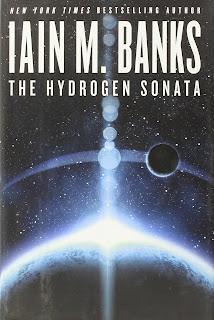
The Hydrogen Sonata - Iain M. Banks (2012)


Rating: Excellent

Well, that certainly was fun. I'd read that the last two Culture novels were not as good as the earlier ones, however The Hydrogen Sonata, the last, unfortunately, due to the author's death in 2013, is no slouch when it comes to Culture driven thrills. The novel is flawed, in that, as usual, Banks can really take a long time to get to the point, both when putting a plot together and during certain scenes in which dialogue or extrapolation is lengthy, however to many this is part of the attraction, including myself. Other than Banks' usual stylistic predilections, The Hydrogen Sonata is quality science fiction. The principal theme of the novel is the concept of subliming, when an advanced species has been around long enough and has achieved enough that it can move on to a higher reality. In the novel this is helpfully described as a limitless lucid dream state existence. The humanoid Gzilt, who once could have joined in on setting up the Culture, are set to sublime, however some have their doubts and there is a possibility that their holy book, The Gzilt Book of Truth, which ultimately directed them to this point, is all a pack of lies.

The Culture becomes very interested in whether the Gzilt are about to sublime under false pretences, as are two opposing factions of the Gzilt. Enter Vyr Cossont, an eccentric Gzilt women who sports an extra pair of arms so she can play T. C. Vilabier's 26th String-Specific Sonata For An Instrument Yet To Be Invented - 'The Hydrogen Sonata', on an instrument called an eleven string. Cossont is asked to look for Ngaroe QiRia, an extremely long-lived man who should have memories of when the Book of Truth was introduced to the Gzilt. This is a typical Banks premise, as is the clever humour and the legion of Culture ship Minds who band together to try and solve the mystery. I enjoyed the Minds in this Culture novel much more than in other some of the other books in the series, I'm not sure exactly why, but their personalities and motives seem much more tangible. The novel is ultimately nicely paced, once you get used to Banks' style of course, but where he really excels, as usual, is in the many set pieces that show off what was an exceptionally creative imagination. One of the best being the scenes on a Gzilt party ship, travelling through an immense tunnel within a circular habitat, partying hard for five years until the subliming, most notably when Cossont meets the chief partier, a body artist called Ximenyer, who features forty eight penises all over his body. Enough said, perhaps, except to say that The Hydrogen Sonata did not disappoint and Banks was at the height of his considerable powers nearing his premature death. It's such a pity he is no longer with us, as I'm sure he had many more Culture novels left to write.

Monday, 15 November 2021

The State of the Art - Iain M. Banks (1991)


Rating: Excellent

I knew I had to reach for an Iain M. Banks book after reading about M. John Harrison's friendship with the great writer, it had been a while after all. The State of the Art is a rarity in Banks' cannon, a collection of short stories. It's a curious bunch of stories. The first two seem like fragments, or experiments in preparation for bigger works. Road of Skulls (1988) is a gothic curio, which I'm still thinking about even though it seems inconsequential; two misfits travel along a road of skulls, literally, and only one person seems to know what it's all about, and it's not them. The second, A Gift from the Culture (1987) really does seem like a fragment, with a former citizen of the Culture being blackmailed to do the bidding of terrorists and is the most inconsequential story in the collection. Odd Attachment (1989) is darkly hilarious, which is exactly the kind of humour you find in his work, and is very entertaining. Descendant (1987) is very clever, making you go back to check how it all plays out. Cleaning Up (1987) is perhaps the best non-Culture story in this collection, and is, once again, very clever and darkly humorous, with a touch of misanthropy thrown in for good measure. Piece (1989) could be described in exactly the same way. So far so good.

The real highlight of this collection is the near novella set in the Culture universe, you guessed it, The State of the Art (1989). The story is brilliant and fully formed. The Culture visits Earth in 1977 and acts very much the anthropologist, with Culture humanoids visiting the surface to sample different countries and all the Earth has to offer. Some are cynics, some are entranced and want to save humans from themselves with contact (by, erm, Contact) and one individual wants a whole lot more. As with all Culture stories, there's a massive space-craft with an AI 'Mind' who is very much in control, pondering over the moral implications of interference. Banks' cynical approach to humanity is perhaps a bit overdone, however this was the Cold War era, so fair enough. It's fantastic writing and as usual Banks explores all kinds of existential issues throughout the narrative, coupled with the Culture's amazing technology. It's stirring stuff and made me immediately want to read the remaining Culture novels I haven't read yet. I'd forgotten just how much I love his writing. The collection ends with Scratch (1987) which is both slight and one of the most obtuse existential jokes ever. It made me think that Banks had been reading J G Ballard's more experimental short stories from the late seventies, which he probably had been I'd say. Despite a couple of minor curios, this collection is well worth the effort.

Sunday, 24 October 2021

Light - M. John Harrison (2002)


Rating: Excellent

After reading Light I can't believe that I've gone all my adult life without having read an M. John Harrison novel. Harrison has been writing since the late 1960's and is the author of the proto-cyberpunk novel The Centauri Device (1975) and the Viriconium sequence (1971 - 1985), among many other delights from what I've read online. Light encompasses three seemingly disparate storylines that dove-tail towards the end. The first, set at the turn of the twentieth century, involves a physicist called Michael Kearney who is co-researching some weird theoretical physics, but also spends a great deal of time being a homicidally dysfunctional human and being freaked out by an entity he calls The Shrander. There's Seria Man Genlicher, who lives four-hundred years in the future and is fused with a K-Ship that's gone rouge and is both dysfunctional and homicidal. Finally there's Ed Chianese, at 'twink', who is, you guessed it, dysfunctional as all hell and lives in the same time-frame as the K-Ship. Although two thirds of the narrative focusses on humanity among the stars, they are still as fucked up, greedy and perverse as ever, which I think is part of the point. Would anyone expect humanity to 'grow up' morally and physiologically to keep pace with technological advancements? No...

Light is a wild ride, surreal and complex, but also with more sex and violence than any other science-fiction novel I can remember reading. There's also plenty of dark humour to keep you going. Many of the minor characters are overtly strange and are perhaps stereotypes of a sort, if you can indeed stereotype future humans utilising freaky technology pillaged from alien artefacts raided from a region of space-time called the Kefahuchi Tract. This region in space features a singularity without an event horizon and a wormhole created by a vanished alien civilisation. The Kefahuchi Tract screws with the laws of physics considerably. It's entertaining stuff, which apparently is the point. I've read that Harrison was friends with the great Iain M. Banks and one night whilst they were drinking whiskey Banks told him that his trouble was that he didn't have enough fun. Harrison thought "I'll show you I can have fun..." and went home and started writing what became Light with no advanced plan for the narrative worked out. Well, Light certainly was a lot of fun, and excellent writing too, so I'll be tracking down the sequels, Nova Swing (2006) and Empty Space (2012). Harrison has also just recently published a new novel I'll investigate called The Sunken Land Begins to Rise Again (2020).


Sunday, 8 August 2021

Death's End - Cixin Liu (2010) Translated by Ken Liu (2016)


Rating: Sublime

Death's End, the third book of the Remembrance of Earth's Past trilogy, is a remarkable science fiction novel, perhaps the greatest one I've ever read, and certainly the best closing novel of a trilogy I've ever read. I've never encountered a science fiction novel quite like Death's End. The manner in which Liu spins his tale is just beguiling, endlessly fascinating and compelling. The narrative is logical and precise, despite being six hundred pages long. Nothing is wasted, everything is connected and the narrative thrills are astounding. What is truly remarkable is that Liu takes his time, never giving in to any notion of satisfying the reader's narrative greed; back stories are given space to breath and when the narrative is jolted forward by a revelation or plot development it comes across as a totally natural development of what came before, even though you didn't see it coming. Death's End encompasses an enormous time frame, beginning during the twentieth century 'Common Era' of the first novel, The Three Body Problem (2008), and through the 'Crisis and Deterrence Eras' of the second novel, The Dark Forest (2008); and then through the 'Post-Deterrence Era' and five other eras before ending some eighteen billion years later! What occurs in-between is just a stunning and unique exploration of humanity's struggle to survive in a dark universe (and I mean bleakly dark). 

Cixin Liu - science fiction genius

One of Cixin Liu's most impressive achievements is the application of the laws of physics and cosmology taken to their most extreme and logical end points. The highlights of this approach are numerous and unfortunately hard to talk about lest I reveal too much. However it's probably safe to mention the sections that involve humans encountering and exploring four dimensional space. The manner in which Liu uses four dimensional space as both a brilliant plot device and as a way to just blow your mind is incredible. This is just one example of the many times I actually exclaimed out loud "Wow!". It does help to know something about physics, such as theoretical eleven dimensional space, quantum mechanics, black holes and relativity, so if you can brush-up before reading it will greatly enhance your enjoyment. To contrast this (although it is connected with physics), Liu also includes three fairy-tales that are brilliant in their own right, in particular in the clever way they are connected with the main narrative. As for the writing, although not exceptional, Liu's style is more than adequate, and compared to the first two books is quite often poetic and beautiful. The characters, which sometimes came across as merely vessels to help tell the story in the first two books, are more well rounded here. Unusually for me I've indulged in some hyperbole in this brief review ( I could easily write an essay), but I have to say there's no other way to get across just how good this novel is. If you are fan of science fiction you have to read it, but you'll have to read the first two books first! Fortunately both are excellent in their own right, but Death's End is the amazing reward that closes out an incredible imaginative exploration of what the universe could well be like (but let's hope not!).