Showing posts with label Cult fiction. Show all posts

Saturday, 15 August 2026

2666 - Roberto Bolano (2004) Parts 1-3


Rating: Excellent

The late Roberto Bolano was a unique writer, who produced compelling narratives that were often experimental, particularly in terms of form and featured complex thematic threads with meanings that hovered like literary mirages over wrecked narrative landscapes. Bolano's themes usually concerned the nature of art, writing, poetry, writers, politics, morality, fascism and nitty gritty of life and death, often set in an immoral or amoral landscape of human folly. 2666, his last work, completed as a first draft before his death in 2003 from liver failure, was meant to be published as five separate novels, mainly because Bolano believed that it would benefit his family financially, but after his death the managers of his estate decided that the novel would be published as a whole, with the proposed novels presented as parts. My edition complicates the matter, being a special edition presented in a slipcase and divided into three volumes. Due to the sheer size of the work, well over a thousand pages, I decided to read and review the first volume (which contains the first three parts/novels) and then read the other two volumes later. Also 2666 is challenging conceptually, with dark undercurrents of violence, mental illness, existential bleakness and death, written in a style that blends beautiful poetic turns of phase with realism that borders on straight ahead reportage. Stylistically, Bolano was one of those writers of which you can say his prose was very much an extension of himself and when you read him you become fully immersed in his world; indeed, my experience reading 2666 was one of total immersion.


The special slipcase edition

The Part About the Critics

The first part of 2666 is the longest featured in the first volume and perhaps the most fully realised. Here the mysterious German writer, Benno von Archimboldi is introduced, a cult writer who has managed to build an ever increasing readership, including four Europeans who become critical and academic experts of his oeuvre, Jean-Claude Pelletier, Manuel Espinoza, Liz Norton and Pierio Morini. This part is precise, yet sedately paced as we are immersed in the lives of the four critics, their friendship, their work, petty jealousies and love-life. All four characters are well fleshed out and there's some beautiful writing here, in particular some evocative passages of description and mood setting. The four critics meet Archimboldi's publisher and then a Mexican who tells them that he knows someone who encountered the writer in Mexico. They decide to pilgrimage to the border-city, Santa Teresa, in the hope of meeting the elusive writer. Important elements (in terms of being keys to understanding the overall meaning of 2666, from my perspective in any case; having read about the novel and Bolano in general, no one, it seems, really knows for sure...) in The Part About the Critics are the cult artist, Edwin Johns, a disturbed individual admired by the critics; a violent incident involving the critics and an Arab taxi driver and then their experiences in Mexico, which are ultimately futile and imbued with disturbing background elements. In the first part, as with the others, what is not said and not shown is perhaps more important than what is; also the mundane and the extraordinary is, essentially, treated in the same way.


A youthful Bolano


The Part About Amalfitano

The critics meet fellow academic Oscar Amalfitano in the first part and he his seen through their eyes, so all we know about him is from when they interact with him, or he appears within their circle; one of the critics thinks that he is having some kind of a breakdown. In the second part Amalfitano becomes the main protagonist and we learn about his life in Spain, prior to taking up his teaching position in Santa Teresa. He's an intriguing character with a tragic background - his wife, Lola, having left him and their daughter, Rosa, to search for an insane homosexual poet whom Lola and another woman admire to the point of blind worship (one of the main thematic thrusts of the novel is, I believe, the notion that art and artists of all sorts should not be set apart from humanity as exemplars of virtue, reason and morality, nor do they have the answers to life's great mysteries; Bolano himself was very cynical about the latin American literary scene and could be a harsh critic of literary pretence). Amalfitano appears damaged by his life experience, he finds life in Mexico difficult and worries that his now teenage daughter may become another victim of the hundreds of femicides occurring thought the city. The key aspects of The Part About Amalfitano are the mysterious book Amalfitano finds in his belongings, Rafael Dieste's Testamento Geometrica (1975), which he decides to hang from his clothes line (therefore recontextualising it in a manner reminiscent of Marcel Duchamp, perhaps as a fulcrum for the geography of the horror, male dysfunction and murders occurring in the city), the moral depravity and insanity of the poet and the emerging awareness of the femicides, which Bolano based on Ciudad Juarez, a Mexican city in which five hundred women were murdered during the 1990s and 2000s. 


An older Bolano, contemplating 2666


The Part About Fate

This part follows black American journalist, Oscar Fate, and his assignment in Santa Teresa to cover a boxing match after the violent death of the newspaper's sports journalist and the tragic death of Fate's mother. Death stalks this part much more obviously than in the first two parts. At this stage the novel reads like a descent into the dark, violent environs of both the human psyche and Santa Teresa itself (one and the same?). Fate comes across as a mostly passive observer, trying to navigate a world that is, at the very least, against him just for being black. Fate is an outsider in his own society, coming into a foreign city of horrors, which emphasises his outsider nature even more. Fate makes some Mexican acquaintances, such as fellow journalist, Chucho Flores and Guadalupe, a female journalist who is terrified of the prospect of being sent on assignment to a prison to interview a chief suspect of the femicides. As this part progresses it becomes darker and darker, with Flores becoming mercurial, menacing and with an array of suspicious characters being added into the mix. The Part About the Critics and The Part About Amalfitano intersect when Flores introduces Fate to Rosa, Amalfitano's daughter, whom is sexually involved with him. By this stage it occurred to me that the characters and the plot was heavily influenced by David Lynch; something that was confirmed later when Fate finds himself in the strange house of eccentric film buff, Charly Cruz, watching bizarre cult movies while discussing the oeuvre of David Lynch. The end of this part takes on an intense forward momentum, a creeping dread prevails, filled with tension; of particular note is the reappearance of Amalfitano and a visit to prison for an impactful scene involving the femicides main suspect, who, if you are paying attention, seems very familiar indeed (or typically, not at all). 2666 and Bolano's writing certainly makes for a challenging and disturbing ride, but for readers who enjoy a conceptual and philosophical challenge, 2666 is a brilliant literary achievement, particularly considering that Bolano was severely ill during its writing and it is a first draft. Amazing. 

Sunday, 14 June 2026

The Ganymede Takeover - Philip K. Dick and Ray Nelson (1967)


Rating: Excellent

Some part of me that desired, no, actually needed a shot of paranoid weirdness that only Philip K. Dick can provide. This happens at least a couple of times a year. Fortunately, Dick was prolific, so there are still plenty of his novels I’m yet to read, despite being an avowed ‘Dickhead’ for decades. The Ganymede Takeover is one of the few novels that Dick collaborated on with another writer, in this case Ray Nelson, who was an interesting character in his own right, as an author, cartoonist and the inventor of the propeller beanie hat that went on to become emblematic of science fiction geekdom. Nelson and Dick were friends from childhood and it was after Nelson gave Dick his first LSD trip (I read somewhere that Dick didn’t have a particularly good time, no surprise there...) they decided to collaborate and apparently Dick rounded up some in-progress story fragments and they came up with The Ganymede Takeover. Set on a future Earth that has been invaded by reptilian worm creatures from, you guessed it, Jupiter's largest moon, Ganymede. The Ganymedian invaders are also aided by a ‘Creech’ slave race of ugly bipedal monsters. There’s only one area (a ‘bale’) left on Earth in Tennessee that resists the worms from Ganymede, where a ‘Neeg’ leader called Percy X leads a small army of black Americans. There’s also another rebel group called the ‘World Psychiatric Association' (of course) who end up collaborating with Percy X. This premise is merely the framework for hanging all of the typical Dickian tropes from, such as flying cars (ionocraft), telepaths (Percy X and Mekkis, one of the Ganymedian's), vidphones, androids, liberal drug taking and, of course, half deranged doctors who design weird brain warping machinery; everything you’d want from a Philip K. Dick novel basically.

P. K. Dick, staring down Ray Nelson

The Ganymede Takeover can be placed among Dick’s lesser novels; however it is a much better effort than many of his pulpy novels, which typically were knocked off under the influence of legal amphetamines to keep the money, and the amphetamines, coming in. It could very well have been the collaboration with Nelson that created a narrative that is more polished than the usual knock-off effort by Dick. It’s still a wild, schlocky ride though, particularly about halfway through, when an epic battle begins between the Neegs and the Creech led Ganymedian army, involving a herd of gigantic African Aardvarks with “...evil, glittering eyes...” and "...tongues that lick ionocraft out of the sky...", causing the greedy and slovenly character of Gus Swenesgard (a typical Dick character, well and truly trapped within the maw of his flaws) to exclaim “Oh my god, not Aardvarks!!” It becomes unbelievably wilder from that point on, with a totally crazy battle involving all kinds of bizarre creatures that emerge straight from the fevered minds of Percy X and his assistant, who are using a machine stolen from the mentally unstable Doctor Balkani that can create very real shared hallucinations. The plot becomes a bit convoluted from that point on, but it is entertaining non-the-less and it was a totally enjoyable 157 pages of Dick freakiness. The Ganymede Takeover is not the place to start for Philip K. Dick initiates, but for established Dickheads it's lots of freaky fun of the kind you’d expect and, of course, need in your life.

Tuesday, 29 November 2022

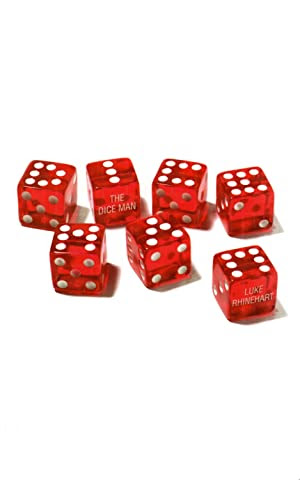
The Dice Man - Luke Rhinehart (1971)


Rating: Excellent

The Dice Man is perhaps one of the most famous cult novels of all time. By the time I was a teenager in the 1980s I'd heard of it, even though I knew no one who had actually read it. Just hearing about the concept was enough to get the imagination going. Now that I've finally read the novel I realise just how influential it was. I detect its influence on writers such as Chuck Palahniuk and Bret Easton Ellis, for example. Certainly the protagonist, also called Luke Rhinehart, reminds me of a toned down Patrick Bateman from American Psycho (1991). Although Rhinehart is not as an extreme a character as Bateman, he does appear to embody the disaffection and ennui at the heart of the middle-class professional in mid to late century America. The novel begins with Rhinehart despairing about his outwardly perfect life; with a wife, two children and a career as a notable psychiatrist (as was the author himself, geddit?). At this point the prose seems a touch self conscious and I was thinking that the novel was going to be an ordeal, however quite quickly, at the throw of a die, no less, it became fascinating, fun and outrageous. Rhinehart becomes a compelling character, one whom you want to follow down the 'liberating' path of putting the course of your life in the die's hands. The tone of the novel is one of revolutionary fervour, in keeping with the times it was written and published in, but it is also an irreverent ride into the sunset, not caring where it ends up.

The Dice Man is a touch dated, I can imagine that it would have been recommended by Playboy to its readers back in the day. One could argue that it is misogynous, as the female characters are usually willing to indulge sexually when Rhinehart is around, particularly when the roll of the die orders him to rape and pillage. It's certainly misanthropic, almost bitterly so at times. There's also increasing references to the 'The Book of the Die', as Rhinehart's notoriety increases and his adherents increase in number. The point the author is making about religion and cults appears obvious, that they are inherently absurd, as is human nature and existence it seems. Rhinehart doesn't hold back, but there's also plenty of humour, some of the funniest scenes are those that satirise psychiatrists and psychiatry itself. There's also some fantastic episodes involving mental patients that are disturbingly hilarious. The novel does become darker as it progresses and one wonders where it will end up. The answer is with two disturbing episodes and then a set-up for the sequel, which was a bit disappointing, but understandable. From what I've read Rhinehart diluted the impact of this novel with each sequel, but he's hardly the only one to fall into that trap. What fascinates me is that I've met several older people, some library patrons, who experimented with a die rolling lifestyle due to reading the novel, mostly with inconsequential results. I did hear about one instance in which a decision to engage in an affair due to the roll of a die blighted decades of a marriage. What a curious afterlife this novel has had. I recommend reading it not just because it is ultimetly a fine piece of writing, but also for its cultural significance.


Saturday, 18 September 2021

The Process - Brion Gysin (1969)


Rating: Not Rated

The Process is the first book in about fifteen years that I've abandoned. I have a fairly formal arrangement with my reading self to not abandon books I'm not enjoying, which in part probably stems from the discipline of reading for a book club, particularly as I facilitate the sessions. I lasted one hundred pages before I couldn't stand it any more. The problem? Mostly because I've read too many novels like this one, with narratives that are plotless, predominately picaresque in nature and full of flaneur type characters. I love the Beat writers, in particular the great Jack Kerouac, but Gysin, here at least, does not match Kerouac's flair, technical prowess and wide-eyed wonder at the world. Instead, the main protagonist, Ulys O. Hanson, sets out from Morocco to travel across the Sahara Desert, with no luggage save for a hefty bag of 'Keff' that he smokes continually in a pipe. Apparently Hanson meets with the famous Master Musicians of Jajouka and L. Ron Hubbard along the way, but I didn't get that far, worn down by Hanson's stoned wanderings and descriptions of the desert people, the landscape and the mystical trances those he allows to puff on his pipe go through. It's mildly engaging, but I couldn't get rid of an impatient itch inside me that grew until I couldn't stand it any more. I used the excuse of having to begin the next book club novel to bail.

Gysin and Burroughs with the Dreamachine

Brion Gysin (1916 - 1986) himself was quite an interesting character however, a friend of William S. Burroughs and inventor of the 'cut-up technique' of constructing narrative, of which Burroughs embraced wholeheartedly for a series of startling novels from the 1950's until his death in 1997. Gysin was predominately an artist, poet and performance artist and also inventor of the Dreamachine, a stroboscopic device that induced patterns of colour when viewed with eyes closed. Far out man. The Process is Gysin's main novel, with other publications mostly featuring poetry and short fiction, including The Third Mind (1978), co-authored with William Burroughs. Alas, such a pedigree of creative spirit and connections was not enough to propel me forward through to the end of The Process, so in fairness I'm not going to rate this book, only the second in the ten year history of this blog not to be rated. 


Monday, 27 July 2020

Querelle of Brest - Jean Genet (1947)


Rating: Excellent

I've long known about Jean Genet by reputation, but initially through Bowie's sneaky play on his name for the 1973 song The Jean Gene. I found a copy of Querelle of Best in WA's Mostly Books about five years ago when it was closing down. I was amazed at the time as it was the only Genet book I'd ever seen around. I didn't really know what to expect, but such was the quality of Genet's prose within the first few pages I felt more than willing to be be immersed in the seedy sailor world of Querelle. Ah yes, Querelle - a young sailor (matelot) full of raw sexual swagger, ranging about in the fog shrouded harbour town of Brest in the south-west of France. Querelle is somewhat of a sociopath, robbing, killing and taking advantage of those around him. He also just happens to be gay and most of the sex in this novel is of the homosexual kind; some of it is quite explicit, but some is merely implied. If Querelle of Brest were published today it would still be regarded as shocking, but not necessarily due to to the homosexual sex scenes (although they'd still shock some people, but then they wouldn't be reading Genet in the first place really), rather it would be for the extreme psychologies of Querelle and many of the other characters. There's not a great deal of love in this novel, rather human relations are presented as sadomasochistic and desperate. Coupled with Genet's unyieldingly rigorous prose style, this makes for compelling reading.

Genet was certainly a great writer, although style-wise barely any authors write with such florid and knowing prose any more. No doubt the likes of Bukowski would have hated Genet's style, being the opposite of his pared back existential prose. The novel flirts with postmodernism, with its slightly hyperreal tone, fragmented form (although subtly) and Genet's meta authorial interjections; even suggesting toward the end of the narrative that Querelle had being getting up to things that were unknown even to the author. Since finishing the novel I've read that one of Genet's main themes in his work over-all was the struggle for identity. Many of the characters in the novel, including Querelle himself, are in a state of psychological flux, and as such the homosexual elements throughout the novel are actually secondary to the exploration of the human psyche. However this would not stop many people from being perturbed by some of the scenes in the novel and I had to be a bit careful reading it on the train lest someone read over my shoulder, receiving an early morning shock to their conservative senses. Still, I'm sure Genet would have enjoyed the thought of one of his novels' still causing consternation seventy or so years after publication.


Friday, 30 August 2019

The Crying of Lot 49 - Thomas Pynchon (1966)

Rating: Admirable

Thomas Pynchon is perhaps the most famous cult author, not just because of his unorthodox work, but also because of his purported reclusiveness. Pynchon offers up a heady combination in the context of Western post-war culture where everything is viewed as being justifiably up for grabs. I'm kind of ashamed to admit it, but The Crying of Lot 49 is the first Pynchon novel I have ever read. I do have Gravity's Rainbow (1973) on my shelf, but opted for this novel because of its refreshing brevity. Unfortunately despite Pynchon's reputation I have been left underwhelmed and wondering whether the novel is a brilliantly complex post-modern puzzle or a now passe mundane indulgence (it is probably a bit of both). The novel's Wikipedia entry notes that The Crying of Lot 49 can be viewed as an example of post-modernism and perhaps also a satire of post-modernism itself, a technique that  ironically lies at the heart of post-modernism in any case. Reading the Wikipedia entry was, in some ways, more entertaining than the novel itself; perhaps this could become the new way to read novels, just read other people's interpretations, don't go to all the trouble of reading the actual novel itself, no need to ponder all the obscure cultural and historical references, the clever word-play and biting satire....

Sorry, what was I on about? Who knows - anyway, back to the review. The Crying Lot of 49's main protagonist, Oedipa Maas, is named as executor of the estate of a former lover and therefore becomes exposed to the supposed existence to an alternative postal service that goes back centuries - originating in Europe and still operating in a clandestine manner in 1960s California. The novel is brimming with unusual situations and strange characters, but despite this The Crying Lot of 49 was mostly mundane rather than intriguing. Perhaps it is due to an overexposure to post-modern techniques that really hit the mainstream in the 1990's in cinema and television in particular. In fact Pynchon himself appeared (well, his voice at least...) in The Simpsons as himself, satirizing his reputation as a weird recluse. Despite my mild disappointment the novel was worth reading and I did enjoy the satirizing of conspiracy theories in general, which I believe is the main theme of the novel; it was published three years after the assassination of Kennedy after all, which became one of the most prevalent conspiracy theories of them all. Sorry about the lukewarm review Mr Pynchon (if you ever read this...), but I promise I'll still get around to reading Gravity's Rainbow one day, or maybe I'll just read about it...

Sunday, 24 February 2019

Nightwood - Djuna Barnes (1936)

Rating: Admirable

Almost everything about Nightwood is beautiful, from the eloquent introduction by T.S. Eliot, the intensely baroque language and the special green Faber and Faber edition (as pictured above) that exudes style and class. The novel's content, however, is a different matter altogether. Nightwood's characters are tortured, dissolute and trapped in dysfunctional cycles of their own making. It is also a great example of prime modernist writing, the prose being opaque, elliptical, poetic (Eliot points out in his introduction that lovers of verse would get the most out of the novel), and the narrative is episodic in a fragmented way. It is a typical modernist novel in that the detail defies easy interpretation; especially when the transvestite doctor (during certain nights at least) Mathew O'Connor spouts endless monologues of lyrical but nonsensical opinion and advice to the tortured women involved in a love triangle - Robin Vote, Nora Flood and Jenny Petherbridge, and yet the overall meaning is apparent.*

The novel is known to be one the earliest significant examples of lesbian literature and for that alone it makes for fascinating reading, particularly as the novel is a known example of a roman à clef narrative from that period. However despite Nightwood's reputation and charms the novel did not make for a particularly enjoyable reading experience. Like many modernist narratives it would be best appreciated as part of a literature course at university where all the hidden meanings and arcane language can be teased out and understood. If read as a novel to casually enjoy feelings of tedium gradually creep up, making the short novel a challenge to complete. Nightwood is really frozen in time, like a beautiful leaf preserved in an old book. No one writes like the modernists any more and if they do it ironically seems quaint and out of place. I'm pleased to have finally gotten around to reading it, but it is unlikely that I'll be recommending it to others to read.

* If you must know I believe that the novel represents its characters as being slaves to their subconscious desires and such desires are animalistic, particularly when expressed during the 'wilds of the night', which then leads them to suffer and never find the happiness they desire.


Sunday, 14 October 2018

Solaris - Stanislaw Lem (1961)

Rating: Sublime

A year or so ago a close friend gifted me a copy of Solaris, telling me that it was among the greatest novels he'd ever read. His words were certainly true, Solaris is a brilliant science fiction novel, and is up there with the great novels from any literary genre. Lem's prose style is beautifully precise and absolutely compelling. It is certainly one of the most psychologically intense novels I have read, with the protagonists life aboard the station hovering above the theoretically sentient 'sea' on the planet of Solaris portrayed in claustrophobic detail. Lem presents a highly believable premise in which humanity grapples with the possibility of first contact and yet struggles pathetically to comprehend the 'sea' of Solaris and the 'visitors' that are generated from their own minds. 

Lem managed to both expose humanity's hubris and also create a presence that is truly alien. The 'sea' broils with creative intent, whilst the visitors torture the crew with their cruelly demanding presence. Solaris has inspired two feature films, one by the Soviet director Andrei Tarkovsky and more recently by Steven Soderbergh, both of which are satisfying in their own ways, but in my opinion neither came close to capturing the brilliance of Lem's novel.


Monday, 18 June 2018

One Three One - Julian Cope (2014)


Rating: Admirable

Julian Cope is one of the finest cult musical artists in the world and is certainly one of the most endearingly creative and eccentric. Cope can also definitely write, having produced perhaps the greatest rock autobiography in the form of the hilariously manic Head On (1994). Cope also has a fascination with Neolithic Europe and has produced scholarly tomes such as The Modern Antiquarian (1998) and The Megalithic European (2004), but is he also a successful novelist? The answer is, well, maybe? One Three One is, as they say, a mixed bag; featuring a rock star character called Rock Section, football hooligans, neolithic stone sites on the Italian island of Sardinia (where most of the novel is set), Paganism vs Christianity (the Christians are the bad guys...) time travel (back some 10, 000 years), a multitude of musical references and a series of fictional rave era bands that many of the secondary characters have a hand in. It's heady stuff and most of the time Cope's freewheeling narrative style keeps you interested, however sometimes I was just plain bored, or frustrated and perplexed, and sometimes I was totally enthralled. I veered between thinking I'd rate the novel as mediocre and other times as excellent; but ultimately One Three One is quite an achievement for an eccentric cult artist whose main gig is producing excellent music at a fairly prolific rate. Well done Mr Cope... 

Monday, 7 May 2018

Martian Time-Slip - Philip K. Dick (1964)


Rating: Admirable

I thought it was about time I read another P. K. Dick novel, because frankly I need that kind of thing in my life on occasions. Martian Time-Slip is a typical P. K. Dick novel in almost every way, featuring shifts in reality, characters with unusual mental abilities, time distortions and many of the 'every-man' characters who endure the weird situations that appear in his novels, including this one. Although Martian Time-Slip is not without its flaws, it is ultimately one of Dick's better novels from the 1960's. P. K. Dick was an utterly unique writer, combining disparate elements that other writers would only flirt with. Although many of the novel's characters are fairly one dimensional, perhaps even mundane, Dick portrays them in such an unusually direct manner that ultimately such shortcomings are transcended, something that also significantly adds to the novel's hyper-real tone. As usual P. K. Dick pays no attention to scientific practicalities, pretty much portraying life on Mars as if it was merely some strange desert region on Earth; but ultimately it doesn't matter, it's a Philip K. Dick novel after all...


Monday, 19 December 2016

The Drought - JG Ballard (1965)


It seems to be an unlikely conclusion to make, but perhaps the most interesting and significant section of The Drought are the two essays at the back of the book. One is by Ballard himself, entitled Cataclysms and Dooms (1977), in which he ruminates over the tradition of world cataclysms in literature. Here he states that “Psychiatric studies of the fantasies and dream life of the insane show that ideas of world destruction are latent in the unconscious mind.” The second essay is by British author Will Self, entitled The Ballard Tradition (2003), in which Self notes that “...Ballard has issued a series of bulletins on the modern world of almost unerring prescience.” Self goes on the conclude that “Indeed, the time has come to entertain the notion that one of the new seasons we are experiencing - dry spring, warm winter - should be named, simply, ‘Ballard’.”  During the post war period many of the possibilities offered up in science fiction have come to pass, from advanced computer driven technologies, medical breakthroughs, astronomical discoveries and most recently significant advances in the development of robotics and AI. Unfortunately the sad reality is that one of science fiction’s dominant tropes, a post apocalyptic world ruined by humanity’s short sighted hubris, is looking more and more likely to come to pass.

As Ballard himself noted, a novel such as The Drought does belong to the rich tradition of the cataclysmic, or post-apocalyptic novel. Human pollution results in the breaking the hydrologic cycle, creating successive years of drought, causing rivers to stop flowing and then civilization itself to collapse. Dr Charles Ransom, the novel’s principal protagonist is a typical Ballardian character, a brooding loner adrift in a situation in which he is more of an observer than an actor. An appropriate ensemble of eccentric and desperate characters surround him; Richard Lomax and his sister Miranda, wealthy eccentrics who exude a sophisticated kind of denial; Philip Jordan, denizen of a dying river; the brusque Reverend Johnstone, and Quilter, Lomax’s dwarf assistant. Rather than being a portrayal of a world-wide apocalyptic event, Ballard focuses the narrative on the lakeside town of Hamilton. As the drought progresses a sometimes surreal microcosm of civilization in decline plays out within the town. Fishermen hunt humans in the semi-deserted streets with nets, lions are let loose from the zoo, Quilter lurks in the half shadows and Ransom vacillates between leaving along with everyone else to the coast or staying with the Lomax siblings in their luxurious home whilst they blithely waste precious water keeping the lawns alive. Eventually Ransom does leave for the coast only to find the last vestige of civil order, in the form of the army, is attempting to keep the teeming hoards from leaving the mainland.

The Drought provides a timely reminder that from early in his career Ballard’s ability to explore human psychology under strain from unusual circumstances, and more significantly, under supposed normal circumstances, is one of his most enduring contributions to speculative fiction. It can be argued that The Drought stands as an early example of psycho-geography. Developed by Guy Debord, a French Marxist theorist, psycho-geography is “...the study of the precise laws and specific effects of the geographical environment, consciously or not, on the emotions and behavior of individuals.” Throughout the novel Ballard’s protagonists exist in a psychic limbo between the decay of humanity’s built environment and a natural environment rendered dysfunctional by human interference.

Although The Drought is a worthy read for Ballard fans, it is perhaps not a good place to start for novices. Often the novel seems unfocused, promising apocalyptic drama, only to have it resolve into a narrative plateau characterized by the psychological drift of Ransom. The writing is clunky at times and Ballard’s characteristically dry, almost emotionless tone is not yet fully formed, something that gives his subsequent work an almost unbearably pleasurable tautness. The novel’s endgame, although initially promising, passes by like a surreal dream during an afternoon nap on a hot day, leaving you feeling uneasy and then ultimately unsatisfied; as with most great and important artists and writers, the best was yet to come. The Drought makes up one part of a loose quartet of novels featuring cataclysmic natural phenomena; the others being The Wind from Nowhere (1961), The Drowned World (1962) and The Crystal World (1966), which is where things really start getting interesting. Meanwhile a good place to start for the curious will always be The Complete Collected Short Stories of J.G.Ballard (2009).

I’m not sure whether it was some kind of subconscious decision on my part, but I began reading The Drought during the last month of the US presidential campaign. I’m sure that Ballard, who died in 2009, would have been fascinated by the election and the manner in which it was conducted. The concept of a ‘post truth’ era and the osmotic bleed between the hyper-realism of both cyber and broadcast media and what passes for ‘reality’ these days would have stimulated him enormously. As his daughter noted recently in an essay for The Guardian, we are living in Ballard’s world now (with some Philip K Dick thrown in for good measure I believe...). Perhaps the most unerring and frightening aspect of this era is the retreat into the irrationality of conspiracy theories, in particular those of the climate change deniers, whose voices are nightmarishly becoming louder and louder. The conspiracy theorist displays a special kind of narcissism that allows a retreat into the safety of the ego, from where they can proselytise what they believe to be the ‘real truth’, a ‘truth’ that irrationally counters the carefully researched scientific conclusions of the majority. It makes them feel special and powerful, giving them an agency over the world that they would not otherwise have; I’d almost feel sorry for them if it wasn’t so horrifying. Significantly the climate change deniers only confirm Ballard’s theory that ideas of world destruction are innate within the human psyche (or, pointedly, just those of the insane?). Meanwhile as I watch in horror climate change deniers do all they can to protect and reassert the status quo that is ultimately only steering humanity toward an apocalyptic future of its own devising, I’m going to prepare myself further by reading Ballard’s The Drowned World.

Wednesday, 6 May 2015

Solar Lottery - Philip K. Dick (1955)


Rating: Admirable

The debut novel of any significant author is always a fascinating prospect, particularly after most of their later works have already been read. Solar Lottery reveals that Philip K. Dick arrived nearly fully formed, with many of his typical obsessive thematic threads featuring strongly.  Although Solar Lottery is certainly flawed and is not up there amongst his finest works, it still stands out due to Dick’s unique vision and writing style. When you read a Philip K. Dick novel you know that you are in for a weird time and Solar Lottery does not disappoint.

Solar Lottery is set hundreds of years in the future and humanity has colonised much of the solar system. This future solar civilisation is ruled by a person selected at random by a computer generated lottery to hold the title of Quizmaster. Although governed by the Quizmaster, society is dominated by powerful corporations and most humans survive by pledging allegiance to both corporations and individuals. Ted Benteley, a typical Dick everyman, is dismissed from a corporation he hates, allowing him to attempt to work for the current Quizmaster - Reese Verrick. He succeeds only to learn that Verrick has been usurped by Leon Cartwright. Cartwright is also the leader of a society that follows the theories of John Preston, who’s life’s work focused on finding the legendary outer planet known as Flame Disc. Dick’s typically paranoid and cynical version of future humanity also involves sanctioned assassination attempts on the new Quizmaster and the unfortunate Benteley becomes embroiled in Verrick’s attempt to assassinate Cartwright. The novel’s convoluted plot is a bit creaky in places, but Dick ultimately manages to pull off what seems like two short stories melded into one narrative.


Solar Lottery
features many of the tropes that would feature heavily in Philip K. Dick novels to come. Flying cars feature briefly, (but they don’t give unsolicited advice...), there’s controlling corporations, altered consciousness, telepaths, an android and ordinary people caught up in extraordinary events. Typically for a Philip K. Dick novel there is a lot going on for what’s only a short novel and at times the narrative pace is frantic. At this early stage Dick’s writing style features abrupt segues and some pretty unnatural dialogue, however inadvertently these stylistic flaws create a hyper-real tone to the narrative that’s in keeping with Dick’s obsession with replicated or altered reality. The novel does have a pulpy tone, but Dick’s ideas are, as usual, intriguing and weird; exploring deeper themes than the average action oriented pulp novel from that era. I wonder how readers would have reacted to this novel back in 1955?

Although future novels would be superior both stylistically and thematically, Solar Lottery is well worth reading for any Dick-head. Dick would go on to craft an extraordinary body of work that would prove to be both prescient and highly influential. Dick was a unique voice and it’s such a pity that his lifestyle choices (including over a decade of abuse of legally sourced amphetamines) led to an early demise in 1982. In keeping with Dick’s vision, perhaps one day we’ll have a replicant Philip K. Dick AI churning out new novels for our amazement. Now that’s something I’d like to see.

Sunday, 26 October 2014

Portions From a Wine Stained Notebook - Charles Bukowski (2008)


Rating: Admirable

So what do you do when you are feeling oppressed by nuns and sick to your stomach? Read some Bukowski, that’s what. It was a no brainer reaching for this, the first of two recent volumes of previously uncollected short pieces, including some from his infamous “Notes of a Dirty Old Man” columns and other rare Bukowski miscellany. Bukowski’s writing makes you feel better, it soothes the rough edges of life and gives you a smelly beer-soaked hug and a cuff around the ear for daring to have any pretences. Portions From a Wine Stained Notebook covers all the Bukowski bases, from musings over the stupidity and cruelty of humanity, to the greatness, or not, of other writers, drunkenness, perverted sex, John Fante, women, assorted lowlifes, tragedy, bathos and pathos - sometimes all at once. Although a fine Bukowski collection, it is not quite up to the standard of Absence of the Hero (2010) and some of the pieces are bordering on substandard for Bukowski. Still, it’s well worth a read for Bukowski enthusiasts; others should start with the immortal novels, Post Office (1971) and Women (1978).


Friday, 25 April 2014

I’m Still the Greatest Says Johnny Angelo - Nik Cohn (1967)


Rating: Excellent

Nik Cohn is a British music journalist and author of Awopbopaloobop Alopbamboom: The Golden Age of Rock (1970), which is considered to be one is the first serious works of rock journalism and is also included in David Bowie’s list of his hundred favourite books. I’m Still the Greatest Says Johnny Angelo is Cohn’s first published work and is the fantastic story of street urchin Johnny Angelo’s seduction by early rock ‘n’ roll. The novella is a wild fast paced allegory about the cultural impact of rock ‘n’ roll and in many ways perfectly captures the primal energy of rock music.

In the beginning Johnny Angelo is a typical unloved youth and from the age of four indulges in escapist behaviour, initially by dressing up in a red suit and parading back and forth, like a showman, on top of a wall. The adults are outraged, of course, and so begins his flight from the grimy reality of post-war Britain. By the age of six Johnny is a petty thief, stealing watches from the markets, and before the age of ten he meets a mysterious William Burroughs type character called the Doctor (no, not that Doctor). The Doctor becomes a mentor, spinning fantastic stories whilst grinning through yellow teeth. The Doctor also possesses a honeypot of crystals that ‘makes flowers blossom’ in his brain. Like much of the symbolism throughout the novella, the Doctor and his honeypot of crystals is partly self evident and partly nebulous.

Their unlikely friendship comes across as a changing of the generational guard and it is significant that the Doctor remarks to Johnny ‘Doesn’t truth get tiresome? When lies are so much fun.’ Such advice gives credence to the notion that this novella did indeed influence David Bowie, who only five years later would invent himself as a rock star in the form of alter-ego Ziggy Stardust. The novella is a rock ‘n’ roll fantasia, complete with bikes revving endlessly in the streets, the flowering of youthful rebellion, hero worship and street-wise fashion. Significantly by the age of fifteen Johnny both leaves home and hears and sees through a scopitone Little Richard singing Tutti Frutti. His mind is suitably blown. 


I’m Still the Greatest Says Johnny Angelo
manages to both capture the impact of early rock ‘n’ roll and to also predict its future. Johnny’s fuck you attitude, his gang of bikers and his posing finds Johnny rooted in the early rock ‘n’ roll moment, but his violently riotous live shows complete with wild animals (a metaphor for the energy of rock ‘n’ roll?) and freaky circus performers point toward the future of glam rock theatre and the nihilism of punk only nine years later. There’s an interview with Johnny that comes across like the infamous interviews Lou Reed gave in the 1970’s, full of casual deadpan distain. Johnny lives for the moment, the moment of danger and release that is the rock ’n’ roll concert. This is both his making, and true to rock ‘n’ roll mythos, his undoing as well.

I’m Still the Greatest Says Johnny Angelo also tells the story of the establishment’s knee jerk reaction to rock ‘n’ roll and how that contributed to the fatalistic hubris of rock stardom. Hounded by the establishment and holed up with his followers, Johnny’s endgame is one of futility and egotism. With amazing prescience Johnny’s story ends at the age of 27; that mythic and tragic age that would later claim Jimi Hendrix, Janis Joplin, Brian Jones and then Kurt Cobain decades later. My copy of the novella was published in 1970, tempting me to think that perhaps Cohn tinkered with Johnny’s age for the reissue, because by the end of that year Hendrix, Joplin and Jones were all dead. Either way I’m Still the Greatest Says Johnny Angelo is a recommended read for anyone interested in the rock ‘n’roll mythos and the evolution of rock writing in general. 

Tuesday, 15 October 2013

Infinite Jest – David Foster Wallace (1996)


Rating: Sublime

Infinite Jest is perhaps the most significant cult novel of the last twenty years. It has also been a critical success, with Time Magazine listing it as one of the hundred greatest novels since 1923. Viewed as a prime example of so called hysterical realism, Infinite Jest is a challenging monster of a book. It’s undoubtably important, intelligent, and brilliant; but it’s also obtuse, arcane, extreme, digressive, frustrating and unrelentingly verbose. The page count, including the endnotes, clocks in at 1079 pages, however the font is tiny, so really the book would be the equivalent of about 1800 standard font pages. Infinite Jest is not your typical reading experience, it’s more like embarking on a relationship; you have to work hard at it and it can be both a satisfying and difficult experience. 

Infinite Jest has three narrative streams that eventually converge (and I really mean eventually). The first involves the Incandenza family – Hal, Mario and Orin are the sons of Avril (The Moms) and James Incandenza (Himself), who founded the Enfield Tennis Academy in Boston. James Incandenza, an amateur auteur, is the creator of the film Infinite Jest (alternately referred to as The Entertainment), which is fatally addictive. A significant portion of Infinite Jest is set at the tennis academy and it is perhaps the most impenetrable of the three streams. Tennis related argot is used extensively and there are sequences that are extremely digressive and obscure, not that this isn’t typical of the novel as a whole. 

The second stream, which is set in a nearby drug and alcohol recovery centre called Ennet House, is perhaps the most accessible. The colourful characters who inhabit Ennet House are arguably more relatable than the ones who populate the tennis academy. The Ennet House sections are particularly tragicomic and endlessly inventive. Wallace riffs on the pathos of addiction, whilst revealing characters back stories in uncomfortable detail. The Ennet House denizens are great fodder for Wallace’s totally devastating satire on the dark side of Western culture’s obsession with instant gratification. 

The third and perhaps most bizarre stream features the Les Assassins des Fauteuils Rollents (A.F.R.) or The Wheelchair Assassins, a French Canadian separatist group who wish to obtain a master copy of Infinite Jest to use as a weapon. This quest to find Infinite Jest binds together the three streams. As the novel progresses they become more involved, including a brilliant sequence in which they raid a shop and search it for the master copy of Infinite Jest; with some of them climbing the walls using suction cups on their stumps, which typically for Infinite Jest is both disturbing and hilarious simultaneously.


Infinite Jest
is an utterly original novel and Wallace’s singular style makes a virtue of extreme detail and digression. Wallace’s style is so densely rendered that initially it can be almost impenetrable, requiring great commitment and concentration on behalf of the reader. The narrative form is fragmented across both time and place and characters or events that initially appear to be minor end up being important elsewhere. A throwaway comment by a character or a few sentences in a random paragraph often act as vectors towards understanding the overall plot arc. Unusually for a work of fiction there are over three hundred endnotes (some with their own footnotes), many of which are pages long and are of particular importance to understanding the novel. To read Infinite Jest requires that the reader push beyond their standard passive reading paradigm and actively engage with the novel on its own terms. 

Like the fatal film itself, Infinite Jest is addictive. After a while I realised that I was beginning to think in the style of Wallace’s writing in my everyday life, which fortunately was not such a bad thing. Once you adjust to the digressions, complexity and the multitude of characters the novel becomes a total pleasure to read. The highlights are manifold, such as Mario’s first and only romantic encounter (Mario is a macrocephalic), Hal’s visit to a supposed marijuana addicts recovery group session, Ennet House resident Lenz’s sick nocturnal habits and his drug addled raves; what transpires when Hal comes home and enjoys the smell of dinner cooking, and the tragicomic account of a man’s addiction to watching M.A.S.H that takes him over the edge. 

Towards the end stalwart Ennet House resident Don Gately’s past, present and future becomes entangled in the metaphysical meaning behind what is on the Infinite Jest film. Yes, you do find out what is on the film and it is totally satisfying both metaphysically and intellectually. It is not merely a throwaway plot device and makes perfect sense when the principle reasons behind many of the characters problems with addiction are considered and then applied to the population in general. Most of them have an emotional void created during childhood that they are desperately trying to fill. There is a satisfying existential depth to Infinite Jest that Wallace has pulled off with aplomb. 

Infinite Jest manages to be everything you would want from a great novel, brilliantly realised ideas, intellectually satisfying, mysterious, multilayered and most importantly, profound in its humanity. Wallace himself suffered both from depression and drug addiction (he also played tennis) and to know his story helps to understand where Infinite Jest is coming from. The novel is this era’s Ulysses (James Joyce, 1922) and will keep academics and university students busy for decades to come. One last word of advice, to understand how the plot resolves you will need to pay particular attention to the beginning, which is set during a time after the narrative finishes. Another option is to submit to the pull of addiction and read Infinite Jest again and again and again.....


Lead Image:Jonathan Franzan and David Foster Wallace 1996 at the launch of Infinite Jest (Photo by Marina Garnier)

Friday, 5 April 2013

Infinite Jest – David Foster Wallace (1996)


The ABC’s First Tuesday Book Club was televised, funnily enough, last Tuesday, and they ended by revealing that they would read and talk about Infinite Jest in next month’s show. I inwardly groaned because so far this book has defeated me. I bought it a few years back and initially I enjoyed both the style and the premise, but then I became bogged down and finally halted completely. I’m languishing on page 420, half way through 30 April / 1 May Year of the Depend Adult Undergarment (this will make sense if you try and read it).

The late David Foster Wallace was an adherent of the so-called hysterical realism style, which basically involves over the top prose that is all encompassing in its attention to detail regarding plot, characters and the minutia of the everyday and the not so everyday. Basically you are up for pages and pages of detail spent on one issue or subject, during which any number of tangents is not nearly enough. Well, this is my interpretation anyway.

The premise is suitably intriguing, complex and amazing. Infinite Jest is party focused on teenage tennis players at a sport-focused American college and partly on the patients at a drug rehab centre. It also involves a video that is so entertaining that the people watching it will starve to death and defecate where they sit rather than stop watching. Oh and it also seems to be set either in the near future or in an alternative present, I can’t quite work out which.

So the question is - should I attempt to finish this book that is sometimes tedious and sometimes brilliant? Has anyone else had the same problem? Or is Infinite Jest a work of genius and I’m simply not up to its challenges? I know from briefly researching the book online that it undoubtedly has its admirers and that it is perhaps the ultimate cult book of our times. This is all very well, but I still can’t get enthused about finishing it. Perhaps I should just get on with it; after all, I kind of want to know what’s on that videotape.


Monday, 3 December 2012

White Noise – Don DeLillo (1985)


Rating: Sublime

Was it a coincidence that I had to abandon reading Pox, a book about syphilis and how it influenced certain historical figures, at the chapter about Hitler so I could begin White Noise in time for my book club? Most likely, but somehow I couldn’t shake the feeling that it was significant that White Noise’s protagonist - Jack Gadney, happened to be a professor of Hitler studies. It was also just the kind of trivial coincidence that is elevated to profound significance throughout the novel. Jack and his academic colleague - Murray, would have been suitably impressed and pondered its meaning over many paragraphs.

DeLillo is considered to be a significant postmodern novelist, and White Noise is his most postmodern novel. The book touches on almost every significant postmodern concept available to literature and this is undoubtedly the key to understanding the novel. White Noise utilises meta concepts, hyperreality, irony, parody, deconstruction, media saturation, cultural fragmentation and the nefarious influence of high capitalism on culture. The novel could also very well be a parody of postmodernism itself (I strongly suspect that this is the case). White Noise is also an extremely funny book and perhaps a bit too clever for its own good, which in this case is a good thing. Perhaps it is pretentious, but personally I love a good dose of pretension.

The Gadney clan sits at the centre of the narrative, a fragmented family of children from three or more different marriages. The children are, for much of the time, more adult than Jack and his blonde bombshell wife - Babette. Their son - Heinrich, is a fast-talking deconstructionist who argues with Jack about whether the rain outside the car actually exists, particularly if the radio has stated that it wasn’t going to rain. DeLillo uses the Gladney family as a means to explore both the decline of the traditional family unit and the lack of certainty that comes with it. Jack Gladney neurotically searches for meaning in a modern world in which meaning is constantly shifting.

In the first of three titled sections - Waves and Radiation, Jack discovers that Babette is secretly taking a mysterious drug. Both Jack and Babette also suffer from a profound fear of death. The adult Gadneys are obsessed with death and the many new ways of dying that the modern world has manifested all around them. They argue over who will not cope the most if the other dies, but meanwhile they take great pleasure in watching disaster footage on television, totally divorced from the reality of what they are witnessing.

Hyperreality, in which simulations of reality are mistaken for the real thing, is a concept that dominates White Noise. Babette reads absurd pulp magazine articles to the blind and no one questions their validity. In the second section - The Air-Born Toxic Event, the disaster management organisation called SIMUVAC regards the real disaster merely as good preparation for the future simulations they plan. When they do carry out a successful disaster simulation that features noxious gas, there is an actual noxious gas cloud the very next day, but no one responds because it doesn’t seem real.

The dubious truths presented by the media also feature prominently, with Babette’s addiction to talkback radio and the frequent non-sequitur interactions from the TV that masquerade as mystical messages.  Murray only seems to talk in theories, deconstructing the world whilst also negating it with his hyperreal academic argot. Murray is also obsessed with the plain packaging isle at the supermarket, which are hyperreal versions of ‘real’ food. In many ways Murray is the most significant character in White Noise – he is a bullshit artist and genuine at the same time, like a personification of postmodernism.


Perhaps the most entertaining aspect of White Noise
is the parody of academia. Jack is the professor of Hitler studies, but can’t speak German. Murray is trying to establish himself as professor of Elvis studies. The meaning of “Hitler’s achievements” (as Jack un-ironically states) is subverted into meaningless pop academia in a superb scene in which Jack trades off comparisons between the two figures with Murray in a lecture that ends with the two being mobbed by the students, as if they themselves were rock stars. Jack’s fellow academics also argue frequently about trivial cultural experiences and act like petulant teenagers, rather than serious academics.

There is so much crammed into this amazing book that a lengthy essay is needed just to begin to address its significance. DeLillo playfully parodies academia, but at the same time he wrote the perfect book to be studied by English Literature students. This is how I first came to read White Noise and now having read it for the third time I remain just as impressed. If you decide to read White Noise you’ll find out what Dylar is, why Jack and Babette covert baby Wilder’s company, the significance of atheist nuns and why it’s always a good idea to have a full tank of fuel in the car in case of air-born toxic events. Out of all the DeLillo novels I’ve read, White Noise is his most fully realised. If you read just one DeLillo novel, make it this one.