Showing posts with label Postmoderism. Show all posts

Sunday, 20 April 2025

Money: A Suicide Note - Martin Amis (1984)


Rating: Sublime

Money is acknowledged as the beginning of a run of brilliant Amis novels that represents his imperial period, that continued with London Fields (1989), the booker Prize shortlisted Time's Arrow (1991) and ending with The Information in 1995. Narrated in first person by main protagonist John Self, the novel follows his trashy, decadent life as he moves back and forth between London and New York while attempting to get a film project off the ground based on an idea drawn from his own life. Money was inspired by Amis' involvement with the screenplay for a stinker of a film called Saturn 3 (1980), starring Kirk Douglas and Farrah Fawcett, which I actually managed to watch last year; it's a truly terrible, yet fascinating folly. One of the characters in Money is based on Kirk Douglas, the fantastically named Lorne Guyland, who is a total prima donna, fretting about getting enough sex scenes with the young leading lady and often ending up naked whilst having long rambling narcissistic conversations with Self. Everything around the supposed film, variously called 'Good Money', then 'Bad Money', is satirically brilliant, from the exorbitant excesses undertaken by Self and his partner Fielding Goodney in the name of tax breaks on expenses, to the actors themselves, including Spunk Davis (who is outraged when he finds out what his surname means in England), Caduta Massi and Butch Beausoleil, two leading ladies with their own neurotic impulses. Of course Amis takes things much further by inserting himself into the novel, not just once, but many times, and as a writer for hire no less, a fixer for the screenplay that Self is distinctly unhappy with. There's even some discussion from Amis (the character) about the nature of the relationship between author and protagonist which is just brilliant. It's the best example of author as character I've ever read. Apparently Kingsley Amis threw his copy of the book across the room, never to be read again, when he reached the part that includes Martin, talk about generational envy.

Amis, contemplating the nature of the self

John Self (who is based on John Barry, the director of Saturn 3) is one of the great anti-hero protagonists, a total hedonistic slob who careers throughout the novel consuming vast amounts of alcohol, drugs, fast food and porn, whilst coming onto any and all women in his vicinity. Amis described Money as a voice novel, rather than a plot driven narrative. Fortunately Self is such a vivid and charismatic character that you can't help but get swept up into his world of dubious logic and decadent self-sabotage. Self's narration of his follies and adventures is unrelentingly hilarious and tragic. It is a difficult thing to write a funny novel, but Money is the funniest I've ever read. It is undoubtably a masterpiece of literary comedy. Money is also exceedingly clever, not just for its biting satirical themes around the film industry, wealth and class, but also for the above mentioned post-modern metafictional techniques. The keys to unlock the novel's multi-layered narrative is the game of tennis played between Goodney and Self in the first third of the novel (Self is literally being played) and the game of chess toward the end between Amis and Self, in which Self thinks that he is winning, before he's brutally taken down by Amis. The relationship between author and protagonist is revealed for what it is, sinister manipulation. The epilogue, printed in italics, appears to be Self free from authorial manipulation, his own 'self', down and out, but with a new found freedom. Essentially Money is a must read novel, a work of genius, with mercilessly satirical prose and irrepressible humour. It certainly was a huge step up from the otherwise excellent Other People (1981) which proceeded Money. Martin Amis, despite John Self's poor opinion of his work and lifestyle, was definitely a genius level novelist. 

Saturday, 22 March 2025

Leviathan - Paul Auster (1992)


Rating: Excellent

I'd long wanted to read a Paul Auster novel, having seen his books on shelves for many years, without really knowing that much about him, other than he seemed to be a typical 'New York' writer. That phrase could be taken as a compliment, or a put down, in Autser's case it's definitely a compliment, as Leviathan is a cut above the typical narratives about kooky New Yorkers getting into scrapes. The critical opinion of Auster is that he was a significant post-modern author, using multilayered narratives, and typically exploring themes of identity, chance, the nature of truth and identity. His childhood directly influenced his writing, having witnessed a lightening strike that killed a teenager while they were on a school camp, Auster became obsessed with the role of chance in life. Leviathan explores chance through the lives of various characters, most notably the friends, Peter Aaron and Benjamin Sachs, who are both writers (Auster's protagonists are typically writers apparently). Chance events and chance meetings with other characters drives Sachs to take some radical directions in his life, all told from the perspective of the narrator, his friend Aaron. Sachs struggles with self-worth and the nature of purpose, and being a novelist ends up being viewed by him as a trite manner in which to engage with the world, instead Sachs takes a more radical path. Sachs' journey is compelling, maddening and, ultimately, tragic. 

Auster, contemplating the nature of chance

Auster's writing is dense, layered and full of tension and mystery, which makes for compelling reading. This novel really gets under your skin, you begin to live it. The unravelling of the mystery of just how Sachs ends up at the point of his ultimate fate is engaging and fascinating. Auster could really write believable and complex characters, including the female characters, such as Sachs wife, Fanny, who is also a romantic interest for Aaron. Another brilliant female character is Maria Turner, a photographer who is based on French conceptual artist, Sophie Calle. Turner is the fulcrum around which the other characters move through the complex plot, in particular Sachs, who is strongly influenced by Turner's experiments with art, chance and lifestyle. Aaron's narrative voice draws in the reader, like a story-teller around a camp fire, you want to stay with him and be pulled further into the story (or even the fire). The plotting is circular in nature, with Sachs' fate revealed at the beginning, and the path that led him there is then fleshed out by Aaron's musings and investigations. It's like a detective story with political and cultural leanings, piecing together fragments of the complex life of Sachs and his search for meaning within the context of America and its place in the world. The novel's title is a direct reference to Thomas Hobbes exploration of society and the nature of government, Leviathan (1651); some familiarity with its themes would help decipher Auster's Leviathan, although it's not essential. Appropriately the novel begins with a dedication to DonDello, one of the twentieth century's greatest writers, who is also another 'New York' writer who transcends that label. Auster and DeLillo were friends, but on the evidence of this novel, they were certainly also equals. It's such a pity that Auster passed away in 2024, but at least there's his rich body of work, of which I'll be reading more of in the coming years, and so should you.

Sunday, 23 June 2024

In the Approaches - Nicola Barker (2014)


Rating: Excellent

First of all, In the Approaches is a very strange novel. Secondly, only an English author could write such a novel. In the Approaches is a multifaceted beast, a romantic comedy, of sorts, a surreal tale of eccentric characters being very odd in the English country-side in the 1980s, a metafictional narrative, a rumination on faith and, also, terribly chaffed and inflamed buttocks (yes, you read that correctly). The narrative unfolds in alternating first person chapters, mostly swinging between the two main protagonists, Franklin D. Huff and Carla Hahn. Hahn is a resident of the sea-side village of Pett Level in the UK and Huff is a visitor, on a quest to try and discover what happened many years prior when his wife lived and worked there, before she was horrifically burnt in a bomb blast. Stylistically it is a difficult novel to get used to, Barker loves to leave sentences unfinished, the thoughts of the characters are left there hanging as they try and make sense of the situation and how they feel about it all. She also loves parentheses (apparently this is a hallmark of Barker's writing), so much so it is made fun of throughout the novel, particularly by one of the minor characters, Clifford Bickerton. Bickerton is a thoroughly post-modern character, complaining about having to be part of the story, raging against the author (referred to as 'she') and undergoing an existential crisis due to his self awareness about just being a minor character in a novel. At one point printed words stream out of his mouth as he has a breakdown, trying to deal with the awfulness of it all. It is, in actual fact, all quite entertaining.

Once I got used to Barker's idiosyncratic style and settled into the characters and the story-arc, In the Approaches shaped up to be a satisfying read. The characters are potentially irritating, in particular Franklin D. Huff, but Barker manages to make them endearing and their continued perplexed state of being becomes a plus, rather than a minus. Just how Barker manages to do this is somewhat of a mystery, as the seperate ingredients seem like a recipe for irritation, rather than satisfaction. Perhaps it's Carla Hahn's propensity to continually flick her hair behind her ear with her hand, or her tendency to take no heed of feminine gender norms. Perhaps it's the chapters entirely given over to a parrot called Baldo (or is that Teobaldo?) who shrieks and scratches its way through what seem like entirely too long chapters (yet somehow, in the end this works). Or perhaps it's the mystery of the thalidomide child, Orla, who became saint-like in her obsession with Christianity before her death and who went on to influence proceedings in gnostic ways that perplex many of the characters who inhabit In the Approaches. Perhaps it is the romantic pull and push between Huff and Hahn, which involves a dead and rotting shark under a bed, a tiny sauna perched on a clifftop about to fall into the sea, and the strange smell of eucalyptus that surrounds them both. Intrigued? Then maybe this is the novel for you. The novel's denouement is oblique and perhaps a tad disappointing because of it, but then Barker is not a typical author prone to cliches used to wrap things up neatly, after all, the novel is aptly named, as in the end, the reader, like the characters who populate the novel, is also trapped in the approaches. 

Tuesday, 29 November 2022

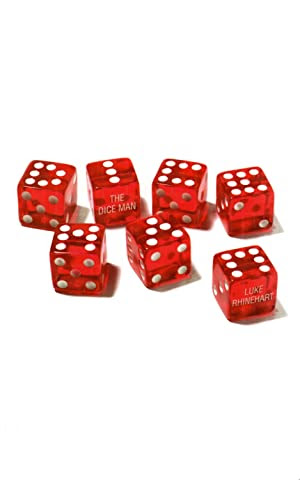
The Dice Man - Luke Rhinehart (1971)


Rating: Excellent

The Dice Man is perhaps one of the most famous cult novels of all time. By the time I was a teenager in the 1980s I'd heard of it, even though I knew no one who had actually read it. Just hearing about the concept was enough to get the imagination going. Now that I've finally read the novel I realise just how influential it was. I detect its influence on writers such as Chuck Palahniuk and Bret Easton Ellis, for example. Certainly the protagonist, also called Luke Rhinehart, reminds me of a toned down Patrick Bateman from American Psycho (1991). Although Rhinehart is not as an extreme a character as Bateman, he does appear to embody the disaffection and ennui at the heart of the middle-class professional in mid to late century America. The novel begins with Rhinehart despairing about his outwardly perfect life; with a wife, two children and a career as a notable psychiatrist (as was the author himself, geddit?). At this point the prose seems a touch self conscious and I was thinking that the novel was going to be an ordeal, however quite quickly, at the throw of a die, no less, it became fascinating, fun and outrageous. Rhinehart becomes a compelling character, one whom you want to follow down the 'liberating' path of putting the course of your life in the die's hands. The tone of the novel is one of revolutionary fervour, in keeping with the times it was written and published in, but it is also an irreverent ride into the sunset, not caring where it ends up.

The Dice Man is a touch dated, I can imagine that it would have been recommended by Playboy to its readers back in the day. One could argue that it is misogynous, as the female characters are usually willing to indulge sexually when Rhinehart is around, particularly when the roll of the die orders him to rape and pillage. It's certainly misanthropic, almost bitterly so at times. There's also increasing references to the 'The Book of the Die', as Rhinehart's notoriety increases and his adherents increase in number. The point the author is making about religion and cults appears obvious, that they are inherently absurd, as is human nature and existence it seems. Rhinehart doesn't hold back, but there's also plenty of humour, some of the funniest scenes are those that satirise psychiatrists and psychiatry itself. There's also some fantastic episodes involving mental patients that are disturbingly hilarious. The novel does become darker as it progresses and one wonders where it will end up. The answer is with two disturbing episodes and then a set-up for the sequel, which was a bit disappointing, but understandable. From what I've read Rhinehart diluted the impact of this novel with each sequel, but he's hardly the only one to fall into that trap. What fascinates me is that I've met several older people, some library patrons, who experimented with a die rolling lifestyle due to reading the novel, mostly with inconsequential results. I did hear about one instance in which a decision to engage in an affair due to the roll of a die blighted decades of a marriage. What a curious afterlife this novel has had. I recommend reading it not just because it is ultimetly a fine piece of writing, but also for its cultural significance.


Sunday, 30 August 2020

The Man Who Saw Everything - Deborah Levy (2019)


Rating: Mediocre

The Man Who Saw Everything is a novel in two parts. I quite enjoyed the first part, but unfortunately my level of interest completely fell away during the second half. The novel concerns Saul Adler, a very good looking young man who is hit by a car having his photo taken by his artistic girlfriend at the famous Abbey Rd crossing in 1988. His girlfriend then breaks up with him just before he embarks on a trip to East Berlin to undertake research, where he becomes romantically entangled in the lives of a brother and sister who are compromised by life in the Eastern Block. The first section is told from Adler's point of view, however during the second half of the novel you come to understand that his self perception and his perception of those around him is significantly lacking. Adler is again hit by a car at Abbey Rd (or is it the first and only time? I have my suspicions...) in 2016 at age 56. He is badly hurt and spends the second half of the novel in a hospital bed being visited by people from his past, while ruminating over his life in an opiated haze.

The Man Who Saw Everything is an ironic title, as Adler does not see himself as others see him and Levy uses this as a means to explore the notion that life, perception, and history itself is fragmented and unreliable. An argument could be made that the the novel is quite clever in its exploration of such themes (it's a divisive novel, with a portion of my book club members loving it - the others were totally dismissive), however both Adler and the narrative failed to hold my interest and I became totally indifferent to its (actually limited) charms. Adler is not a particularly likeable character, he is obviously both damaged and narcissistic, which is fine, as I often enjoy antiheroes, but coupled with the fact that the narrative becomes so diffuse and opaque, there is very little motivation to spend the time to work out what is actually going on. While I was still writing this review I began reading the Christos Tsiolkas novel Damascus (2019) and the difference between the two novels made me realise that post-modernism is totally dead. Tsiolkas' brutally straight-forward writing style was incredibly refreshing and dynamic compared to the oblique exploration of the subjectivity of reality in The Man Who Saw Everything

Monday, 27 July 2020

Querelle of Brest - Jean Genet (1947)


Rating: Excellent

I've long known about Jean Genet by reputation, but initially through Bowie's sneaky play on his name for the 1973 song The Jean Gene. I found a copy of Querelle of Best in WA's Mostly Books about five years ago when it was closing down. I was amazed at the time as it was the only Genet book I'd ever seen around. I didn't really know what to expect, but such was the quality of Genet's prose within the first few pages I felt more than willing to be be immersed in the seedy sailor world of Querelle. Ah yes, Querelle - a young sailor (matelot) full of raw sexual swagger, ranging about in the fog shrouded harbour town of Brest in the south-west of France. Querelle is somewhat of a sociopath, robbing, killing and taking advantage of those around him. He also just happens to be gay and most of the sex in this novel is of the homosexual kind; some of it is quite explicit, but some is merely implied. If Querelle of Brest were published today it would still be regarded as shocking, but not necessarily due to to the homosexual sex scenes (although they'd still shock some people, but then they wouldn't be reading Genet in the first place really), rather it would be for the extreme psychologies of Querelle and many of the other characters. There's not a great deal of love in this novel, rather human relations are presented as sadomasochistic and desperate. Coupled with Genet's unyieldingly rigorous prose style, this makes for compelling reading.

Genet was certainly a great writer, although style-wise barely any authors write with such florid and knowing prose any more. No doubt the likes of Bukowski would have hated Genet's style, being the opposite of his pared back existential prose. The novel flirts with postmodernism, with its slightly hyperreal tone, fragmented form (although subtly) and Genet's meta authorial interjections; even suggesting toward the end of the narrative that Querelle had being getting up to things that were unknown even to the author. Since finishing the novel I've read that one of Genet's main themes in his work over-all was the struggle for identity. Many of the characters in the novel, including Querelle himself, are in a state of psychological flux, and as such the homosexual elements throughout the novel are actually secondary to the exploration of the human psyche. However this would not stop many people from being perturbed by some of the scenes in the novel and I had to be a bit careful reading it on the train lest someone read over my shoulder, receiving an early morning shock to their conservative senses. Still, I'm sure Genet would have enjoyed the thought of one of his novels' still causing consternation seventy or so years after publication.


Sunday, 3 May 2020

Running Dog - Don DeLillo (1978)

Rating: Excellent

Don DeLillo is one of my all time favourite novelists and I have deliberately not rushed to read all of his novels so that I can always have some lurking there waiting for when I feel that certain itch to immerse myself in his unique narrative style. DeLillo wrote two of the great post-modernist novels, one could even call them guidebooks to post-modernist thought - White Noise (1985) and Underworld (1997). Running Dog does not scale the lofty heights of those two novels, but it does deliver enough intellectual DeLillo thrills to illicit a certain literary smug satisfaction. Running Dog features a typical DeLillo premise: various shady factions maneuvering to get their hands on a film that purports to contain footage of Nazi's getting up to carnal naughtiness in the last days in Hitler's bunker as the Soviets creep ever closer. DeLillo pulls the reader into this circle of lust over the film, making you want to see and know just as much as the next nefarious 'businessman'.

Typically for a DeLillo novel Running Dog has an ensemble cast of characters, rather than one main protagonist leading the way. This is certainly not a weakness due to DeLillo's ability to bring alive the psychological core of a character in a just a few lines - "He appeared younger than twenty-two, looking a little like a teenager with a nervous disability. High forehead, prominent cheekbones, large teeth. He seemed intense, over-committed to something, his voice keening out of a lean bony face..." Coupled with DeLillo's dialogue, which is stripped down, yet bursting with a deeper complexity, irony and a rhetorical self awareness, the novel can't help but to delight. I burst out laughing a number of times, including after the very last line, which is a difficult thing for a novelist to achieve. Even more effective is the realisation that if the premise of the existence of an amateur Nazi porn film wasn't disturbing enough, the reality of what actually is on the film has its own subtly disturbing implications. I thoroughly enjoyed Running Dog at a time when I really needed something to take me away from our current reality, which, as we all know, has its own disturbing implications. I have no doubt that DeLillo will be one of those authors who pen a post-plague novel in the tradition of many great novelists.


Friday, 30 August 2019

The Crying of Lot 49 - Thomas Pynchon (1966)

Rating: Admirable

Thomas Pynchon is perhaps the most famous cult author, not just because of his unorthodox work, but also because of his purported reclusiveness. Pynchon offers up a heady combination in the context of Western post-war culture where everything is viewed as being justifiably up for grabs. I'm kind of ashamed to admit it, but The Crying of Lot 49 is the first Pynchon novel I have ever read. I do have Gravity's Rainbow (1973) on my shelf, but opted for this novel because of its refreshing brevity. Unfortunately despite Pynchon's reputation I have been left underwhelmed and wondering whether the novel is a brilliantly complex post-modern puzzle or a now passe mundane indulgence (it is probably a bit of both). The novel's Wikipedia entry notes that The Crying of Lot 49 can be viewed as an example of post-modernism and perhaps also a satire of post-modernism itself, a technique that  ironically lies at the heart of post-modernism in any case. Reading the Wikipedia entry was, in some ways, more entertaining than the novel itself; perhaps this could become the new way to read novels, just read other people's interpretations, don't go to all the trouble of reading the actual novel itself, no need to ponder all the obscure cultural and historical references, the clever word-play and biting satire....

Sorry, what was I on about? Who knows - anyway, back to the review. The Crying Lot of 49's main protagonist, Oedipa Maas, is named as executor of the estate of a former lover and therefore becomes exposed to the supposed existence to an alternative postal service that goes back centuries - originating in Europe and still operating in a clandestine manner in 1960s California. The novel is brimming with unusual situations and strange characters, but despite this The Crying Lot of 49 was mostly mundane rather than intriguing. Perhaps it is due to an overexposure to post-modern techniques that really hit the mainstream in the 1990's in cinema and television in particular. In fact Pynchon himself appeared (well, his voice at least...) in The Simpsons as himself, satirizing his reputation as a weird recluse. Despite my mild disappointment the novel was worth reading and I did enjoy the satirizing of conspiracy theories in general, which I believe is the main theme of the novel; it was published three years after the assassination of Kennedy after all, which became one of the most prevalent conspiracy theories of them all. Sorry about the lukewarm review Mr Pynchon (if you ever read this...), but I promise I'll still get around to reading Gravity's Rainbow one day, or maybe I'll just read about it...

Monday, 17 June 2019

Asymmetry - Lisa Halliday (2018)

Rating: Excellent

There's a scene right at the end of David Bowie's twenty minute video Jazzin' for Blue Jean (1984) where Bowie's rock star character, Screaming Lord Byron, leaves with Bowie's every-man character's female interest (Bowie plays both characters). Every-man Bowie engages in a tirade against the retreating rock star and then breaks character and talks to the director (Julian Temple) and production crew about how the scene should be re-shot. Bowie and Temple then argue about the merits of being 'clever clever'. Asymmetry is just like Bowie and Temple's postmodern take on the music video; it is 'clever clever' and perhaps a bit too clever for its own good. It also uses most of the typical postmodern techniques that have become all too familiar and therefore a bit stale. The novel is arranged into three seemingly disparate sections - Folly, Madness and Desert Island Discs, yet they are connected by a series of clues. There are innumerable allusions to writers and novels and the female protagonist in Folly is called Alice and she does indeed descend down the rabbit hole into a relationship with a much older man, a writer called Blazer, whom is based on Philip Roth, whom Halliday had a relationship with when she was in her twenties. I could go on...(but I only write two paragraphs these days...)

I completed Asymmetry with feelings of ambivalence, cynicism even; however I had to admit to myself in the end that the novel was quite an achievement. The writing is tightly focused, littered with beautiful imagery and manages to be both playful and profound, in particular during the middle section written from the perspective of Amar, an Iraqi/American citizen held for questioning at Heathrow airport in the early 1990s. Amar's character is nicely rounded, but more significantly he becomes a mouth-piece that enables Halliday to talk about political issues whilst at the same time acknowledging how talking about political issues in literature is fraught with pointlessness and pomposity - now that's clever clever. Halliday manages to pack a lot of thematic juice into what is a refreshingly short novel. She covers relationships, aging, the anxiety of influence, the role of literature in culture and the existential difficulty of finding a meaningful path through life. Asymmetry may annoy you, frustrate you, but in the end it's worth the effort and indicates that just maybe there is life left in postmodernism after all.

Monday, 5 September 2016

The Age of Reinvention - Karine Tuil (2013, 2015 English translation)


With the publication of The Age of Reinvention French author Karine Tuil has added to the vast pile of literature that has been directly influenced by 911 and the West’s endless war on terror. The attack on the twin towers, the wars and the terrorism that have followed have had such a profound impact on culture that perhaps it is finally time to view this period as being apart from the Post-Modern era that developed since WWII. Coupled with the absolute reach of the World Wide Web and a myriad of other technological innovations surely cultural theorists can be inspired to come up with something, or are the stylistic tropes of Post Modernism really the last word in examining the current predicaments humanity finds itself in? (actually, the way forward lies in science fiction, but that’s just my opinion...) The Age of Reinvention does not offer anything new stylistically, but it does, depending on what you want from a novel, offer a relatively compelling exploration of human identity within the context of the current cultural and political climate.

At the centre of The Age of Reinvention is a love triangle between three university friends: Nina, the downtrodden goddess, the complex and brooding Samuel Baron and the French -Tunisian charmer Samir Tahar. The bulk of the narrative takes place twenty years after Nina and Samir have had an inevitable affair, which was subsequently curtailed by Samuel, who then proceeded to bind Nina to him with the worst kind of emotional blackmail. After twenty years Samuel is a failed novelist and Nina is a fashion catalogue model. In contrast Samir is now a successful lawyer living in New York and is married to the daughter of one of the richest Jews in the USA. The crucial plot device is that Samir has stolen Samuel’s life backstory, remodelling himself as a Sephardic Jew and in the process has disowned his mother and his much younger half-brother, who are both still living in poverty in the ethnic slums of Paris. When Samuel and Nina discover Tamir’s subterfuge (via the internet, of course...) they are drawn back into his life, with huge consequences for all concerned.
 

In an interview from last year Tuil states that “...there are novels which exist to entertain and novels which exist to ‘disturb’...” The Age of Reinvention can certainly be placed in the latter category. The curious thing about the novel is that its strengths are also its weaknesses, depending on the readers’ perspective. Tuil’s narrative style is intense and much of the action takes place in the present tense, which gives the novel an edginess that successfully conveys the desperation inherent in the protagonists' lives. Tuil delivers some fantastic lines, particularly in the first third of the novel, with some sentences covering almost half a page. These stylistic attributes drew me into the novel’s world and I felt a compulsion to read on to find out what would happen, but by the middle of the narrative Tuil’s style grew wearisome and I began to find certain aspects of the novel, such as the dialogue, to be jarring and melodramatic. Despite these flaws my enthusiasm remained undiminished; however other readers may find Tuil’s style to be overwrought and heavy-handed. There are also some quirks, such as footnotes that are used frequently to elaborate briefly on a minor character’s background, a technique I personally enjoyed, but others may find irritating. The wild swings in the fortunes of the protagonists may seem unrealistic and characterizations cliched and shallow, in particular that of Nina, who could be seen as a mere cipher for the submissive kept female, although, like the male protagonists, she does find a way to reinvent herself late in the novel.

The Age of Reinvention is a political novel, but is ultimately focused on the politics of the self rather than that of nations and the war on terror. The demands placed on an individual’s identity, ethnicity, sex and status by the forces of culture and history are Tuil’s chief obsessions here. Although the novel’s overall tone is bleak, in the end Tuil offers a glimmer of hope that the individual can ultimately be the master of their own destiny. The novel resonated with me, despite its flaws, and it provided an appropriate counterpoint to Michel Houellebeque’s controversial novel Submission (2015). I’m certain that The Age of Reinvention will not be the last word on this era’s discontents, but will it be remembered as one of its defining texts? We’ll see...

Wednesday, 13 July 2016

Aunt Julia and the Scriptwriter - Mario Vargas Llosa (1977, English translation 1982)


The imperiously named Jorge Mario Pedro Vargas Llosa, 1st Marquis of Vargas Llosa, is a Peruvian writer of some renown, with a prolific career both in literature and in politics. Now eighty years of age, his latest novel has recently been published - The Discreet Hero (2013, 2015) as has a collection of essays, aptly named Notes on the Death of Culture (2015). Llosa also won the Nobel Prize for Literature in 2010, among many other prizes throughout his career. I’m quite an admirer of South American writing in general, so I was looking forward to reading Aunt Julia and the Scriptwriter, which had been selected by my library book club group. The novel did not disappoint, proving to be a humorous farce that also featured some deft post-modern experimentation with narrative form.

Aunt Julia and the Scriptwriter is set in the Peruvian city of Lima in the 1950’s and is based on the author’s early life, in particular his marriage to Julia Urquidi at the age of 19 (Julia was 29). The principle protagonist, just one character among multitudes, is Marito (or Mario, as he is referred to later in the novel), an 18 year old aspiring writer who works as part of a news team at a local radio station. The much older Aunt Julia, a recent divorcee, unwittingly stirs the youthful passions of Marito and soon they are innocently romancing in secret away from the unforgiving gaze of the extended family (or so they think, of course...). The brilliantly eccentric character of Pedro Camacho, a Bolivian renowned for his ability to churn out brilliant scripts for radio serials, is employed by the radio station to improve ratings. This amazing character was actually based on a coworker of Llosa’s when he worked at a radio station, which makes me wonder just how much of Camacho’s unique idiosyncrasies are based on reality, such as asking the radio soap actors to masturbate so their voices are suitably relaxed for romantic scenes.

Like many South American writers Llosa’s style is intense, detailed and highly descriptive; there’s kind of fever-dream quality about it, although it is not as surreal as his former close friend’s writing, Gabriel Garcia Marquez (Llosa famously gifted Garcia Marquez a black eye in their final encounter). The novel’s style is influenced by post-modernism, experimenting with form and meta fiction, whilst also providing entertaining light comical farce. Not only is Llosa writing about his own relationship, but also what it is like to be an aspirational writer who sees both situations and the people he meets as potential fodder for stories; essentially Llosa is writing about writing. Camacho’s role in the novel is both as an eccentric mentor for Marito and as a writer of increasingly surreal radio serials. The radio serials provide the material for every third or forth chapter, acting a counterpoint to the chapters involving Marito and Julia as they desperately attempt to be together in the face of family resistance. Toward the novel’s end their story becomes as dramatic and surreal as the serials, of which Camacho has lost control, mixing up the characters and events so much so that these chapters become like parodies of avant-garde writing. Despite Llosa’s experimentation the novel is engaging, funny and features a poignant ending. The novel is also crammed full of arcane and unusual words, so much so that I advise having a large dictionary on hand (or, yes, the internet...).

A film adaptation of Aunt Julia and the Scriptwriter, called Tune in Tomorrow, was released in 1990, starring a young Keanu Reeves as Mario and Barbara Hershey as Aunt Julia. The actor who undoubtedly steals the movie is the late and undeniably great Peter Falk, who plays Camacho with a brilliance that does the novel justice. I actually saw it at the time and I have to say that it makes for a great first date movie. It is worth both reading the novel and watching the film, as there is enough difference between the two to make it worthwhile and both are, in their own particular way, funny, farcical and ultimately touching in a manner that causes you to fondly recall your first love, and that is not such a bad thing.

Tuesday, 20 October 2015

The Golden Notebook - Doris Lessing (1962)


I must admit that I was ignorant of Doris Lessing until only a few years ago when she was name dropped by Robert Fripp in an interview for Mojo Magazine. In the interview he recalled how one night on tour in the US with King Crimson he brushed off a waiting groupie after the gig and instead went back to his hotel room to read his Doris Lessing novel! He didn’t mention which one, but I wonder if it was The Golden Notebook? (no doubt it was one of her science fiction novels...). My ignorance about Lessing is reasonably shameful because she is a significant writer and a cultural figure of some renown. Lessing won the Nobel Prize for literature in 2007 and was listed in fifth place on The Times list of the fifty greatest British writers since 1945. Lessing was also outspoken about feminism, culture and politics and was for a time in the 1950s a member of the British Communist Party, which resulted in her being spied on by the MI5 for twenty years. She even collaborated with composer Philip Glass, writing lyrics for two operas based on her work.

The Golden Notebook is one of Lessing’s most recognized novels and as I was soon to discover also one of her most challenging. The principle protagonist is Anna Wulf, a writer suffering from writers block and also a particular kind of mental anguish that comes with living in the 1950s; confused gender roles, the cold war, nuclear weapons and a stifling conservatism that is already beginning to crumble. The narrative is highly structured; divided into sections according to notebooks - black, red, yellow and blue, finishing with the golden notebook that unites them all. At regular intervals there are sections ironically titled ‘Free Women’ (or “ironical” - a word that Wulf uses incessantly throughout the novel), which feature Wulf, her friend Molly, their children and a host of male characters, most of whom are reprehensible. Like Lessing herself in the 1950s, Wulf is a member of the Communist Party and the red notebook reveals a deep disillusionment with the Soviet Union as the revelations about Stalin’s reign become too hard to ignore. The black notebook explores Wulf’s writing life, with all its inherent frustrations. Wulf is psychologically unable to accept her life as a writer and resents its bittersweet rewards and suffocating writers block. The yellow notebook records her emotional life and the blue her every day life. Both are fraught with the pressures of life and reveal a woman very much on the edge of a nervous breakdown, a theme that Lessing notes in her preface from 1971 as being more significant than the political and feminist themes.

Within the notebook sections there is further experimentation with form, with Wulf creating fiction that explores what is actually happening in her life. There are significant motifs that are repeated throughout: Wulf endlessly wants to leave the Communist Party and she is constantly drawn to married men, or they are drawn to her. Lessing explores changing gender roles in post war Britain, in which female identity is in flux. The irony inherent in the Free Women sections is that whilst the female characters live independently of men, they continually define themselves by their relationships with them. The male characters are generally dissatisfied and are prone to misogynist behavior that is unfortunately all too believable. Some hard ‘truths’ are explored throughout The Golden Notebook and Lessing is rightly admired for having been so bold in both her themes and her execution. However the novel is also flawed, containing a great deal of stilted dialogue. Many of the scenes are designed to put ideas across and then to repeatedly hammer them home. At times the novel is turgid, filled with endless character ruminations about their own situation or the plight of society as a whole. Also it doesn’t help there is absolutely no humour in the novel whatsoever. A mere one hundred pages into the novel it occurred to me that it was the most neurotic writing I’d ever read and Wulf was the most neurotic character I’d ever encountered. The narrative is painfully self aware and is intensely psychological in an uncomfortably way; it just never lets up and is unlike anything else I’ve ever read. It took me two hundred pages to finally become absorbed by the narrative. The middle third, although unrelentingly demanding, was almost enjoyable, yet by the last third I once again felt like I was wading through narrative quicksand.

This uncompromising book is certainly a challenge, but is it a challenge that is worthwhile? To answer that question requires writing endless pages of rumination in several notebooks, followed by periods of angst and the obsessive cutting out of articles from newspapers to stick onto the walls. Actually, whoops, that’s the book! Curiously, however, reading The Golden Notebook was a rewarding experience, although exactly why is hard to pin down. The novel is certainly significant culturally both for its impact on the feminist movement and its brave experiments with form; but the novel has dated significantly, being very much a product of its times and in that context it can perhaps be viewed as an anthropological document of one woman’s struggle to make sense of her life against the backdrop of history.

Monday, 3 December 2012

White Noise – Don DeLillo (1985)


Rating: Sublime

Was it a coincidence that I had to abandon reading Pox, a book about syphilis and how it influenced certain historical figures, at the chapter about Hitler so I could begin White Noise in time for my book club? Most likely, but somehow I couldn’t shake the feeling that it was significant that White Noise’s protagonist - Jack Gadney, happened to be a professor of Hitler studies. It was also just the kind of trivial coincidence that is elevated to profound significance throughout the novel. Jack and his academic colleague - Murray, would have been suitably impressed and pondered its meaning over many paragraphs.

DeLillo is considered to be a significant postmodern novelist, and White Noise is his most postmodern novel. The book touches on almost every significant postmodern concept available to literature and this is undoubtedly the key to understanding the novel. White Noise utilises meta concepts, hyperreality, irony, parody, deconstruction, media saturation, cultural fragmentation and the nefarious influence of high capitalism on culture. The novel could also very well be a parody of postmodernism itself (I strongly suspect that this is the case). White Noise is also an extremely funny book and perhaps a bit too clever for its own good, which in this case is a good thing. Perhaps it is pretentious, but personally I love a good dose of pretension.

The Gadney clan sits at the centre of the narrative, a fragmented family of children from three or more different marriages. The children are, for much of the time, more adult than Jack and his blonde bombshell wife - Babette. Their son - Heinrich, is a fast-talking deconstructionist who argues with Jack about whether the rain outside the car actually exists, particularly if the radio has stated that it wasn’t going to rain. DeLillo uses the Gladney family as a means to explore both the decline of the traditional family unit and the lack of certainty that comes with it. Jack Gladney neurotically searches for meaning in a modern world in which meaning is constantly shifting.

In the first of three titled sections - Waves and Radiation, Jack discovers that Babette is secretly taking a mysterious drug. Both Jack and Babette also suffer from a profound fear of death. The adult Gadneys are obsessed with death and the many new ways of dying that the modern world has manifested all around them. They argue over who will not cope the most if the other dies, but meanwhile they take great pleasure in watching disaster footage on television, totally divorced from the reality of what they are witnessing.

Hyperreality, in which simulations of reality are mistaken for the real thing, is a concept that dominates White Noise. Babette reads absurd pulp magazine articles to the blind and no one questions their validity. In the second section - The Air-Born Toxic Event, the disaster management organisation called SIMUVAC regards the real disaster merely as good preparation for the future simulations they plan. When they do carry out a successful disaster simulation that features noxious gas, there is an actual noxious gas cloud the very next day, but no one responds because it doesn’t seem real.

The dubious truths presented by the media also feature prominently, with Babette’s addiction to talkback radio and the frequent non-sequitur interactions from the TV that masquerade as mystical messages.  Murray only seems to talk in theories, deconstructing the world whilst also negating it with his hyperreal academic argot. Murray is also obsessed with the plain packaging isle at the supermarket, which are hyperreal versions of ‘real’ food. In many ways Murray is the most significant character in White Noise – he is a bullshit artist and genuine at the same time, like a personification of postmodernism.


Perhaps the most entertaining aspect of White Noise
is the parody of academia. Jack is the professor of Hitler studies, but can’t speak German. Murray is trying to establish himself as professor of Elvis studies. The meaning of “Hitler’s achievements” (as Jack un-ironically states) is subverted into meaningless pop academia in a superb scene in which Jack trades off comparisons between the two figures with Murray in a lecture that ends with the two being mobbed by the students, as if they themselves were rock stars. Jack’s fellow academics also argue frequently about trivial cultural experiences and act like petulant teenagers, rather than serious academics.

There is so much crammed into this amazing book that a lengthy essay is needed just to begin to address its significance. DeLillo playfully parodies academia, but at the same time he wrote the perfect book to be studied by English Literature students. This is how I first came to read White Noise and now having read it for the third time I remain just as impressed. If you decide to read White Noise you’ll find out what Dylar is, why Jack and Babette covert baby Wilder’s company, the significance of atheist nuns and why it’s always a good idea to have a full tank of fuel in the car in case of air-born toxic events. Out of all the DeLillo novels I’ve read, White Noise is his most fully realised. If you read just one DeLillo novel, make it this one.