Showing posts with label jazz. Show all posts

Friday, 16 May 2025

Dark Magus: The Jekyll and Hyde Life of Miles Davis - Gregory Davis and Les Sussman (2006)


Rating: Mediocre

I absolutely love jazz, but I'm the first to admit that it is not for everyone. I've always advised the jazz novice to begin with Miles Davis, due to the fact that he both excelled at and helped create so many types of jazz that he offers something for everyone. It's just a matter of finding a way in, but if you want to read something to help you try and understand Mile Davis, then unfortunately Dark Magus is not that book. I found my copy in a pretty cool op-shop in Melbourne, it has a great cover and when I opened it the couple of paragraphs I read convinced me to spend all of five dollars to gain access to a family member's thoughts about the great man himself. Gregory Davis is Miles Davis's oldest son and as such he spent a great deal of time with him as his PA, bodyguard and general dogsbody. In the introduction Gregory promises "...not just another chronicle of his life and career..." and also that there are "...no sour grapes to this book..." He then proceeds to give a fairly chronological account of Miles family, his childhood and early years developing his jazz career. To be fair it does contain quite a bit of information that only a close family member would know, which is mostly interesting. As for the sour grapes, well, Gregory does go on to talk about being cut of the will (which is rightly something to be upset about), so I'll give him the benefit of the doubt there. Apart from the first six chapters, which covers Miles early years, most of the book does jump around in time and features chapters named after either albums or songs, such as Quiet Nights and Miles Ahead. Miles Davis had a career that was so multifaceted, influential and successful you'd think there would be no end of amazing anecdotes and obscure facts to bring to light. Well, they are there, but are buried within repetitious accounts of Miles moods, his impulsiveness, his women, his drugs and his apparent Jekyll and Hyde duel nature.

Miles Davis, contemplating his moodiness.

I can’t help but feel that Dark Magus is marred by Gregory Davis’s inherent closeness to his subject. It's not a book about Miles the music-maker, rather it is about Miles the moody patriarch. What is missing is some kind of insight into his music-making impulses. Miles seemed to be able to make the intangible tangible in his music, channelling something authentic from within to create some incredible music, perhaps the greatest in jazz, period. Another problem is that there’s not much in the way of revealing insights into his relationships with key musical colleagues, there’s Charlie Parker and Dizzy Gillespie early on and Clark Terry (Bebop trumpeter) writes the foreword, but what about the likes of Wayne Shorter, Joe Zawinul and Herbie Hancock? Possibly Gregory was not privy to such musical relationships, despite being his eldest son (born in 1945), PA, bodyguard, whilst living with Miles on and off for years. It’s a shame, but I would not recommend Dark Magus to anyone interested in his music. It’s as much Gregory’s story as it is Miles, and that’s fair enough, but Dark Magus seems like a wasted opportunity. Also the quality of writing in Dark Magus is subpar at best and could have done with some judicious editing to improve the constant repetition and the banal style. For insights into Miles Davis the man, it's best to look elsewhere, such as Miles Davis: The Definitive Biography, by Ian Carr (1999), which I read in the era before I started writing this blog. Or perhaps Miles: The Autobiography, with Quincey Troupe (1990), which I haven't read, but Miles apparently over-uses the word 'motherfucker' a great deal, which sounds promising to me! 

Sunday, 28 November 2021

Freedom, Rhythm & Sound: Revolutionary Jazz - Original Cover Art 1965-83: Compiled by Gilles Peterson and Stuart Baker (2009)


Rating: Excellent

When you really fall for jazz, as I did some twenty five years ago, you soon realise that it contains endless multitudes of musicians who made a massive amount of incredible music. The only way to attempt to take it all in is to become a dedicated Jazzbo for whom loving jazz is a way of life. Recently a fellow Jazzbo leant me this superb coffee-table book. It does exactly what it says on the cover, and more. The book includes quality text detailing some of the prime movers during this incredible period in culture, from musicians to those who started up now obscure record labels. The American civil rights era inspired a great deal of wild and important jazz music. Reading through this fascinating book it occurred to me that jazz got there first in terms of the creation of indie do it yourself record labels well before the indie label explosion that began in the late nineteen seventies during the punk and post-punk era. A little while after I happened to read the back blurb and it said exactly that! If you love jazz then this book is essential in that it alerts you to an even deeper layer of jazz, most of which I've never seen nor heard of. There's some of the acts you'd expect, like Sun Ra and Don Cherry, but then there's the likes of Idris Ackamoor, Roy Meriwether and The La Mont Zeno Theatre, among many obscure jazz acts.

The book's main thrust is the album art and the reproductions of album cover art is just superb. Here's some examples below:


Many of these I've never seen second hand or as new re-releases. As yet I haven't searched for any of them online, god knows how much original pressings would cost. I'm thinking I'm going to stick to the book for now and hope that during this re-release era many will emerge over the years.

Sunday, 25 July 2021

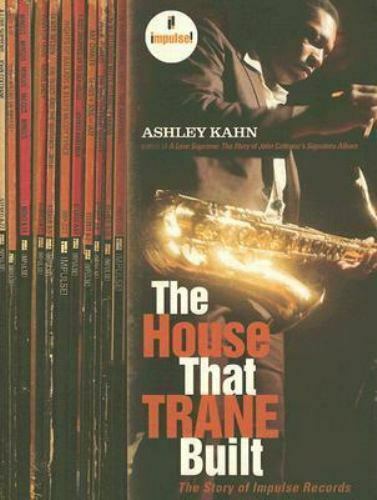
The House That Trane Built: The Story of Impulse Records - Ashley Kahn (2006)


Rating: Excellent

A week ago I was remarking to my friend, Owen, who lent me this book, that jazz is the greatest music genre because it is endlessly complex, filled to the brim with amazing practitioners and has something for everyone, from soft, slow cool jazz to freaky skronky spiritual jazz. He didn't disagree. Impulse Records was, and, once again, is, one of the most important and influential jazz labels. The House That Trane Built is a fine book detailing the history of this important label from 1960-61 to 2004, when Alice Coltrane released her last studio album, the incredible Translinear Light. Oddly, however, the discography near the back of the book ends in 1977, when the label was sold and then mainly became a source of reissues. This is a minor issue, as the writing is engaging, the history fascinating and the major players, such as producer Bob Thiele, who worked extensively with John Coltrane, are all correct and present. Coltrane, is, of course, one of the greatest musicians of the twentieth century. There's plenty within these pages for Coltrane fans, in particular regarding Coltrane operating in the studio and some insights into his home life. Although Coltrane does dominate, Impulse signed some of the key innovative jazz acts of the sixties and seventies outside of Miles Davis, making this book a history of jazz itself during that period as it took on the rising force of rock in the late sixties and early seventies.

John Coltrane - the greatest...

One of the most enjoyable aspects of The House That Trane Built is the regular two page features on specific albums, many of them unknown to me, or ones that I'd forgotten that I had lurking away among my records and CDs. As expected Coltrane himself is included a number of times, with his first for the label, Africa/Brass (1961), featuring early on, which I hadn't listened to for years. There's also obscurities like Ask Me Now! by Pee Wee Russel (1961), which somehow I had in my collection, un-listened to, which turned out to be beautifully poised and gently ebullient. There's also some great photos, such as Albert Ayler playing the bag-pipes and some very sexist print ads for the era, one of which features a naked women being spoon fed. At least the jazz can't be cancelled. The book was put together in a timely fashion, with many of the major players still alive to contribute, like Alice Coltrane, McCoy Tyner, Elvin Jones and many of the producers used throughout the first life of the label. Their first-hand contributions really make this book shine, and also unfortunately highlight the sad fact that John Coltrane died at the age of forty in 1967. The book does become less interesting after this point, but this is not really the fault of Kahn. Although Kahn is no great stylist, his straight-forward accounts still manage to convey his obvious passion for jazz. If you've never really understood jazz, I wouldn't necessarily recommend the music covered in The House That Trane Built as a place to start. Depending, of course, on your general musical experience and predilections, I'd begin with 50's hard bop before moving on to the likes of Impulse. If you get that far then this book is a perfect initial guide. However if you are ready to dive into the deep end of jazz, then Impulse has just released a beautiful sixtieth anniversary box set that I can personally vouch for as well worth your investment.


Thursday, 25 June 2015

Coming Through Slaughter - Michael Ondaatje (1976)


Buddy Bolden is standing second from the left.


Charles Joseph Bolden (Buddy Bolden) is credited as being a principal originator of jazz, a new form of music that emerged in the dying years of the nineteenth century and in the early years of the twentieth. Bolden and his band played ragtime, added some blues and gospel elements and most importantly improvisation, which lies at the heart of jazz. This kind of historical knowledge about the origins of jazz, in particular narrowing it down to one man, is like finding the source of a great river that begins as a trickle before winding down the slopes of great mountains, through crazy rapids and into massive cataracts of water before spilling into a sea of infinite possibilities. Jazz truly is something wild and, even now, untamed; drawn deep from the inner creative soul of humankind. Ondaatje’s portrayal of Buddy Bolden and his milieu is like the above grainy black and white photo come to life and examined from multiple viewpoints.

Coming Through Slaughter is structured like jazz, with a narrative arc that is fragmented into vignettes that continually lead back to the main narrative motif. That motif is the life of of Buddy Bolden and his sudden disappearance. Bolden abandons both his life in New Orleans and his band apparently due to the onset of schizophrenia that eventually led to his incarceration in an old civil war asylum near the town of Slaughter in 1907, where he finally died aged 54 in 1931. Not a great deal is known about the life of Bolden accept a few fairly concrete facts coupled with a great deal of myth and conjecture. There aren’t even any recordings of Bolden and his band in existence, although there are rumors of recordings on cylinders that weren’t made for general consumption and ended up in the hands of collectors, although none have ever surfaced. Much of what occurs in the novel is therefore either exaggerated or fictionalized, however this benefits Ondaatje and allows Bolden and New Orleans to really come alive.

What Ondaatje offers is historical conjecture filtered through experiments with narrative form, such as switching without warning from a third person omniscient point of view to the first person point of view Bolden himself. Text from interviews (probably not real) and descriptions of films are some of the other forms used. To Ondaatje’s credit this narrative blend works well to give a fascinating take on Bolden and the birth of jazz. Central to the novel is the only surviving photograph of Bolden, along with his band, taken by E.J. Bellocq, the photographer known for his images of prostitutes (he’s portrayed here as a hydrocephalic). There’s an inferred connection between Bolden and Bellocq that seems to suggest that artistic brilliance is the domain of those who suffer, a tragic subtext that gives the novel emotional frisson.

Despite the brevity of Coming Through Slaughter and its unorthodox structure, it’s an absorbing read. The novel is regarded as one of the best jazz novels (is that a genre?) and jazz aficionados should certainly give it a read. I can’t help but feel that Bolden is too good to be true, a wild blower of the cornet, pioneer of the kind of inspirational improvisation that would establish jazz as one the great musical genres and sufferer of a mental illness that would be both his undoing and perhaps also his source of inspiration. If Bolden didn’t really exist then someone would have to make him up, and in a way that’s exactly what Ondaatje does in Coming Through Slaughter.