Monday, 30 April 2012

New Edition Bookshop – Fremantle, Western Australia


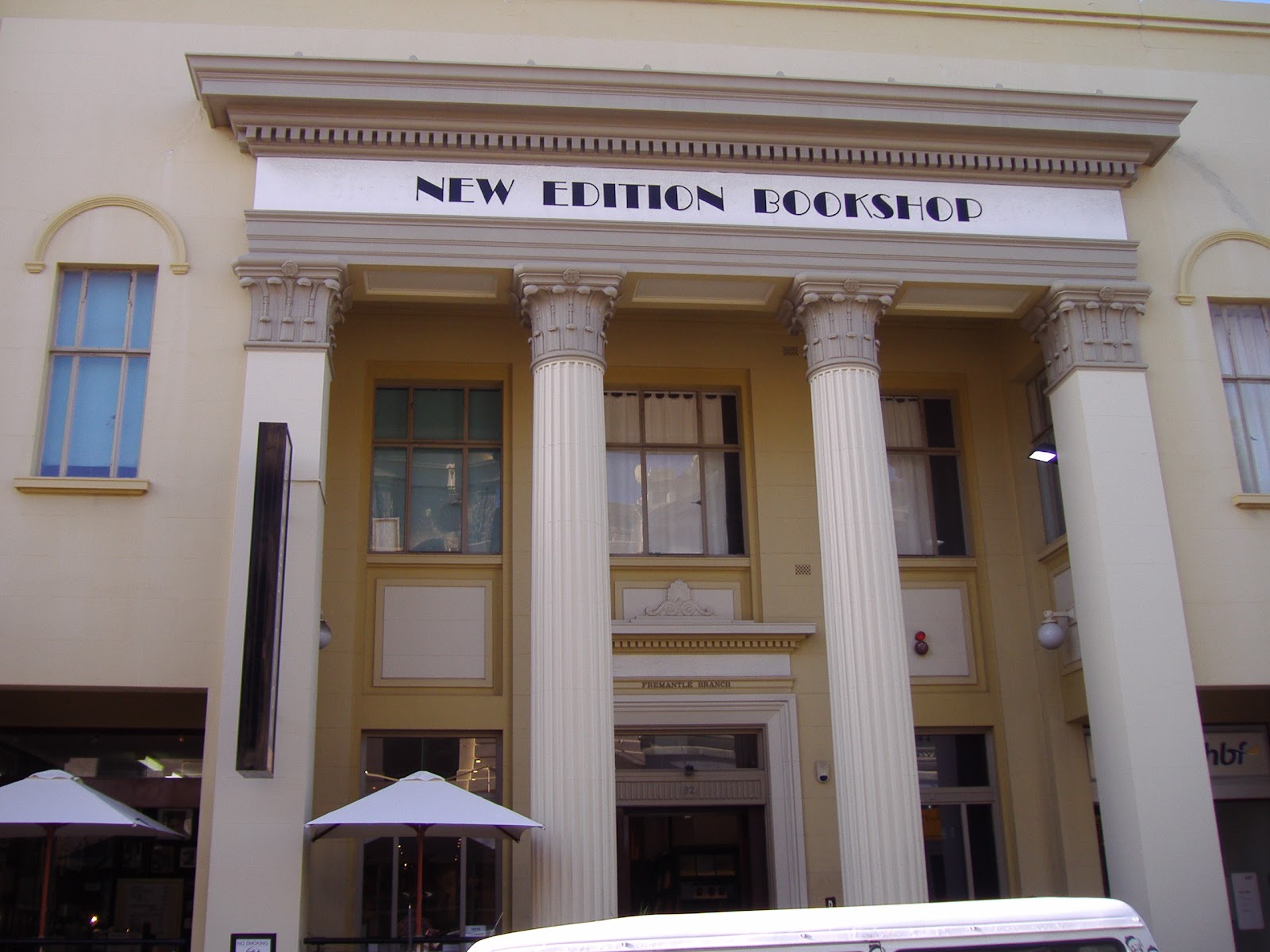
New Edition has had a long history in Fremantle, Perth’s port city. Initially established in a small shop on the main cappuccino strip of downtown Fremantle, it moved about five years ago into an old bank building on High St. This building makes New Edition an attractive place to shop for books. With a classical looking façade sporting what are possibly Greek Ionic columns and a spectacular entrance, the building oozes character. 


It’s a huge shop and one of the great things about visiting New Edition are the comfortable chairs and tables set up for browsing your potential purchases. I love the layout, with the ceiling high wooden shelves and the lamps and sculptures. Overall it’s decked out very tastefully with rugs and posters and due to the character of the old bank interior you really don’t want to leave in a hurry. If you go to the very back of the huge space you’ll see the former bank vaults with the original doors intact. 


One of New Edition’s specialties is a wide range of reference books covering architecture, cooking, design, art, theatre, music and photography, amongst other subjects. Their stock is beautiful, varied and full of hard to get editions. The fiction section has everything you need coupled with all the books you didn’t know you needed. I find it interesting that they mix the science fiction in with the literature – no literature/genre distinctions here. Make sure you have plenty of money if you visit, as it is extremely hard to resist buying just one book. 


New Edition is a high-end boutique bookshop and well worth visiting when you are in Fremantle. They have recently established a tiny coffee shop at the front of the store so that you can boost your capacity to take it all in with tea or coffee; or you can just sit out on their front verandah. Another great thing is that just down the street the Bill Campbell Book Store awaits to fulfill your second-hand book needs. Give them both a visit and help keep bookshops alive – they are not simply just businesses, but are also important cultural hubs in our community.


Monday, 23 April 2012

Muriel Spark Reading Week


Over at the great book blog - Stuck in a Book they are hosting a Muriel Spark reading week. If you'd like to contribute or comment then visit the site here. I will be contributing at some stage in a minor way. It's a great idea and I think that it will be well supported.

Meanwhile - keep reading!

Monday, 16 April 2012

The Sisters Brothers – Patrick deWitt (2011)


Rating: Admirable

Waiting in my chiropractor’s treatment room I spied this book on his bookshelf. I was looking it over when he came in and he immediately insisted that I borrow it. He was very enthusiastic about the book and so I obliged. After reading the book I now know that my good-natured chiropractic practitioner is a fan of dark humour and a high body count. He also knows what he is talking about because The Sisters Brothers is a fine novel and also one that manages to reinvigorate the Western for a modern palette by going beyond genre conventions into the realm of literature.

Set in 1850 on the west coast of America, the novel concerns the picaresque journey of two brothers who are in the employ of the Commodore (a wealthy thug basically) as hired killers on the trail of a strange individual called Hermann Kermit Warm. Charles is the eldest brother and is also the most headstrong and violent. Eli is the novel’s narrator and voice of reason amongst the carnage. Eli and Charles are infamous killers and they attract and involve themselves in various killings and misfortunes, many of which they take in their stride with psychopathic aplomb.

There is a great deal of casual black humour associated with the situations the brothers get themselves into and Eli’s dry observations are often both entertaining and drolly insightful. Despite being dysfunctional killers in the employ of a powerfully evil businessman, De Witt’s depiction of the brothers makes them very sympathetic characters. Eli’s predilection towards questioning the validity of his profession and to yearn for a more settled lifestyle is contrasted with Charles’s confident and bloodthirsty attitude. Despite this Eli’s love for his brother shines through. We also see Eli clumsily attempt to woo various women and treat strangers fairly until proven otherwise. Eli also cares deeply for his ineffectual horse, which at one stage he saves from a bear and keeps riding it even though it is seriously compromised by a mauled eye. He’s a killer with a heart of gold it seems.


The novel benefits from the simple yet effective plot. After the Sisters brothers manage to become sidetracked into all kinds of adventures on their way to kill Hermann Warm, they arrive in California to find that Henry Morris (a dandy informer in the employ of the Commodore) has absconded with their target for the goldfields of California. Here’s where the tale becomes very dark indeed. Whether or not this tale is a cautionary one, or has some kind of allegorical subtext, is very much up to the reader. I cannot make up my mind just how deep deWitt’s tale goes, but fortunately you do not need to worry either way, as the novel is very entertaining in any case.

Personally I’m a fan of spaghetti westerns and the HBO series Deadwood and I find this period in American history to be fascinating, even via potentially historically dubious mediums. So the plot held great entertainment value for me and I appreciated that deWitt made the effort to give the characters historically authentic speech patterns and turns of phrase. At least it seemed authentic to me when comparing it to Deadwood, in which the producers went for authenticity, unlike their series Rome in which the Romans spoke like modern day citizens.

I was sorry when this novel ended as I’d become attached to the Sisters brothers and was thoroughly hooked into caring about what happened to them. The Sisters Brothers was short listed for the 2011 Man Booker Prize, which is in many ways better than actually winning it, which seems to be a bit of a curse these days. The Sisters Brothers is not the greatest book ever written, but it is an example of how to write a tale that manages to be both literate and engaging. Meanwhile I may well check out deWitt’s debut novel Ablutions (2009), which has Bukowskiesque themes that I find very attractive in a book.


Monday, 9 April 2012

The Magus – John Fowles (1966)


Rating: Sublime

Initially The Magus seems intimidating, boasting 650 pages of dense type. Then there is its reputation as one of the great cult books; described as being a cascade of literary, philosophical and psychological pretensions in Gina McKinnon’s 500 Essential Cult Books (2010). Whilst such descriptions are relevant, the novel offers far more than these perfunctory summations, being one of those genuine masterpieces that can both challenge and enthral the reader. Fowles spent over ten years writing the book and also ended up rewriting sections for a new edition released in 1977. The Magus is a complex novel and will take you on an enthralling journey if you are prepared to invest both time and patience.

Set in post WWII Britain, the novel’s protagonist – Nicholas Urfe, is both inhibited by his upbringing and restless within his own middle class society. The novel is divided into three sections, with the first being concerned with Nicholas’ life in the shadow of his parents and the stifling conformity of early 1950’s Britain and also his early days in Greece. This initial section is by no means a dull prologue, with Fowles revealing an unpretentious narrative style that displays a clear and sparse beauty, particularly in the later sections set in Greece.

In frustration Nicholas applies for and gains employment at an exclusive private school on a remote Greek island known as Phraxos (based on the island of Spetsai, where Fowles taught English at the Anargyrios College in the 1950’s). Before he is able to leave he becomes involved with an Australian woman called Alison. He spurns her love and arrives in Greece in a conflicted state of mind.  His lonely exploration of the small island soon brings him into contact with Maurice Conchis, the eponymous ‘Magus’ figure of the book. Having heard about this mysterious character during a brief meeting with his predecessor Nicholas can’t help but be curious.

“Are you elect?” This is the question that Maurice Conchis asks Nicholas just before Conchis starts to take him, and the reader, down some vary strange paths. I looked up the meaning of this word and I believe that Fowles uses this term as a noun, meaning either a person worthy to be chosen, or the theological meaning: when a person or persons are chosen by God, especially for favour or salvation. After finishing this remarkable novel I believe that this is a question that is also aimed at the reader.

The long middle section can only be described as a total head-trip. I cannot think of a more apt term to describe the shifting realities of Nicholas’s interaction with Conchis and the philosophical and metaphysical concepts that challenge Nicholas’s conception of his own place in the cosmos. This section is supremely suspenseful and I totally surrendered to Fowles’ tricks as he drove the narrative forward with increasingly mysterious and extreme events. I found myself thinking about the book constantly and was driven to read it to discover just what was going to happen next, making this novel perhaps the most enjoyable I’ve read for quite some time. The Magus is also perhaps the most intense book I’ve ever read. I advise you to read this book when you have plenty of time to think about its themes and also to have time to recover from the tension it creates. I suggest some fine red wine to facilitate both!

John Fowles: he was elect.

Fowles has been described as one of the first British post-modern writers. I can’t personally judge the validity of this claim, however the novel does invite the reader to make their own judgments about the meaning of Nicholas’s experiences at the hands of the duplicitous Conchis and his never-ending ‘masque’. Fowles has famously refused to explain the meaning of The Magus, except on one rare occasion, of which I suggest you read after you’ve tackled the novel and thought about it yourself. I came to three conclusions about the meaning of what Fowles was portraying during the course of the novel, two of which correspond roughly with his summation and a third that did not. I’m not going to talk about what I believe the novel is about because each new reader will need to come to his or her own conclusions. Let me know what you thought or contact me if you want to know what I thought.

The third and final section of the novel finds Nicholas back in England a changed man in search of answers. This section’s bleak tone and slow pacing is in stark contrast to the intense middle section, but works well as a necessary coda to the events of the rest of the book. The ending is famous for being inconclusive and baffling, however after thinking about it for some time I realised that it is totally apt and fits well with my own conclusions about the book; in fact it serves to push you in the right direction if your eyes are open. The Magus is a work of genius and for the first time in the short history of this blog I'm awarding a sublime rating.

Wednesday, 21 March 2012

Jack Kerouac


Ah, Jack Kerouac, the literary love of my life. Kerouac is the author of my all time favourite book - The Dharma Bums (1958). Kerouac is simply the most inspirational writer I’ve ever had the pleasure to read. Inspiration, insight, confusion, joy, despair and existential wonder - I’ve experienced all of these things and more from Kerouac’s writing. 

Jack Kerouac first came into my literary orbit when I was in my early 20’s. A ripe time to get into the Beats one would think, but despite the allure of the two louche figures arm in arm on the cover of On the Road (1957) the book failed to really interest me. The tale of a loner leaving home and embarking on an odyssey across the bulk of America, with its hip anachronisms, Americanisms and the obsession with cars and jazz just didn’t do it for me at the time. I finished it and moved on, slightly disappointed.

A few years later a friend slipped me a copy of The Dharma Bums, after a night of red wine and other frivolous indulgences. Seems I was ready for Kerouac this time. The Dharma Bums connected with me on some deep previously unknown level. Responding to nebulous yearnings I didn’t really understand I totally connected with Ray Smith, the spiritual seeker character based on Kerouac himself (nearly all of Kerouac’s novels are autobiographical). Ray Smith travels mostly around the west coast of America, hooking up with his friend Japhy Ryder, who is exploring Buddhism. The highlight of the novel comes when they climb a mountain and talk about nature and Buddhism. Kerouac’s prose here is amongst the most beautiful and inspired I’ve ever read. The novel also created a conflicted duality within me. I simultaneously felt incredibly inspired and also depressed that I wasn’t living my life to the fullest.

I went back and read On the Road and this time I totally connected with Kerouac’s special turn of phrase, the rolling flow of words, the liveliness, joy and fervor. It was like I’d stumbled onto a new way of seeing the world, a totally unique perspective. Recently I flicked through it and read some of the descriptions of Sal and Dean freaking out to jazz in sweaty clubs. Now that I’m heavily into jazz it’s about time I read the original scroll version (the book was written on a roll of paper fed into the typewriter so that Kerouac would not be interrupted by having to change the paper). For newcomers, however, I recommend the original novel.


Kerouac’s writing is replete with beauty, insight and innovation, as well as despair, ugliness and dysfunction. Some of his books can be infuriating, but when he hits his stride his writing is transforming. He’s certainly had his critics, with Truman Capote famously referring to his writing as “typing.” I refute such criticism however; the spontaneous prose style he developed allows for a direct insight into the complexities of what it is to be human and that certainly includes both the exulted and the banal. When you read Kerouac you are reading the moment – its pulse, flow and rhythm. The prose can, as Kerouac desired, be like listening to Jazz.

Kerouac’s bibliography is filled with inspirational works and also others that are impenetrable or best tackled as a seasoned reader of Kerouac. Kerouac was prolific, so I’ll discuss only a few of his works here. For the novice I recommend both On the Road and The Dharma Bums. The short story collection – Lonesome Traveler (1960), which is actually entries from Kerouac’s travel journals, is beautiful and evocative. Desolation Angels (1965), written and set when On the Road was published, suffers slightly from fractured digressions, but provides insight into Kerouac’s internal struggles. Particularly poignant are the sections when he is stationed on a remote mountain (Desolation Peak) working as a fire lookout in Washington State’s wilderness areas. Here Kerouac faces his demons before descending back into an America that is busy reading the just published On the Road.

The Subterraneans (1958) is a novella that delves into the jazz scene and finds the protagonist, Leo Percepied (Kerouac) in a relationship with an African American woman. Utilizing Kerouac’s spontaneous prose style, the book acts as a fine snapshot of what his writing was all about. Big Sur (1962) presents Kerouac – aka Jack Duluoz, as a post fame alcoholic attempting to find solace in a cabin in Big Sur, a central coastal region south of San Francisco. Some of the same characters from his earlier works once again appear, however the tone of the book is dark and at times harrowing. It’s very sad to read about Kerouac’s decline but it does make his humanity shine through. It’s well worth reading but is more enjoyable if you are familiar with Kerouac’s earlier works.

Kerouac’s spontaneous prose, his autobiographical rawness, the jazz like rhythm and flow of his writing will certainly not appeal to all readers; however if you want to immerse yourself in 50’s American beat culture then look no further. With friends like William Burroughs and Alan Ginsberg, Kerouac was right at the centre of this fascinating underground culture. Most of its key figures appear as characters in Kerouac’s books, providing insight into a rebellious culture that foreshadowed the 60’s hippy movement.

An early shot of Kerouac (second from left), Ginsberg and Burroughs.

The key to reading Kerouac is to just let your self be pulled along by the flow of the prose, to accept its flaws and to be open enough to revel in its triumphs. What Kerouac’s writing represents is an authentic exploration of the human spirit in all its existential glory. In this way his writing can be exceptionally inspiring. It can also be maddening and erratic, but this is part of its charm. If you want to try something different, then Kerouac’s writing is an adventure waiting to happen.

Monday, 12 March 2012

The Prime of Miss Jean Brodie – Muriel Spark (1961)


Rating: Excellent

The Prime of Miss Jean Brodie is a deceptive book. Its effortless style is so perfect that the themes presented only reveal themselves gradually. I cruised through most of the book admiring the writing but wondering just what was the point of it all? It wasn’t until to two thirds of the way through that the full ramifications of what Spark was presenting hit home. I soon realised that the book is an example of psychological fiction at its best.

Set in 1930’s Edinburgh the novella (it’s only 126 pages long) examines the relationship between a teacher  - Jean Brodie and her ‘set’; six ten year old girls. Brodie has an unconventional attitude toward teaching, which mainly involves interactions based on her opinions and experiences, with a touch classical education thrown in to broaden their minds. Each girl is described as being famous for something – Rose is famous for sex (in the future, not at ten!) and Sandy is famous for her English vowel sounds and notorious for her small, almost non- existent eyes. They fair better than Mary, who is famous for being a “silent lump, a nobody that everyone could blame.” The principle thing they have in common is their loyalty to Miss Jean Brodie and how that influences their lives both while they are at the school and into the future.


Brodie’s influence over her set continues even after she stops being their teacher, inviting them to her home for supper and for long walks. The girls are gradually drawn into an adult world of which they only had limited insight previously. The headmistress, who is judgmental about Brodie’s methods, pumps the girls for information about Brodie that could be used to dismiss her. Brodie presents herself as being in her prime and the girls refer to it continually. It becomes a catch phrase that justifies Brodie’s behaviour. Meanwhile a love triangle develops between Brodie, the one armed art teacher and the music teacher. This adult world of duplicity, lust and self-deception casts an increasingly dark tone over proceedings. 
The themes of power, narcissism and fascism are the subtexts that give this slight book an impact that comes seemingly from nowhere. Brodie travels to Italy and Germany and speaks highly of the benefits of fascism in those countries. She admires how organised they are and talks of what a great example they set. It only takes a subtle shift on behalf of the reader in order to start viewing Brodie’s efforts to influence her set as something akin to fascism.

Spark’s prose is beautiful and succinct, a style that lulls the reader with its charms, all the while pulling the reader into its darker subtexts. Spark also liberally uses the technique of flash forwarding - moving the narrative forward in time suddenly in order to reveal a character’s future or fate. Rather than being disruptive this technique is quite effective and gives the reader further insight into the influence that Brodie has on the girls later on in their lives. The Prime of Miss Jean Brodie is an impressive achievement and I can understand why this book is regularly included in lists of the greatest books of the twentieth century. After reading The Man Who Loved Children (1940), also set in the 1930s, The Prime of Miss Jean Brodie felt like a literary holiday, but now I’m not so sure! The book has recently been published as one of those $10 orange Penguins, a small investment to make for a book with a lot to say about human nature and the perils of the transition from youth to adulthood.


Sunday, 4 March 2012

Marrow – Robert Reed (2000)


Rating: Excellent

Marrow has come as a complete surprise to me. Although I do love science fiction and have been reading it since before I reached the age of 10 (inspired by all those great science fiction movies of the late 70’s, such as Close Encounters of the Third Kind) my knowledge of what’s out there has diminished over the years. When I saw Marrow at my library I grabbed it because it has one of those great old school covers of a vast space ship – it always appeals. I’d never heard of Robert Reed and assumed that he was a new author. In fact Robert Reed has been around since the eighties and his first novel – The Hormone Jungle emerged in 1988.

Marrow’s premise is simple - future humans detect a massive ship heading towards the galaxy and they manage to board and commandeer the deserted ship before other galactic species manage to beat them to it. The ship is impressively huge – bigger than Jupiter, and is totally mysterious in terms of its origin, purpose and destination. The ship (it’s always just referred to as ‘the ship’) is so multifaceted, so huge and so much a part of this novel that it is entirely appropriate that the opening section is told from the perspective of the ship.

Marrow is divided into sections. The second section, which is appropriately called Marrow, begins with the introduction of Washen - just one of the great characters that populate this entertaining tale. Washen, like all of the humans that live during this time, is virtually immortal thanks to gene therapy that has transformed the human body into a healing powerhouse. The way that immortality is dealt with in Marrow is impressive, exploring both the practical and existential issues that come with it. Reed’s imaginative powers are excellent and he combines it with a hard sci-fi sense of what might just be possible. At times I found myself thinking of Iain M. Banks and his Culture novels, which display a similar imaginative prowess.

The immortal humans may have technology on their side but Reed makes them all too human, with a broad range of subtle and interesting characterizations that help make characters such as Washen (rebellious and complex), Miocine (intense and bitter) and Pamir (an unconventional and ugly individualist) easy to relate to. Such engaging characters are important because the scope of the novel is so huge. The Marrow section, for example, details events over nearly five thousand years, but despite this you are with the characters all the way. This section is easily the most impressive of the book, with tension building continually around the mystery of what lies at the heart of the ship. The mystery behind the ship and its core is brilliantly compelling and is woven into the narrative so well that you never want to put the book down.

Along the way there are plenty of weird aliens and awesome technology on display. The humans take the ship on a tour of the galaxy, picking up paying alien passengers, which sometimes leads to interesting problems. The ship is filled with habitats, including one suspended above a hydrogen sea contained within a tank the size of a moon. Such entertaining distractions are not relied upon by Reed however, as the plot is well thought out and brilliantly executed.

By the time you get to the last third of the novel the tension and mystery is almost unbearable. When the tension is finally released during the novel’s intense endgame it comes almost as a disappointment. Fortunately there is a sequel – The Well of Stars (2004), which no doubt explains some of the unsolved mysteries left dangling at the conclusion of the novel.

Marrow is an impressive achievement, overflowing with great characters and an intricate plot. Reed’s imagination is equal to the task of making the space opera a fresh proposition. It has been quite a while since I’ve enjoyed a science fiction novel as much as Marrow and I thoroughly recommended the book to those whose disposition lends itself to science fiction.