Monday, 6 June 2022

Lives of The Stoics: The Art of Living from Zeno to Marcus Aurelius - Ryan Holiday and Stephen Hanselman (2020)


Rating: Admirable

I bought this book at the beginning of my three weeks off of work in April before I had my hip replacement. It caught my eye because I've always been interested in Stoicism and also I felt that a certain degree of stoicism got me through the one year wait I had to endure to have the surgery. There is, of course, much more to Stoicism than just being resilient and happy despite one's circumstances. There are ethical considerations, along with justice, virtue and the use of logic free of subjective bias. A principle aim of Stoicism is to be free of the baser elements of human emotion, such as envy, jealousy, anger and to work hard toward one's betterment and the betterment of others. The Lives of the Stoics doesn't exactly explain stoicism in such simple terms, rather it illustrates the tenets of Stoicism via the lives of its exponents in the ancient world. Stoicism began in Ancient Greece in the third century BCE when Zeno the Prophet arrived in Athens, poor and down on his luck after losing everything in a maritime Mediterranean storm. Zeno's story here is merely the beginning of Stoicism as a philosophical movement, which then unfolds chronologically over the course three hundred plus pages, many centuries and dozens of historical figures.

The early Stoics hailed from or ended up in Athens. Due to the historical era not that much is known about some of the early Stoics and some entries are either short and/or read as if there is a lot of supposition involved. Things eventually become a lot more interesting with the advent of the Roman Stoics. Greek Stoics, such as Antipater the Ethicist and Panaetius the Connector, would spend time in Rome during the second century BCE, influencing the Romans and leading to such famous Roman historical figures as Cicero, Cato, Seneca and finally, Marcus Aurelius, whom is famous for his written works entitled Meditations (161 - 180 ACE). These are fascinating historical figures and Holiday and Hanselman do quite a good job of relating their historical footprint through the prism of Stoicism. It's interesting and fascinating, but unfortunately not often compelling (but, should it be?). Fortunately due to the book's format the reader can read about one Stoic at a time, usually over about twenty pages or so (the book also features a handy map and a timeline). This is how I approached reading Lives of the Stoics and in-between I started to look more into the period of history each Stoic hailed from and in the end my interest in ancient history was rekindled and I started to read a book from my library discard stash on the Roman Republic (more about that later). Once I started reading Rubicon by Tom Holland (2003) along with Lives of the Stoics, it become a much more vibrant read. Although you have to work to pick out Stoic philosophy out of the stories of its practitioners, I do feel like I have a greater appreciation of Stoicism. To get the best out of this book I recommend my approach of reading it in conjunction with some wider research of both Stoicism and of the ancient historical era.

Monday, 23 May 2022

Mars by 1980: The Story of Electronic Music - David Stubbs (2018)


Rating: Excellent

Mars by 1980 has been my book to read as I've been recovering from a hip replacement, and it's been exactly the right choice (you get good at this as you get older...). It's fascinating and well written, but not too demanding when the ability to concentrate is compromised. I do know and love a reasonable amount of electronic music, but this book has filled in many gaps in an engaging and interesting manner. In the preface Stubbs admits that the book is not an exhaustive history of the genre, which is just as well as it would have to have been an encyclopaedia, such is the genre's lengthy history and ubiquitous twenty first century presence. The genre's history begins in the late nineteenth century and early twentieth century, with the invention of such machines as the pianola (1895), and then the exotically named Telharmonium (1906) and the Intonarumori (1910). Part one was perhaps the most fascinating for me, going from the above mentioned inventions through to the pre WWI Futurists and then onto avant-garde electronic composers such as Edgard Varese, Pierre Schaffer, Stockhausen and John Cage. It was rewarding to read about these innovators and at the same time listen to their compositions via You Tube, a recommended approach for anyone wanting to read this book. Although overall the book is a linear history, Stubbs does jump back and forth in time a bit, which is fine. Stubbs also offers a somewhat personal and subjective perspective, recounting his initial exposure to electronic musical works, which proves to be an effective and engaging approach throughout.

Perhaps the real strength of Mars by 1980 is the quality of Stubbs' writing, which is witty, erudite and perceptive. There are never lulls or boring sections to contend with and Stubbs' subjective opinions are never intrusive or excessive in tone. Stubbs evades any criticism of not even trying to be comprehensive by making what he does cover really count. He gives in depth attention to black musical artists who were trailblazers, such as Sun Ra, Miles Davis and Stevie Wonder, as well as female artists, such as Delia Derbyshire and Daphne Oram, who worked at the BBC in the 1960's. Derbyshire produced the Dr Who theme, which became one of the most famous electronic works within mainstream awareness for quite a while. Perhaps the most enjoyable chapters for me personally were 'The Art of the Duo' and 'Substance', both of which covered electronic music in the 1980's when I was a teenager. So, a nice glow of nostalgia for me as I contended with getting my new hip into gear. Stubbs also examines ambient music, 1990's rave culture, the dominance of sampling and then EDM (electronic dance music) in the twenty first century. Along the way he deftly examines the push and pull between black and white music and the associated question of authenticity, such as when white artists become funky by sampling the work of black artists (hello Moby). Mars by 1980 is much more than just a selective overview of electronic music, it also stands as an almost anthropological examination of twentieth century culture, which, in doing so, strongly gives the impression that the invention of machines that allowed humans to compose electronic music was a highly significant development in human artistic endeavour. Recommended for music lovers who are both curious and adventurous, and really, why not be both?


Monday, 2 May 2022

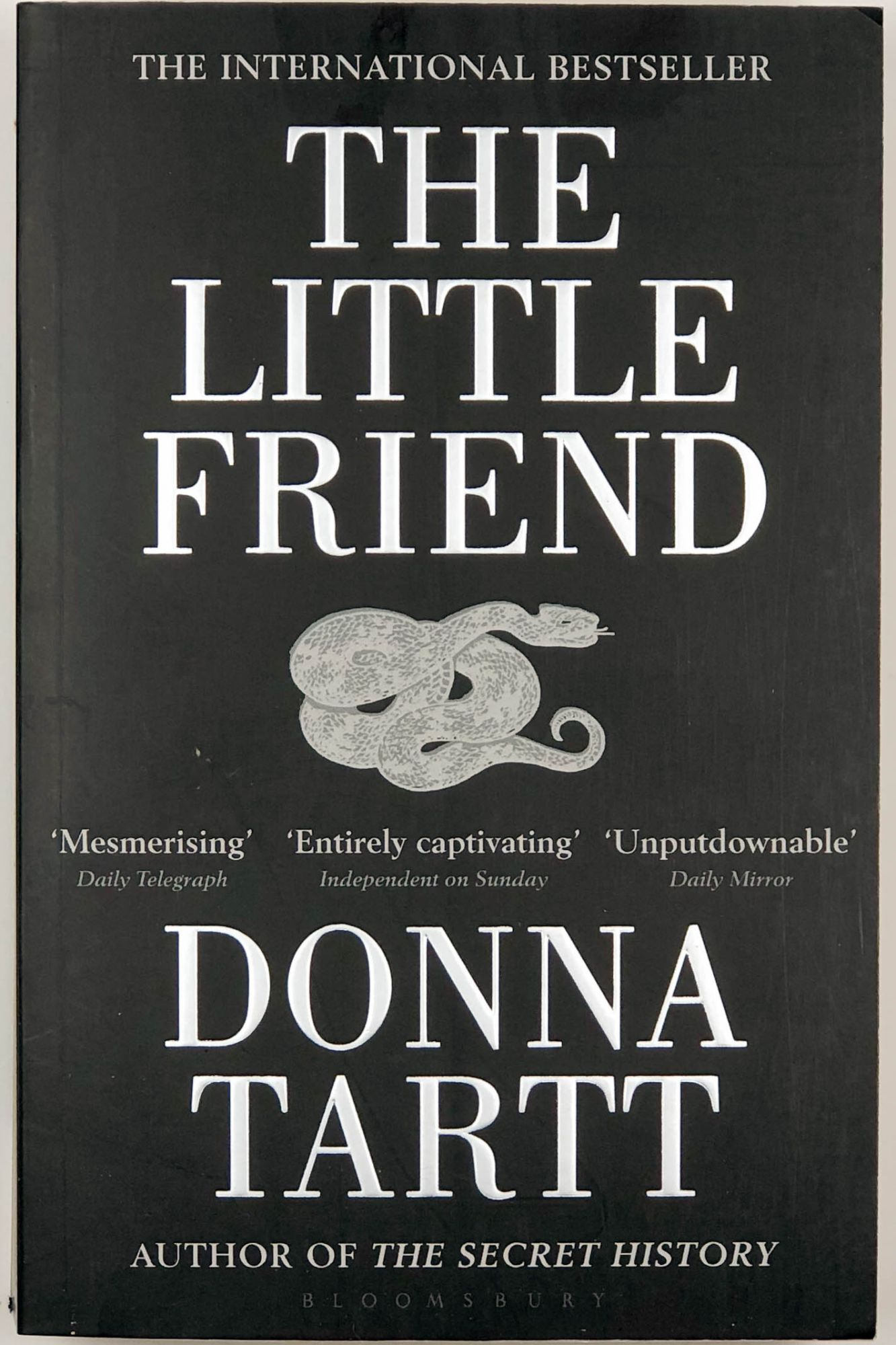
The Little Friend - Donna Tartt (2002)


Rating: Sublime

The Little Friend is an incredible novel, but before I get into just why I need to point out that this does not mean that everyone will enjoy it. The novel disappointed some of Tartt's many fans after the sublime The Secret History (1992), which is one of those special novels that are revered with a cultish intensity. A hard act to follow then, and it doesn't help that The Little Friend is a world away from the university setting of Tartt's debut. Also Tartt takes her time to set the scene, establish the characters and engage in some world building; for example, after the prologue, nothing much happens for fifty plus pages. We are introduced to the Dufersnes family, some twelve years after the nine year old Robin Cleve Dufresnes was found dead, hanging from a tree in the front yard. Among the ensemble of characters, including three aunts, parents, friends, housekeepers and pets, we meet Harriet Cleve Dufresnes and learn that the trauma of her brother's death has resulted in a sad and dysfunctional household. Initially it really seems that the novel just consists of endless dialogue and descriptions of domestic scenes, coupled with a slow pace. However, via the twelve year-old Harriet, who is intelligent, intense and wilful, you are drawn irresistibly into the decaying  small town gothic American south of the mid 1970's. Harriet becomes determined to find and punish whoever killed her brother, and thanks to information provided to her by the family's hard-done-by housekeeper, Ida, she fixates on local red-neck meth-head Danny Ratliff, whom, along with his brothers, are the toughest criminal element in town. Once Harriet and her only friend, Hely Hull, set out to track down Danny the novel really takes off, becoming totally absorbing and engaging. Of course, as with all great novels, you need the set-up for the pay-off to really work, so any requirement of patience and work on behalf of the reader is well worth it.

The Little Friend has been criticised for being something like a Nancy Drew mystery, but this is totally misguided criticism. The novel is very adult, incredibly compelling and the writing is absolutely brilliant. Tartt really is a superb writer of fiction and her descriptive powers are endlessly astounding. When Tartt sets a scene you are really there with the characters, who are all fully realised creations, including the many minor characters. I truly believe that Tartt is one of the most talented writers to ever put pen to paper (or fingers to the keyboard?). The tension that Tartt builds throughout the novel is almost unbearable, I had to keep putting the book down to take a break. On the other hand I have never laughed so spontaneously and so loud and long at a scene that involved a cobra, a skeletal old grandma called Gum and an open-top Trans Am, and the thing is, I'm not even sure if it was meant to funny! The novel is also very dark, filled with despair, malevolence, bathos and paranoia, playing out like a TV series made by David Lynch, but without the supernatural elements. There are also some of the most brilliant set pieces I've ever read, like when Hely eavesdrops on a tense scene in a seedy pool-hall and the intense scenes when Harriet and Hely break into a house containing boxes of poisonous snakes owned by a travelling snake-handling preacher. The Little Friend is filled with such moments, it was a novel I desperately wanted to get to the end of so I could find out what would happen, yet I also didn't want it to end because it was so enjoyable. It's an extremely clever novel in that it doesn't give up its secrets too easily, you need to wait till near the end to find out who the title refers to, and as for some of the other mysteries, I'm not saying anything lest I spoil things for new readers. Oh, and Donna Tartt, it's been nine years since your last novel was published, given your publishing record the new one must be due next year, I certainly hope so.


Wednesday, 27 April 2022

The Expendable Man - Dorothy B. Hughs (1963)


Rating: Excellent

Another crime novel in quick succession, this one I found at the op-shop down the road from my library for a dollar. It's a beautiful New York Review of Books (NYRB) edition and as such is pretty much a guarantee of quality. Dorothy B. Hughes was a renowned crime writer, who wrote In a Lonely Place (1947), that became the basis of a successful film starring Humphrey Bogart. The Expendable Man was Hughs last novel and is regarded as one of her best. It is skilfully written, displaying a high literary quality without becoming stylistically over-bearing, which serves the plot and characters well. The main protagonist, Dr. Hugh Densmore, is introduced on the first page, as he drives his family's Cadillac from L.A. to Phoenix and picks up a young female hitch-hiker against his better judgement. The young woman, of course, goes on to cause Densmore a great deal of trouble, particularly after she is found dead in a canal. Densmore is the main suspect and much of the novel focusses on his efforts to both protect and clear his name. The Expendable Man is a compelling read and the tension builds nicely throughout. There are some cliched elements, like the character of Venner, a hard-man detective who sneers and slurs his speech in what is referred to as a 'pornographic' manner; and the red-neck elements working in the background to try and make sure that Densmore is framed for the murder. It's good to keep in mind, however, that at the time such tropes were not that over-done.

The novel is generally well-paced and the tension is only released in the last pages, which, when it comes, is a relief. Hughs was a clever writer and there's a moment about a third of the way through where, in one sentence, everything is turned on its head and the readers' perception of what is going on is completely changed. I almost gasped when I read the sentence and realised what had happened. There is evil in this novel, but it is not Densmore, rather it is institutionalised via the justice system and the moral standards of the era. The Expendable Man is an indictment of American society at the time and, although it's almost a cliche to say this now, could easily be freshly published today and be seen in the same light. This is noir crime fiction with a social conscience. Although the novel is genuinely excellent, and I did mostly enjoy it, it did leave me feeling slightly soiled by its atmosphere of desperation and deceit. Although I will be reading more crime novels in the future, I'm not sure I like the way they make me feel. At the library crime novels are the most heavily borrowed books and it is also the most successful fiction genre in the world, however it may turn out not to be for me in the end. Curiously the current novel I'm reading, The Little Friend by Donna Tartt (2002), involves both a crime and criminals, so I may be convinced yet.


Saturday, 16 April 2022

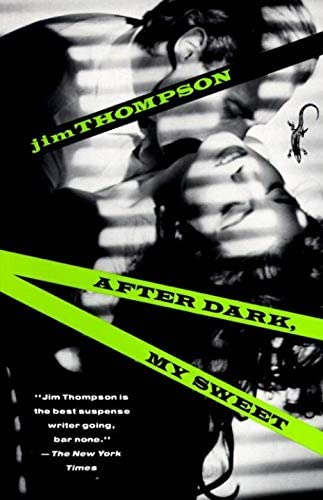
After Dark, My Sweet - Jim Thompson (1955)


Rating: Admirable

Crime is another genre, along with fantasy, that I haven't paid much attention to over the years. For some reason I'm being drawn to crime fiction now and mentioned it in passing to a good friend from Melbourne who then sent me four crime novels he had found in op-shops. Among them was After Dark, My Sweet, by one of the masters of crime noir from the mid twentieth century, Jim Thompson. The novel involves the sociopath, William Collins, former boxer and freshly escaped from a mental institution (his fourth), becoming involved with the alcoholic femme-fatale, Fay Anderson. William is recognised as the perfect fall-guy by Fay's crooked-cop associate, Uncle Bud, who between them have a scheme to kidnap the child of a wealthy family. Even a relative novice in the crime genre like me can recognise that the novel contains all of the typical tropes of crime noir. All of the characters are, in turn, brooding, unpredictable, scheming and violent. The atmosphere is bleak and desperate. The plot unfolds like a tense nightmare that is reasonably unpredictable, despite all the cliched crime tropes being present and correct.

Looking at Thompson's bibliography, he really pumped out the novels, publishing four in 1954 alone! A glance at Thompson's Wikipedia entry reveals the opinion that his output varied in quality, writing some novels in only a month. You can tell, as After Dark, My Sweet does not present as high quality writing, but it is not exactly pulp either. The novel is written in first person from the point of view of Collins, and so is coloured by his hard-man vernacular and distorted world view; so much so it's almost as if he wrote the novel himself. It took me a while to get used to and it doesn't help that there are barely any sympathetic characters throughout the novel. No one trusts each other, and this constant tension makes for a dark and nervous read. I wouldn't say reading After Dark, My Sweet was an enjoyable experience, but it was very interesting. I tried to imagine what it would have been like for readers in the mid-fifties being exposed to such sociopathic darkness, did they have more innocent exceptions back then and were they more easily affected by crime's dark underbelly? Perhaps not, but they might not have quite been used to Thompson's particular gritty, nihilistic style, something the modern reader is well used to by now. I may well read more of Thompson's work, after all he did write the script for Stanley Kubrick's film, The Killing (1956) and this novel did enough to interest me.

Thursday, 31 March 2022

Green Mars - Kim Stanley Robinson (1993)


Rating: Excellent

Yet another large novel, this one 780 pages of hard science fiction. Green Mars is set fifty years after the conclusion of Red Mars (1992), a science fiction novel I consider to one one of the best out there. Green Mars isn't quite up to the same standard, but it does come close. Mars has changed, terraforming has come a long way, with the atmosphere thickening and warming enough for genetically engineered plants and microorganisms to begin to flourish. The survivors of the first hundred are in hiding, mostly in a habitat under the South Pole. Most of the key characters from the first novel have survived, thanks to the longevity treatments developed in the first novel, which is great for continuity, but also not an impossible premise considering research into longevity has been going on for decades in what passes for reality. There's also a host of new characters, mostly offspring of the first hundred, known as the Nisei, bred by the mystic, Hiroko. In the same manner as the first novel Robinson gives large sections of the narrative over to different characters in turn, and it is through one of the Nisei, Nirgal, that the new Mars is revealed to the reader. The legendary stowaway, Coyote, takes Nirgal out onto the surface and introduces him to all of the secret underground communities. Mars exists in a tense split between the transnational corporations and the underground, who want to make Mars their own, away from the corrupt capitalism of Earth promoted by the transnationals.

As with Red Mars, this novel takes its time, giving you long descriptions of the geological landforms of Mars. To get the most out of the novel you must either be really into geology, or appreciate just how vivid Robinson's descriptions of Mars are, so vivid they give you a strong sense of really being there on the surface. Robinson makes it totally believable and even desirable that one day humans would be on Mars in a similar situation. Although there is plenty of focus on the planet itself, often the narrative leans toward the philosophical, scientific and the political. The characters are roughly grouped in this manner, with Hiroko and her followers espousing a profound sense of connection with the planet itself, viriditas. The magnificently named Saxifrage 'Sax' Russell continues his mission to terraform Mars, in fact he is perhaps the key character, an influential 'scientist as hero' (the title of part four in fact). Politics is everywhere throughout Green Mars, via the underground, Nirgal, Coyote and the intense Russian femme fatale, Maya Toitovna. Through Maya the physiological effects of the longevity treatment are explored, what it does to the psyche, the memory and perception, which is generally fascinating stuff. These are merely some of the many themes explored throughout the novel; Robinson really packs an enormous amount of information and detail within the 780 pages, it was almost an exhausting endeavour to get through, however it is well worth it and I'm looking forward to reading Blue Mars (1996) in the near future.


Sunday, 20 March 2022

Crossroads - Jonathan Franzen (2021)


Rating: Excellent

Another family saga by Jonathan Franzen, this time it's the rather dysfunctional Hildebrandt family who live in suburban Chicago circa 1971. I'm one of the few people who haven't read the dysfunctional family saga The Corrections (2001), but I did read Freedom (2010), which was impressive. Crossroads is a massive novel, in terms of length but also thematically, covering religion, morality, trauma, drug addiction, mental illness and all the cultural baggage of the time, such as Vietnam and the counter-culture. Apparently it will be the first novel in a trilogy called 'A Key to all Mythologies', taken from George Eliot's Middlemarch (1871), being the academic work of Edward Casaubon, who is trying to link all mythologies to Christianity. The Hildebrandt family, apart from the youngest son, Judson, all feature prominently, with long sections dedicated to each in turn, focussing on their own particular struggles and world-view. Readers will have their favourites, and mine was Perry, a fourteen year old budding intellectual with narcissistic tendencies who becomes very dysfunctional indeed. Marion, the matriarch, is the queen of dysfunction, closely followed by her uptight and frustrated husband, Russ, who seethes with jealously toward a hip young minister, Rick Ambrose (Russ is a middle-aged minister at the first Reformed Church) and lusts after a beautiful younger widow, Frances. All have their moments in the literary sun throughout the novel, as do older siblings Clem and Becky. Franzen takes his time, giving his well fleshed out characters plenty of narrative space to deal with their issues. Ultimately it makes for compelling reading.

Crossroads is serious literary fiction and requires both concentration and dedication. Fortunately the novel is well worth the effort. The sentences are long, but not particularly showy, there's not much in the way of beauty here, but there is a great deal of psychological intensity in Franzen's prose, and that is something to both enjoy and admire. As with all great novel titles, Crossroads has multiple meanings, being the name of a Christian youth group that is at the centre of the novel, and where most of the protagonists find themselves at one point or another; it's also where American society finds itself as it begins to become more polarised and more secular. The world that Franzen builds is vivid, as are the struggles of the characters. Marion, in particular, is a traumatised and conflicted character, and the long section that delves into her past is disturbing and dark, so much so it's a relief to move onto the next chapter and another character. The age old problems of how to be virtuous and moral are explored via the struggles of multiple characters, but as Perry and Russ find out, easy answers are more often not forthcoming. Such universal themes are always fertile ground for novelists and Franzen certainly makes the most of it in Crossroads, so much so that at the end you are left wanting more. I'm hoping that the 'Key to all Mythologies' will be as rewarding as John Updike's epic Rabbit novels, that played out over decades (beginning in the sixties and ending in the naughties) and followed the same characters as they lived their very human lives. There's your challenge Jonathan Franzen, but I have no doubt that you are up to it, just don't take ten years to deliver the sequels, otherwise you will become Casaubon, which would be regrettable.