Thursday, 14 November 2013

The Tree of Man - Patrick White (1956)


After many years of good intentions I have finally read a novel by that renowned Australian literary curmudgeon, Patrick White. My 1973 edition of The Tree of Man was given to me by a good friend, who once read out a paragraph to me during a visit on a searing hot summers day. I was captivated by White’s lyrical phrasing and his portrayal of the Australian experience, all from one paragraph. Patrick White is considered to be one of Australia’s great writers and one of the significant writers of twentieth century literature. The Tree of Man certainly presents a convincing case for literary genius, however it also caused me to wonder about White’s relevance in modern Australia.

The Tree of Man traces the life of Stan Parker who, along with his wife, Amy Parker, settle on a patch of land close to Sydney in the first few years of the twentieth century. One could say that it is a family saga, yet without the melodrama that usually inhabits such narratives, thanks largely to White’s modernist style. White’s style isn’t exactly the stream of consciousness of the modernists, rather he colours the narrative with the characters subjective thoughts and feelings; creating a kind of allusive narrative impressionism that imbues the mundane aspects of Stan and Amy’s everyday lives with a very Australian mysticism. 

White’s dense modernist style makes the novel a reasonable challenge to read, but one that is well worth pursuing. The novel has strong existential themes which are explored through the lives of Stan and Amy, as they tend to their dairy farm, have children and deal with the vicissitudes of life. Their lives are  made profound against the background of the elemental Australian landscape, yet White also tears away their certainty, referring to them as “ant man” and “ant woman,” reminding us that the control humans have over our destinies is limited; rendering us merely a small part of a far greater capricious whole. Within this existential context Amy and Stan live, like Adam and Eve, in their bush eden and create their own world. The isolation of their lives, with initially few neighbors in the semi wilderness area, gives an impression of what it was like for the first settlers in Australia. There are floods, bush-fires and thunderstorms that threaten their tenuous existence. Yet despite the challenges they persevere and remain together throughout their lives on the land, representing a triumph of will against a backdrop of uncertainty.

The Tree of Man brilliantly portrays the cycles of life, taking Stan and Amy through youth and into middle age. White deals with the psychology of these changes subtly, through their relationships with their son and daughter and the land they live on. Stan and Amy’s relationship evolves through the struggle to understand each other, with Amy often pondering whether she’ll ever really “see into” Stan. As the novel takes them into old age they struggle to understand death and God. White uses old age as a litmus test for the concept of God, or the Christian God at least. Stan is perplexed, whilst Amy takes to the idea more readily. Stan sees God in a gob of spit he produces whilst he is being harassed by a born again evangelist and suddenly his life makes sense, but not the kind of sense that Christianity so earnestly tries to provide.


The last short chapter, only two pages long, beautifully sums up the themes of The Tree of Man and is one of the greatest I’ve ever read. Stan’s grandchild lingers in a wooded gully thinking about his grandfather’s life, feeling helpless and unformed. He decides to write a poem “of life”, a notion that overwhelms him. After a long intense novel filled with White’s allusive, poetic style (poetic realism, I thought to myself over a cup of tea) White is hinting that life itself is poetry; that each person writes their own poetry with their lives and that the essence of a life provides its own meaning, one that is separate to God and religion. 

Although White is rightly considered to be one of literature’s greats, I realised that his writing is deeply unfashionable, in Australia at least. Looking around online I found that I wasn’t the only one to come to this conclusion. I mostly agree with the author of this piece, that White’s modernist style dates his writing, that it is perhaps too dark for most and that the fact that he was Australian makes him peripheral on the world stage. However the notion that ignoring his work has become a bad habit that persists is the most persuasive, and this was certainly true in my case. I ignored White for far too long, so I‘ll end by advising others to not perpetuate this trend, do yourself a literary favour and read Patrick White.

Sunday, 3 November 2013

The Rosie Project - Graeme Simsion (2013)


The Rosie Project provides a perfect opportunity to examine the difference between popular fiction and literary fiction. The previous book I read and reviewed, David Foster Wallace’s Infinite Jest (1996), epitomizes literary fiction. Wallace’s prose style is erudite, dense and complex. Infinite Jest’s plot is multilayered, the characters motives are influenced by their often dark psyches and the narrative explores humanity’s struggle with deep existential issues, both in a personal and cultural context. The Rosie Project has a straightforward plot, simple themes, the characters motivations are easy to understand and it is written in a simple unpretentious style. Does this difference make one novel better or more important than the other?

If The Rosie Project were a movie then it would be a romantic comedy. The principle protagonist is Don Tillman, a geneticist and academic who knows many things about the world but is unaware that he has many of the characteristics of Aspergers. Don is frustrated that his efforts with women never get beyond the first date, so he devises a questionnaire designed to find the perfect woman who displays all of the attributes he believes will make his life complete. Rosie Jarman, is, of course, the complete opposite to everything Don desires in a mate. When Rosie seeks Don’s help to find her real father all manner of situations arise that both pull them apart and bring them together. The ending of the novel is inevitable given the demands of its genre.

The Rosie Project does indeed display many of the hallmarks of its genre, but avoids popular fiction’s tendency to be mediocre. The novel is well written, with a tight fast paced plot that doesn’t allow the reader much time to ponder about its lack of psychological depth. Don and Rosie sparkle when they are on the page together; like any good romantic comedy the chemistry between the two leads can make or break the narrative and in this case it makes it. The Rosie Project is also very funny. Don’s Aspergers-like characteristics allow for some fine deadpan humour and this alone makes the novel infinitely better than the excruciating The Finkler Question that I had to read for the book club a few years ago (I obviously still haven't gotten over it, and rightly so). 

The Rosie Project also has some decent themes to explore; rationality vs emotionality, tolerance of difference and the moral obligations attached to decision making. These themes are dealt with in the context of a fast moving romantic comedy and are therefore not explored in any great depth. The fact that the novel has no pretensions towards being a literary masterpiece means that such superficiality is perhaps of no great importance, but if this is the case then just what is the value of popular fiction?

Are the differences between popular fiction and literary fiction meaningful? Why do we read fiction? Is it for enjoyment or for something more important? Literary fiction can challenge in an artistic sense, it can raise important issues and explore them deeply and it can make us think about what it is to be human. These issue are all valuable and do make make literary fiction important culturally. However it is also beneficial to read for enjoyment and relaxation, and that’s where popular fiction comes into its own. Popular fiction can be psychologically comforting, whilst literary fiction can often be the opposite (but not always, of course). If popular fiction’s aim is to comfort and entertain then that certainly has value.What Infinite Jest and The Rosie Project have in common is that they both achieve what they set out to do within the context of their own genres. I would not have read The Rosie Project if it hadn’t been chosen by my book club members, but I’m pleased that I did because it has reminded me that well written popular fiction does have its place and can be well worth reading.

Tuesday, 15 October 2013

Infinite Jest – David Foster Wallace (1996)


Infinite Jest is perhaps the most significant cult novel of the last twenty years. It has also been a critical success, with Time Magazine listing it as one of the hundred greatest novels since 1923. Viewed as a prime example of so called hysterical realism, Infinite Jest is a challenging monster of a book. It’s undoubtably important, intelligent, and brilliant; but it’s also obtuse, arcane, extreme, digressive, frustrating and unrelentingly verbose. The page count, including the endnotes, clocks in at 1079 pages, however the font is tiny, so really the book would be the equivalent of about 1800 standard font pages. Infinite Jest is not your typical reading experience, it’s more like embarking on a relationship; you have to work hard at it and it can be both a satisfying and difficult experience. 


Infinite Jest has three narrative streams that eventually converge (and I really mean eventually). The first involves the Incandenza family – Hal, Mario and Orin are the sons of Avril (The Moms) and James Incandenza (Himself), who founded the Enfield Tennis Academy in Boston. James Incandenza, an amateur auteur, is the creator of the film Infinite Jest (alternately referred to as The Entertainment), which is fatally addictive. A significant portion of Infinite Jest is set at the tennis academy and it is perhaps the most impenetrable of the three streams. Tennis related argot is used extensively and there are sequences that are extremely digressive and obscure, not that this isn’t typical of the novel as a whole. 

The second stream, which is set in a nearby drug and alcohol recovery centre called Ennet House, is perhaps the most accessible. The colourful characters who inhabit Ennet House are arguably more relatable than the ones who populate the tennis academy. The Ennet House sections are particularly tragicomic and endlessly inventive. Wallace riffs on the pathos of addiction, whilst revealing characters back stories in uncomfortable detail. The Ennet House denizens are great fodder for Wallace’s totally devastating satire on the dark side of Western culture’s obsession with instant gratification. 

The third and perhaps most bizarre stream features the Les Assassins des Fauteuils Rollents (A.F.R.) or The Wheelchair Assassins, a French Canadian separatist group who wish to obtain a master copy of Infinite Jest to use as a weapon. This quest to find Infinite Jest binds together the three streams. As the novel progresses they become more involved, including a brilliant sequence in which they raid a shop and search it for the master copy of Infinite Jest; with some of them climbing the walls using suction cups on their stumps, which typically for Infinite Jest is both disturbing and hilarious simultaneously.

Infinite Jest is an utterly original novel and Wallace’s singular style makes a virtue of extreme detail and digression. Wallace’s style is so densely rendered that initially it can be almost impenetrable, requiring great commitment and concentration on behalf of the reader. The narrative form is fragmented across both time and place and characters or events that initially appear to be minor end up being important elsewhere. A throwaway comment by a character or a few sentences in a random paragraph often act as vectors towards understanding the overall plot arc. Unusually for a work of fiction there are over three hundred endnotes (some with their own footnotes), many of which are pages long and are of particular importance to understanding the novel. To read Infinite Jest requires that the reader push beyond their standard passive reading paradigm and actively engage with the novel on its own terms. 


Like the fatal film itself, Infinite Jest is addictive. After a while I realised that I was beginning to think in the style of Wallace’s writing in my everyday life, which fortunately was not such a bad thing. Once you adjust to the digressions, complexity and the multitude of characters the novel becomes a total pleasure to read. The highlights are manifold, such as Mario’s first and only romantic encounter (Mario is a macrocephalic), Hal’s visit to a supposed marijuana addicts recovery group session, Ennet House resident Lenz’s sick nocturnal habits and his drug addled raves; what transpires when Hal comes home and enjoys the smell of dinner cooking, and the tragicomic account of a man’s addiction to watching M.A.S.H that takes him over the edge. 

Towards the end stalwart Ennet House resident Don Gately’s past, present and future becomes entangled in the metaphysical meaning behind what is on the Infinite Jest film. Yes, you do find out what is on the film and it is totally satisfying both metaphysically and intellectually. It is not merely a throwaway plot device and makes perfect sense when the principle reasons behind many of the characters problems with addiction are considered and then applied to the population in general. Most of them have an emotional void created during childhood that they are desperately trying to fill. There is a satisfying existential depth to Infinite Jest that Wallace has pulled off with aplomb. 

Infinite Jest manages to be everything you would want from a great novel, brilliantly realized ideas, intellectually satisfying, mysterious, multilayered and most importantly, profound in its humanity. Wallace himself suffered both from depression and drug addiction (he also played tennis) and to know his story helps to understand where Infinite Jest is coming from. The novel is this era’s Ulysses (James Joyce, 1922) and will keep academics and university students busy for decades to come. One last word of advice, to understand how the plot resolves you will need to pay particular attention to the beginning, which is set during a time after the narrative finishes. Another option is to submit to the pull of addiction and read Infinite Jest again and again and again.....


Above Image:Jonathan Franzan and David Foster Wallace 1996 at the launch of Infinite Jest (Photo by Marina Garnier)

Tuesday, 17 September 2013

Infinite Jest, Ted Gioia and the Fragmented Novel


Recently I’ve had bit of time to play around with and I decided to reattempt reading David Foster Wallace’s Infinite Jest (1996), an enormous tome I had long ago abandoned after only a third had been read. I’m making good headway and most importantly I’m enjoying the experience. So stay tuned for a review – eventually.

The nature of Infinite Jest has led me to do a bit of reading about trends in literature and I stumbled across a brilliant essay written by Ted Gioia about the rise of the fragmented novel. It is well worth reading and helps put into perspective many significant novels of the last ten years or so, such as Jennifer Egan’s A Visit from the Goon Squad (2010) and Roberto Bolano’s 2666 (2004).

Ted Gioia is an author, musician and cultural theorist. His biography is well worth checking out, as is the list of essays at the bottom of the linked page. Gioia has written much-lauded books about Jazz, but the one I’m most interested in is The Birth (and the Death) of Cool (2009), which is:

…a work of cultural criticism and a historical survey of hipness—his concept of post-cool, outlined in this work, was highlighted as one of the "ideas of the year" by Adbusters

Sounds pretty cool to me! One day when I finally finish Infinite Jest I’ll get around to reading it. Meanwhile Gioia has also written an essay on Infinite Jest – something to be going on with then.

Artwork pictured: Fragments by Henie

Sunday, 8 September 2013

Zaireeka – Mark Richardson (2010)


As much as I love music I rarely read books on the subject, but when a good friend of mine lent me this book I knew that I’d have to read it. Both The Flaming Lips and the Zaireeka album are fascinating and compelling subjects. The Flaming Lips are perhaps the most rewarding underground band to have emerged in America in the last thirty years. Their career arc has been one of unbridled adventurousness, always following their muse without concern for commercial gain, whilst at the same time maintaining a high level of quality control.

Zaireeka was released in 1997 as a four CD set designed to be listened to simultaneously on four separate CD players. As an album Zaireeka also stands as one of the best The Flaming Lips have produced in their long and eccentric career. Richardson notes in the introduction that when he mentioned to friends that he was going to write about Zaireeka they would joke about him having to write four separate books meant to be read simultaneously. A good joke yes, but this inspired Richardson to structure the book in four separate parts that contain eight ‘tracks’ each, a format that serves the subject well.

If you are a fan of The Flaming Lips then Zaireeka is an essential read. Richardson examines Zaireeka as an idea, where it came from and how it then became a fully realized album. He also includes a condensed history of The Flaming Lips that answers the question of how an amateurish bunch of small town freaks inspired by both punk and the likes of Pink Floyd came to transform themselves into an innovative and accomplished band. Both the story of the band and the Zaireeka album are truly inspirational and Richardson does a fine job of articulating just how it all happened.

If you happen to not be a fan of the band then why would you want to read about a bunch of freaks that made an album that is inherently difficult to actually sit down and listen to?  Well believe it or not there is quite a bit of cultural significance attached to Zaireeka. The requirement of actually having to organize four stereos (that’s at least eight speakers!) means that there needs to be at least two or more people present, something that results in gatherings known as Zaireeka listening parties. The act of listening in groups, Richardson muses, is not all that common and when it does happen is fraught with psychological issues; a theory that is perhaps questionable, but also fascinating to consider.

In an age in which both convenience and speed are paramount Richardson argues that Zaireeka represents the music world’s equivalent to the concept of slow food and therefore by extension the slow living movement. I’ve taken part in two Zaireeka listening parties, one amazingly using the vinyl version, in which organisation, patience and sociability were all integral to the overall experience. Zaireeka, fortunately, is well worth the effort.

Zaireeka is number sixty-eight in the thirty-three and a third series of pocket books that focus on one important album. There are some significant albums on the list, including Bowie’s Low, The Beach Boys’ Pet Sounds and Love’s Forever Changes, but no other album engages with the listener in Zaireeka’s unique way. Other albums are more culturally significant, but Zaireeka alone stands in opposition to the effects of the rapid cultural changes driven by technology in recent decades. I recommend to anyone who is interested in listening to the album that they read this book first, after all, you’ll only need one copy and it will make your Zaireeka experience a richer one.

Saturday, 24 August 2013

Profundis – Richard Cowper (1979)


Richard Cowper is a pseudonym for John Middleton Murry Jr, son of John Middleton Murry, a significant English writer and critic during the pre WWII era. Murry Jr first wrote fiction under the pseudonym Colin Murry before then venturing into science fiction during the 1960’s. Profundis is my first encounter with Cowper. I was lured by both the desire to read some 1970’s science fiction and also the book’s fantastic old school cover art.

Profundis is a post nuclear apocalypse novel, the kind of science fiction work that was rife the 1970’s when the cold war was growing ever colder and the production of nuclear weapons was escalating out of control. Set in the then near but just far enough away future of the early twenty first century, the gigantic submarine HMS Profundis trawls the depths of the oceans, staying out of the way of the harmful radiation generated by WWIII.

The eponymous submarine turns out to be a microcosm of what it left behind, with all of the social, economic and political problems that had blighted humanity before the unthinkable happened. This premise allows Cowper to satirically critique humanity’s flaws. The plot is driven by the misadventures of the innocent yet talented protagonist Tom Jones (no not that Tom Jones). Tom attracts the attention of the fantastically named Admiral Horatio Prood, who is up for some messianic manipulations. Initially the most interesting fact about Tom is that he can talk to dolphins and fortunately for him it turns out that the dolphins quite like him. Despite Tom’s talents he’s totally naïve, even about himself; a characteristic that allows Cowper to show how the innocent can be corrupted by the system.

Despite such serious themes Profundis is not science fiction at its best, but it doesn’t stoop to pulp level either. Cowper’s stylistic abilities make the novel an enjoyable one to read in a Sunday afternoon movie kind of way. Cowper writes with a nice dose of sly humour and his style is subtle and lyrical in places. Apparently Cowper was well known for displaying a more human centric approach to his science fiction writing, rather than relying on technology and outrageous plot devices; something reviewers of the time often criticized him for. Profundis does indeed display such characteristics, but also present are the familiar science fiction tropes of androids, a conscious super computer and humans with enhanced psychic abilities. Perhaps Cowper had been listening to his critics?


The main trouble with Profundis is that it initially seems to one of those science fiction novels that is building to a mind-blowing twist, but then unfortunately it doesn’t quite happen. It also doesn’t help that the last third is a bit muddled both in terms of plot and pacing.  Profundis ends with a mildly satisfying conclusion when what was really needed was something dramatic to underline the novel’s thematic concerns.

To be fair Cowper was probably a much better science fiction writer than Profundis would suggest. Apparently The Twilight of Briareus (1974) and The Road to Corlay (1978) are the ones to read. Cowper was a good friend of the great Christopher Priest, who wrote a nice obituary when Cowper died in 2002. If Cowper comes highly recommended by Priest then I’ll give him another chance. No doubt he’ll crop up again in one of my favourite second hand bookstores in the near yet just far enough away future.

Friday, 16 August 2013

WA's Mostly Books


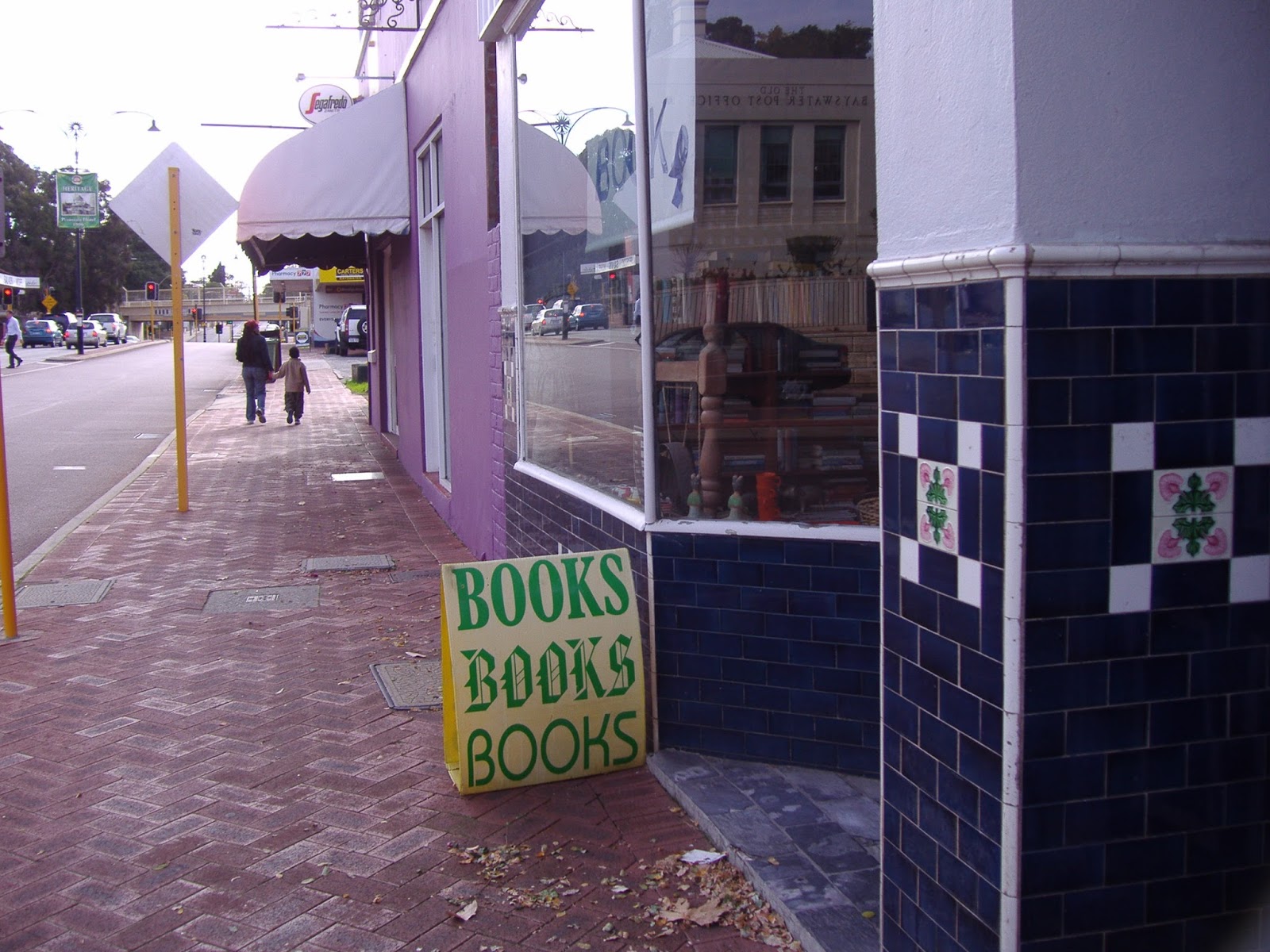
Before I went on my journey north of Perth I finally checked out the latest incarnation of Mostly Books, a second-hand bookstore that has been around since the late 1980's. Mostly Books is one of those great book stores that is much more than a depository of used books. The art on the wall and the various objects laying around around are also for sale. They also add to the esoteric ambience whilst you browse the array of interesting books. 


Back when Mostly Books was in Highgate - North Perth, I would visit occasionally and chat with Don, the proprietor, and he would always have something interesting to say. Once he told me that during the London blitz he would venture up onto the rooftops to view the bombing because the terrible beauty of the destruction was too alluring to worry about safety. When Mostly Books was in Highgate Don had a bookshelf in the corner with a sign saying 'Head Section' - and yes, there were some interesting books to be found there!


These days the shop is in Bayswater - 13A King William St to be exact. As you can see from the photos there is a plethora of great books to look through. I found some seminal 1970's science fiction by the likes of Michael Moorcock and Frederic Brown. The shop also features a great literature section, if you are so inclined. Also Don is quite a character, so make sure you have your wits about you before you venture forth. 


Lastly the reason why the shop is now called WA's Mostly Books is because Don had let the license on the business name slip and someone else from another state claimed the name. Hence it became WA's Mostly Books, in other words WAS Mostly Books, geddit?