Monday, 24 January 2022

David Bowie: A Life - Dylan Jones (2017)


Rating: Excellent

I've read so many biographical Bowie books in the past that I never thought I'd read another one again, however when A Life was published in the year after Bowie's death I kept on reading parts of it each time I went to the book store. I resisted buying it, but then I saw it about six months ago in a second hand book store for only ten dollars, and so here I am. The reason why I bought and read it in the end is because of its unique (among Bowie books) lay-out in which people that knew Bowie in all kinds of capacities talk about him in terms of their personal experiences. What makes this book fascinating is the range of people involved that you don't normally find in Bowie books, there's childhood friends, collaborators, musicians bloggers, journalists, novelists, designers, artists, actors and even a palliative care doctor. This disparate bunch of people give a really interesting perspective into Bowie and his life. Also, refreshingly, A Life does not deal that much with his music, rather the primary focus is on Bowie as a person and on how he went about his business. As a long time Bowie fan who knows a great deal about the man and his music there was a great deal to discover. It was a total pleasure to read. A Life is set out chronologically in time, and is broken up into discreet periods, which worked well. Some may find it a bit repetitive and the other 'flaw' is that there are no photographs, but these are minor matters. If you are a Bowie fan I advise you to read this book.

In keeping with the theme of A Life I thought I'd write about my relationship with Bowie. I was born in 1969 and by 1979 I had become aware of Bowie, but did not become a fan until my sister took me to see him in concert in 1983. I was amazed, enthralled, and started buying his back catalogue. As a typical alienated angsty teenager Bowie was just what I needed. In A Life it is pointed out that Bowie was able to project himself in a way that appeared to be speaking directly to the individual, that you could recognise something about what you were going through in your life and feel that you were understood. In this way he became a kind of friend to me, someone you could turn to when things weren't great. I could put on the Diamond Dogs (1974) album, for example, which was filled with obscure lyrical references and dark themes, and feel like it spoke directly to me. Added to this was his musical brilliance, his predilection for fascinating cultural references and his striking individuality. I was lucky enough to meet Bowie in 1987 at the back of the Sydney Entertainment Centre. I spoke to him briefly and got his autograph. It was a bizarre experience, like I had drunk a few beers on an empty stomach. I'll never forget it. That bonus one on one experience with Bowie was certainly great, but really what I am grateful for is that Bowie gave me a lifetime of both musical and intellectual stimulation and a strong personal connection that ultimately is distinctly humanist. So thank you, Mr David Bowie.

Thursday, 30 December 2021

A Literary High - 2021 Round-Up


Here we are again, another year of reading against the dark background of the pandemic, failing democracies and world leaders fiddling while the world burns, oh, and an engagement (my own). Reading is a fine way of grounding oneself while such events come and go, perhaps the best way. It's been a year of either starting or finishing off trilogies. I completed the Remembrance of Earth's Past trilogy, finally reading Cixin Liu's Death's End (2010), which proved to be not only the best book of the year, but also one of the greatest science fiction novels I have ever read. I read two novels of Jack Vance's Lyonesse trilogy - Suldrun's Garden (1983) and The Green Pearl (1986), both were excellent and also made me want to read more fantasy. I began Kim Stanley Robinson's Mars trilogy with Red Mars (1992), which I also rated as Sublime, joining Colm Toibin's The Magician (2021) and Don DeLillos' Zero K (2016) as among the best books I've read this year. 


In hindsight it was quite a good year for reading, with other notable books being Walter Tevis' brilliant novel The Queen's Gambit (1983) and Curtis Sittenfeld's alternate history novel, Rodham (2020). It was also great to read two Iain M. Banks books, with the short story collection The State of the Art (1991) compelling me to read The Culture novel The Hydrogen Sonata (2012), which was both excellent and a lot of fun. There's always a book that doesn't measure up, and although regular readers will know that I am not a harsh critic, the Alfred Bester novel, Tiger Tiger (1956) was absurd and bloated science fiction, and a very disappointing read. As for the year ahead? I look forward to completing the trilogies I began and my aim will be to read more classics. Reading The Magician about Thomas Mann has reminded me that there's a whole range of classics I've never read, Mann himself and also the Russian greats. I just need to prepare myself for all of the extremely long names and intense existential themes, which shouldn't be a problem, as it will be light reading compared to the daily news...


Tuesday, 28 December 2021

The Magician - Colm Toibin (2021)


Rating: Sublime

For a multitude of reasons The Magician truly is a sublime novel, however I will qualify that statement by saying that it isn't for everyone, particularly for those that enjoy fast paced novels. The novel unfolds like a long evening in the study of a well-spoken individual who is greatly interested in what lies beneath every-day things, while discussing it over many whiskies and cigars. Essentially The Magician is biographical fiction about the life of the German writer Thomas Mann, who was one of the great modernist authors. This is serious literary fiction about a cautious, yet talented man who was caught up both in the tumult of German history and within the careful repression of his own homosexual desires. I finished the novel feeling like I really got to know Mann, almost like I was his confidant. Within the novel lies profound human psychological depths, not just regarding Mann, but also his wife Katia, their six children and the German nation and its peoples. Toibin really is a remarkable writer, his prose is focussed, poised and capable of providing great insight. There's also some sly wit and at times the novel is filled with humour and warmth, but also it does not shy away from exploring the darkness of living during interesting times.

Toibin explores twentieth century history through the prism of the Mann family. Rather than going over familiar historical ground, the culture, history and society of the times are revealed via the lives of the Mann family, in particular through the eldest children, Erika and Klaus, who in the nineteen thirties live the kind of lives that was unimaginable to Thomas Mann himself; they were free to socialise widely and explore their sexuality openly. It's as much their story as it is Thomas Mann's. The same can be said for Katia, and some of the other children, such as the resolute Golo, who after Thomas Mann's death became a historian. The character studies are superb and we are also treated to many cameos of famous authors and prominent historical figures, such as Einstein and the writers W. H. Auden and Christopher Isherwood, who are both treated to some of Mann's withering German wit. The novel also provides great insight into what it is like to live in exile and to be alienated from your own homeland. The Mann's personal pain regarding what happened in Germany is rendered palpable. Once again, The Magician is not for everyone, but it stands as a brilliant achievement by Toibin that makes you want to explore the writings of Mann, which is actually something I'm yet to do.

Monday, 6 December 2021

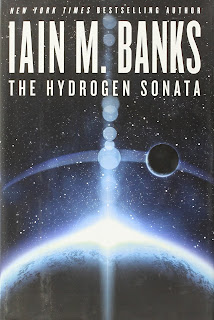
The Hydrogen Sonata - Iain M. Banks (2012)


Rating: Excellent

Well, that certainly was fun. I'd read that the last two Culture novels were not as good as the earlier ones, however The Hydrogen Sonata, the last, unfortunately, due to the author's death in 2013, is no slouch when it comes to Culture driven thrills. The novel is flawed, in that, as usual, Banks can really take a long time to get to the point, both when putting a plot together and during certain scenes in which dialogue or extrapolation is lengthy, however to many this is part of the attraction, including myself. Other than Banks' usual stylistic predilections, The Hydrogen Sonata is quality science fiction. The principal theme of the novel is the concept of subliming, when an advanced species has been around long enough and has achieved enough that it can move on to a higher reality. In the novel this is helpfully described as a limitless lucid dream state existence. The humanoid Gzilt, who once could have joined in on setting up the Culture, are set to sublime, however some have their doubts and there is a possibility that their holy book, The Gzilt Book of Truth, which ultimately directed them to this point, is all a pack of lies.

The Culture becomes very interested in whether the Gzilt are about to sublime under false pretences, as are two opposing factions of the Gzilt. Enter Vyr Cossont, an eccentric Gzilt women who sports an extra pair of arms so she can play T. C. Vilabier's 26th String-Specific Sonata For An Instrument Yet To Be Invented - 'The Hydrogen Sonata', on an instrument called an eleven string. Cossont is asked to look for Ngaroe QiRia, an extremely long-lived man who should have memories of when the Book of Truth was introduced to the Gzilt. This is a typical Banks premise, as is the clever humour and the legion of Culture ship Minds who band together to try and solve the mystery. I enjoyed the Minds in this Culture novel much more than in other some of the other books in the series, I'm not sure exactly why, but their personalities and motives seem much more tangible. The novel is ultimately nicely paced, once you get used to Banks' style of course, but where he really excels, as usual, is in the many set pieces that show off what was an exceptionally creative imagination. One of the best being the scenes on a Gzilt party ship, travelling through an immense tunnel within a circular habitat, partying hard for five years until the subliming, most notably when Cossont meets the chief partier, a body artist called Ximenyer, who features forty eight penises all over his body. Enough said, perhaps, except to say that The Hydrogen Sonata did not disappoint and Banks was at the height of his considerable powers nearing his premature death. It's such a pity he is no longer with us, as I'm sure he had many more Culture novels left to write.

Sunday, 28 November 2021

Freedom, Rhythm & Sound: Revolutionary Jazz - Original Cover Art 1965-83: Compiled by Gilles Peterson and Stuart Baker (2009)


Rating: Excellent

When you really fall for jazz, as I did some twenty five years ago, you soon realise that it contains endless multitudes of musicians who made a massive amount of incredible music. The only way to attempt to take it all in is to become a dedicated Jazzbo for whom loving jazz is a way of life. Recently a fellow Jazzbo leant me this superb coffee-table book. It does exactly what it says on the cover, and more. The book includes quality text detailing some of the prime movers during this incredible period in culture, from musicians to those who started up now obscure record labels. The American civil rights era inspired a great deal of wild and important jazz music. Reading through this fascinating book it occurred to me that jazz got there first in terms of the creation of indie do it yourself record labels well before the indie label explosion that began in the late nineteen seventies during the punk and post-punk era. A little while after I happened to read the back blurb and it said exactly that! If you love jazz then this book is essential in that it alerts you to an even deeper layer of jazz, most of which I've never seen nor heard of. There's some of the acts you'd expect, like Sun Ra and Don Cherry, but then there's the likes of Idris Ackamoor, Roy Meriwether and The La Mont Zeno Theatre, among many obscure jazz acts.

The book's main thrust is the album art and the reproductions of album cover art is just superb. Here's some examples below:


Many of these I've never seen second hand or as new re-releases. As yet I haven't searched for any of them online, god knows how much original pressings would cost. I'm thinking I'm going to stick to the book for now and hope that during this re-release era many will emerge over the years.

Monday, 15 November 2021

The State of the Art - Iain M. Banks (1991)


Rating: Excellent

I knew I had to reach for an Iain M. Banks book after reading about M. John Harrison's friendship with the great writer, it had been a while after all. The State of the Art is a rarity in Banks' cannon, a collection of short stories. It's a curious bunch of stories. The first two seem like fragments, or experiments in preparation for bigger works. Road of Skulls (1988) is a gothic curio, which I'm still thinking about even though it seems inconsequential; two misfits travel along a road of skulls, literally, and only one person seems to know what it's all about, and it's not them. The second, A Gift from the Culture (1987) really does seem like a fragment, with a former citizen of the Culture being blackmailed to do the bidding of terrorists and is the most inconsequential story in the collection. Odd Attachment (1989) is darkly hilarious, which is exactly the kind of humour you find in his work, and is very entertaining. Descendant (1987) is very clever, making you go back to check how it all plays out. Cleaning Up (1987) is perhaps the best non-Culture story in this collection, and is, once again, very clever and darkly humorous, with a touch of misanthropy thrown in for good measure. Piece (1989) could be described in exactly the same way. So far so good.

The real highlight of this collection is the near novella set in the Culture universe, you guessed it, The State of the Art (1989). The story is brilliant and fully formed. The Culture visits Earth in 1977 and acts very much the anthropologist, with Culture humanoids visiting the surface to sample different countries and all the Earth has to offer. Some are cynics, some are entranced and want to save humans from themselves with contact (by, erm, Contact) and one individual wants a whole lot more. As with all Culture stories, there's a massive space-craft with an AI 'Mind' who is very much in control, pondering over the moral implications of interference. Banks' cynical approach to humanity is perhaps a bit overdone, however this was the Cold War era, so fair enough. It's fantastic writing and as usual Banks explores all kinds of existential issues throughout the narrative, coupled with the Culture's amazing technology. It's stirring stuff and made me immediately want to read the remaining Culture novels I haven't read yet. I'd forgotten just how much I love his writing. The collection ends with Scratch (1987) which is both slight and one of the most obtuse existential jokes ever. It made me think that Banks had been reading J G Ballard's more experimental short stories from the late seventies, which he probably had been I'd say. Despite a couple of minor curios, this collection is well worth the effort.

Monday, 1 November 2021

Light Perpetual - Francis Spufford (2020)


Rating: Excellent

Another book club read, this time an excellent one. Knowing nothing about the author my hopes were not high, thinking it may be a bland recreation of post-war history via the lives of those that survived. Instead Light Perpetual takes its premise, that the children and adults that had died in a V2 strike in London (based on actual events as noted on a plaque outside a building the author walked past nearly every day) in fact survive, and runs with it splendidly. Spufford is a sophisticated writer with a nimble, yet beautifully descriptive style. The novel was a total pleasure to read, his prose is beautifully balanced, with nothing overdone or out of place. Apparently Spufford was a specialist non-fiction author until the age of fifty two when his first novel was published, Golden Hill (2016). Perhaps that is why Perpetual Light is the reverse of what seems to pass for middle-brow literary fiction these days, with average at best novels that come across as popular fiction aspiring to be literary fiction.

Spufford follows the lives of five of the children that live via specific time periods - 1949, 1964, 1979, 1994 and 2009. Spufford explores the culture and history of each period and how that effects the characters lives. Perhaps the most effecting is Ben, who suffers from mental illness (schizophrenia it seems). Ben's section in 1979 is perhaps the novel's highlight, although for many it would be an excruciating read. Ben battles his paranoid delusions whist working as a bus conductor on a day that eventually leads him to a confrontation with a group of skinheads. It's almost too much to bear, however you can't help but admire Spufford's incredible insight and skill in revealing what it might be like to suffer from a debilitating mental illness. This is what literature is all about, allowing insight into others lives that hopefully results in understanding and compassion. The other characters stories are full of everything from bathos, pathos, redemption and servings of some just desserts for one particular character, but once again, nothing is overdone and everything is perfectly in its place. I'm impressed, and it takes a lot for current novels to impress me these days.